Digital Research Tools, Newspaper Texts, and Enslaved Fugitives in the Atlantic World
Abstract
This article demonstrates the benefits and pitfalls of utilizing Natural Language Processing to structure a large corpus of newspaper adverts on fugitive enslaved people from the Atlantic World between 1766 and 1821. We evaluate a model for multilingual event extraction trained specifically for fugitive ads and jail lists in its capacity to extract correctly the attributes relevant for historical analysis. Finally, we discuss how the current model may be used to expand and qualify databases concerning enslaved fugitives in the eastern Caribbean.
CONTENT WARNING: This article contains examples of racist language in historical documents as part of its analytical dataset.
Introduction
This article details the results of using Natural Language Processing to extract and structure data from newspaper adverts and jail lists for fugitive enslaved people in the Atlantic World from the mid-eighteenth century to the third decade of the nineteenth century. This collective and interdisciplinary work included historians, archaeologists, and computer scientists with the aim of developing an approach to the study of the Caribbean (and the wider Atlantic World) that combines human and machine intelligence to see how tools developed within the field of computer science may assist in generating information about enslaved people in the Atlantic World at individual and aggregate levels.
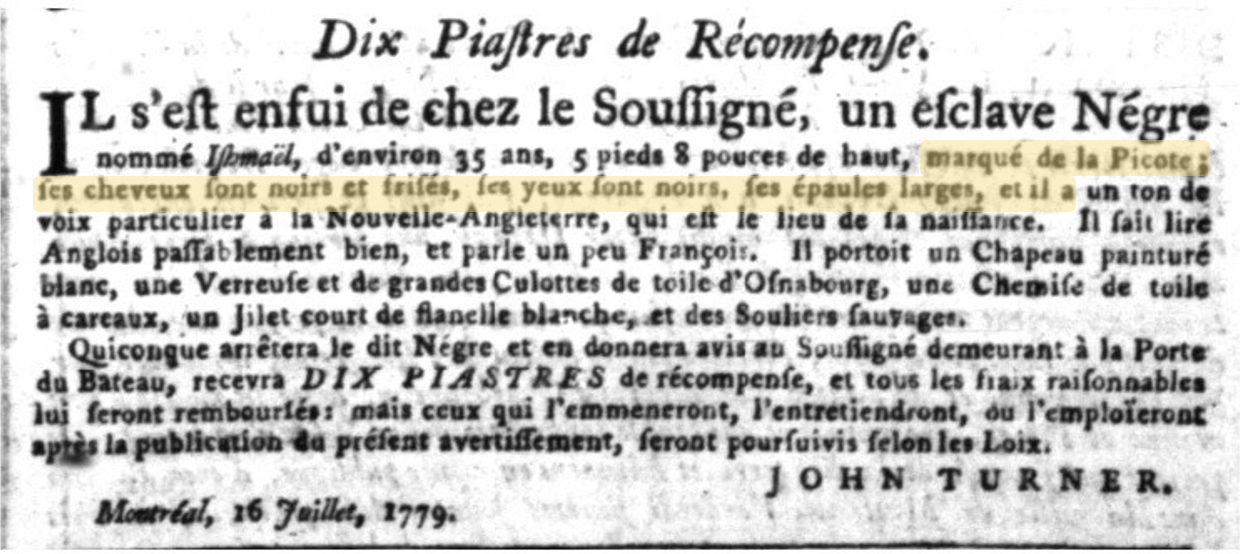
The experiment presented here was conducted by the research teams of Privacy Black & White and In the Same Sea at the University of Copenhagen. Together, we explored how data science can facilitate research on Atlantic slavery.[1] With this experiment, our aim has been to explore how current online projects recording enslaved fugitives on the basis of newspaper adverts (in particular, Runaway Slaves in Britain and Le marronnage dans le monde atlantique) can be used to qualify our own collection of information about fugitives in the Lesser Antilles in the eighteenth and nineteenth centuries.[2] In practical terms, researchers of the project entitled In the Same Sea have constructed a database in which we have entered information about single enslaved persons. For two years, we have been manually finding, clipping, and entering runaway notices and jail lists from digitized colonial newspapers into a database, which now includes approximately 7,000 individuals. This has been a labor-intensive process with a focus on the identification of enslaved individuals in adverts rather than on the detailed registration of various characteristics of the enslaved persons advertised as fugitives. Runaway adverts are mostly formulaic and include varying levels of information. A typical runaway notice includes the name of the fugitive, when they absconded, a short physical description, and sometimes information regarding trades, destination, and language skills. They also include the name of the enslaver, who to contact, and often a reward. There are also jail lists, which include anyone captured and jailed as a suspected enslaved fugitive. They often contain less detail than runaway adverts: the name of the fugitive, their enslaver, the date of capture, and sometimes a short physical description.[3]
The In the Same Sea database records the name of the enslaved person, gender, place of departure, place of capture, and destination. In addition, we note if it was a single person or a group who escaped, and if it was an intra- or inter-island flight. Compared to the wealth of information contained in some fugitive adverts, it is clear that the attributes we selected are but a fraction of the information that can be collected from the source material. Advancements in Natural Language Processing (NLP) might be able to assist in expanding the attribute list and paying heed to the richness of historical evidence of the fugitive adverts. NLP can potentially help structure large corpora of text across many languages and thereby prove instrumental in establishing reliable contextual knowledge for historical and archaeological research. Historians and archaeologists often focus on smaller scales, such as an individual, a group, or a particular place. However, NLP tools can assist them in moving between scales – from the small to the large – and thereby gain a better understanding of enslaved people’s experiences in Atlantic societies. Although NLP offers different tools to parse large data corpora, recent efforts have proven the usefulness of event extraction for historical research.[4] Event extraction can identify particular instances in a text corpus that correspond to a type of event, as well as the participants and attributes within it, if they are present. Our work with NLP focused on fugitive advertisements that enslavers put in local newspapers across the Atlantic World to secure the capture of their enslaved people who had escaped for shorter or longer periods.
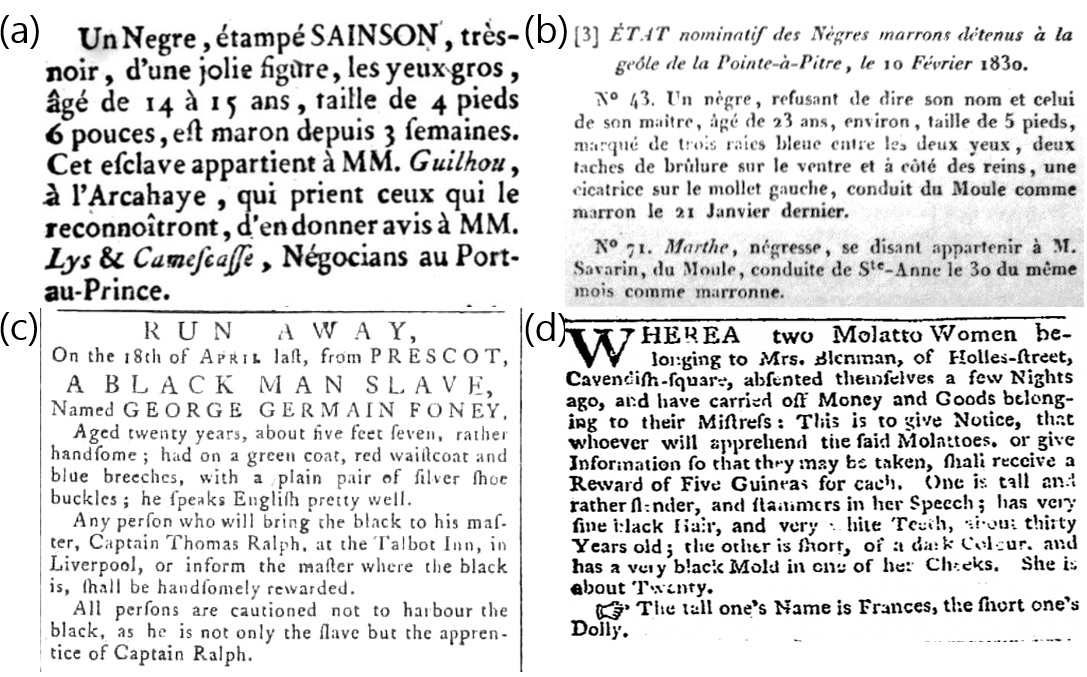
By focusing on fugitive adverts, we follow in the footsteps of other scholars of Atlantic history. Rooted in the interest in enslaved people’s forms of resistance that gained prominence in the 1960s and 1970s, the history of marronage is tightly linked to a desire to better understand how slavery and struggles for freedom shaped enslaved people’s lives. Early studies established types of marronage, such as petit vs grand marronage; later studies have examined patterns of marronage as well as experiences of escape.[5] Recently, we have seen studies focusing on individual fugitives, such as Marisa Fuentes’s study of the enslaved woman Jane, as well as studies of larger groups, such as Simon Newman’s essay on fugitive practices in Jamaica and Jean-Pierre Le Glaunec’s comparative work on French and British Atlantic societies.[6] Each study, in its own way, has highlighted that fugitive adverts can help us get a little closer to how slavery was experienced by those in bondage while also, at times, hiding those very experiences through their reduction of the enslaved person to an item of property.
Some of the scholarly attraction to the fugitive advert is, we believe, related to the fact that it was a ubiquitous part of the print culture of the Atlantic slave societies. The adverts are relatively easy to access, and their standardized form lends itself well to serialization and database construction. This aspect of the adverts, however, also makes them a potentially problematic source to study. As pointed out by scholars such as Jennifer Morgan, Jessica Marie Johnson, and Simon Newman, Atlantic enslavement was heavily dependent on techniques of numerical abstraction and quantification (as enslaved people were valued, counted, and numbered in ledgers, wills, and even on their bodies), and therefore aggregate knowledge should be handled with care and skepticism by historians of enslaved lives.[7] One way of attempting such a careful approach is to establish databases that allow scholars to move between various levels of analysis, ensuring that aggregate abstractions are not the only result of historical reconstruction. Nevertheless, aggregate data (even on a small scale) may be important for pushing our horizons of understanding. One example, drawn from our own research, concerns the collective nature of maritime marronage. By looking at quantitative data on marronage, we were able to show that maritime escapes were often collective efforts.[8] Nonetheless, to allow scholars of Atlantic slavery to push for human interpretations of enslaved people’s lives, experiences, and perhaps even their dreams, databases such as ours must structure aggregate, group, and individual information.
Two existing datasets can help us in utilizing NLP for the study of enslaved marronage. The first is the dataset created by the Runaway Slaves in Eighteenth-Century Britain project of the Department of History at the University of Glasgow under the direction of Simon Newman, with a grant awarded by the Leverhulme Trust. The second dataset was created by the Université de Sherbrooke, Fonds de recherche société et culture Québec, and the Social Sciences and Humanities Research Council of Canada. The model used in the experiment we present below was built using an English-language database (Runaway Slaves in Britain[9]) and tested on a primarily French-language database (Le marronnage dans le monde atlantique[10]). Using both digitized and physical newspapers, the fully searchable database Runaway Slaves in Britain includes over eight hundred runaway advertisements from 60 English and Scottish newspapers published between 1700 and 1780. It helpfully includes the image of the original advert and includes many attributes about the escapee, including name, age, physical characteristics, language, clothing, country marks, and the person to be contacted in case the fugitive is apprehended. As will be discussed below, some of these categories work better for England and Scotland than for the Americas. Le marronnage, a project running since 2009 and directed by Jean-Pierre Le Glaunec and Léon Robichaud, includes 21 different newspapers from across Canada, South Carolina, Louisiana, Guadeloupe, French Guiana, Jamaica, and St. Domingue, dating between 1765 and 1833.[11] It includes a total of 22,639 individual fugitives from slavery in 15,643 fugitive adverts and 6,846 lists of captured individuals.[12] The searchable attributes in the online database are words available in the transcriptions: personal names, gender, region, newspaper, type of advert, and year of publication.
Our experiment aimed to structure the data of runaway adverts in Caribbean newspapers by training a model using the annotated data of the database Runaway Slaves in Britain. In this process, computer scientists used the NLP task of multilingual event extraction.[13] A key issue in this endeavor was that, given our focus on the linguistically diverse context of the Caribbean, multiple languages must be taken into account. As such, the model needed to be able to successfully transfer what it learned from the English examples of the Runaway Slaves in Britain database into another language, in this case French. The best solution found was to convert the attributes stipulated by the Runaway Slaves in Britain database into extractive question-answering tasks.[14] The computer scientist, Nadav Borenstein, had to manually formulate the attributes – such as “Clothing” – as questions – such as “What did the person wear?” – which the model had to search a span of text from the source to answer.[15] The data from Runaway Slaves in Britain used to train the model was then translated into French – which our computer scientists agree could introduce a modern language bias, as the translation was automated – to train the model in French. In order to evaluate this method with regard to the French material, historian Natália da Silva Perez annotated 41 ads from the Le marronnage dataset using the attributes designated in the Runaway Slaves of Britain annotations. The French model was able to extract the attributes of 11,000 French runaway ads from the Le marronnage dataset.
Evaluation of the Attribute Extraction Results
While not as precise as manual annotations, this model performed well, especially when attributes were linguistically simple. The model was very good at finding certain attributes, such as the name of the contact, their address, and their occupation. As the complexity of attributes increased, the model still performed rather well in some instances. It managed to identify the language(s) spoken by 938 individuals and allocated it to the attribute “Language.” Meanwhile, a simple keyword search on the Le marronnage database for the stem of the French verb “to speak” (parl) returned 925 hits. However, because the model was trained on the Runaway Slaves in Britain database, some of the categories do not suit the Caribbean and American contexts and need to be collapsed or refined for greater usefulness. As it stands, the model operates with separate categories for contact address and physical address, which makes sense because often the contact for the ad and the enslaver were not the same.
Besides addresses, the model struggled to pick up destinations. This may be connected to the many categories carried over from the Runaway Slaves in Britain, regarding the locations where the escapees fled from and their destinations. These include “Ran from specified,” “Ran from region,” “Destination (region),” and “Destination (specified).”[16] Sometimes an advertisement will say the escapee fled from a plantation in a specific parish, in which case this level of specificity can be useful, but the computer model was not able to parse the differences between the general and the specific. It would likely make the most sense to collapse these categories down to “Destination” and “Ran from” for the purposes of the modeling or train the model on datasets that annotate more runaway advertisements that include plantation names and the parish in which they are located.
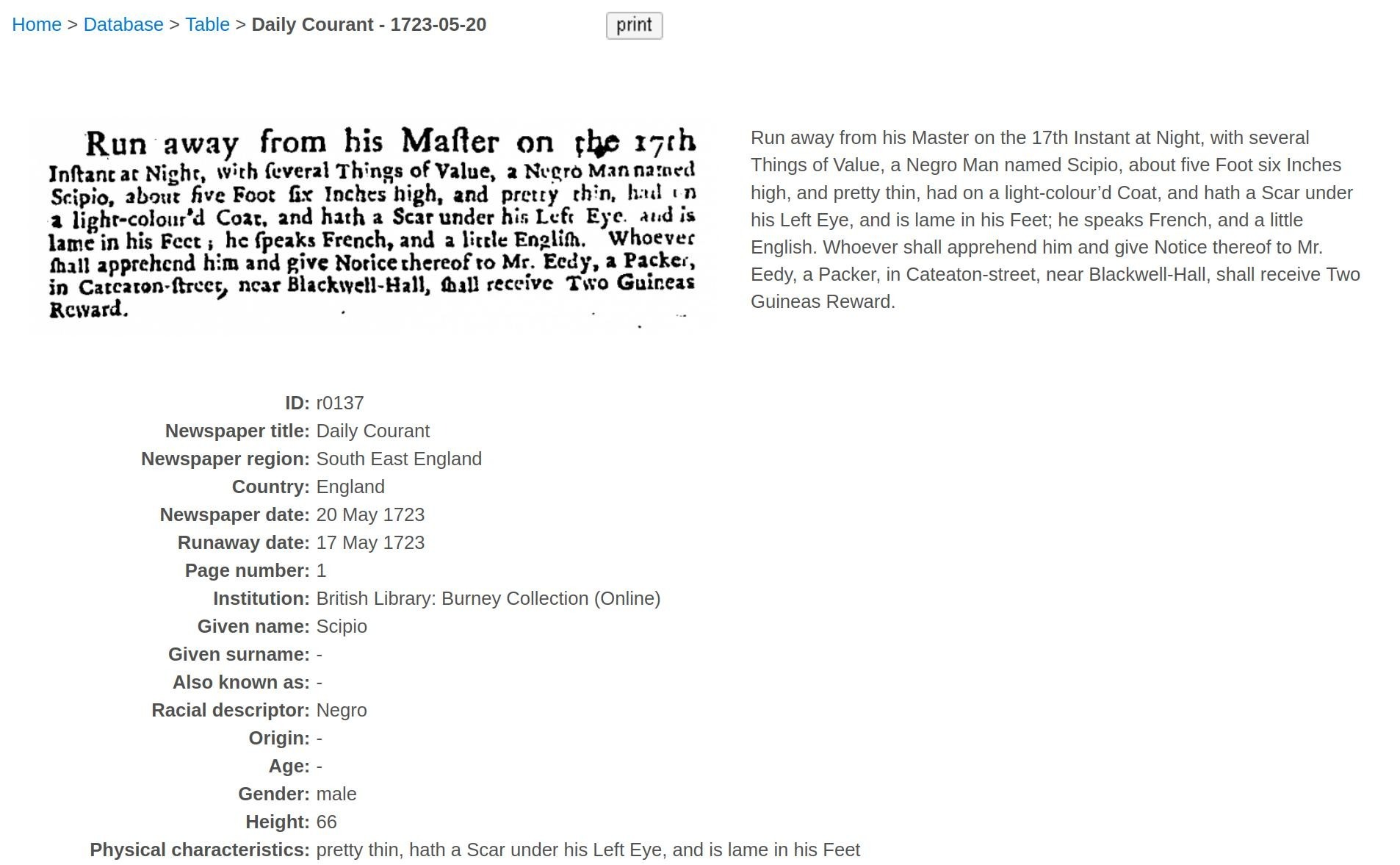
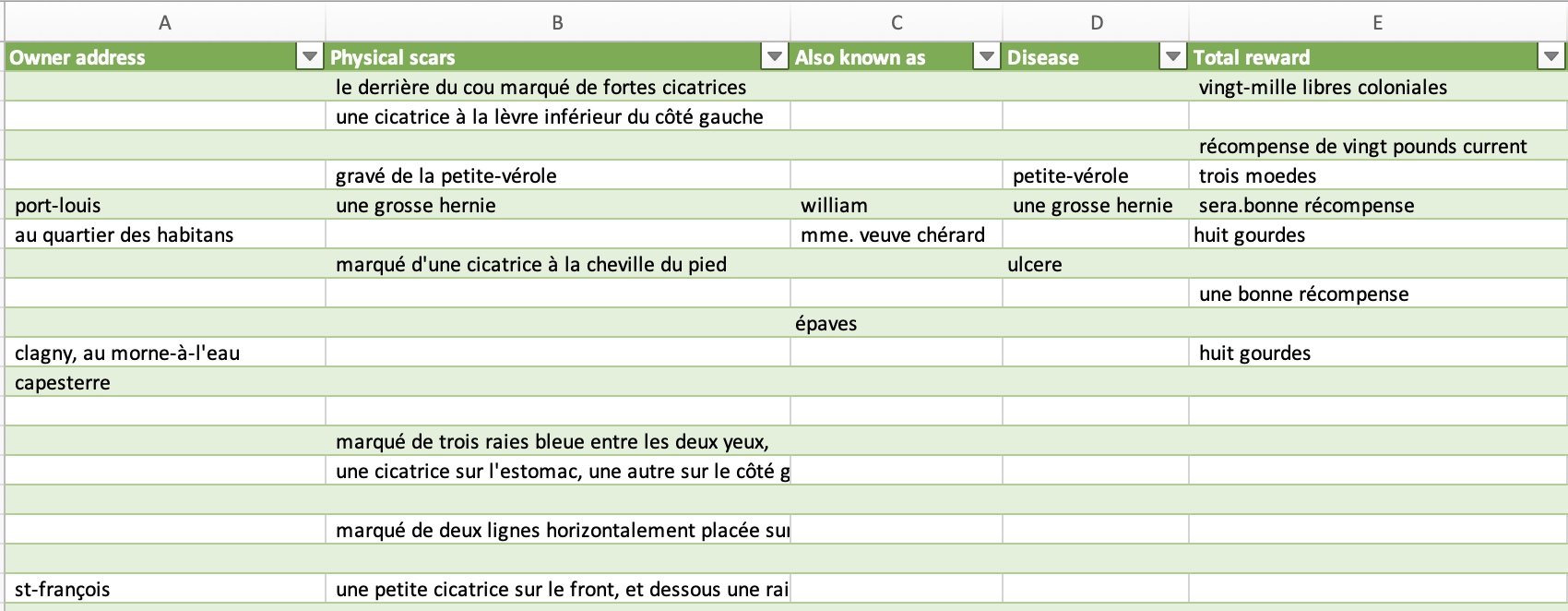
The model also found it difficult to distinguish between various forms of physical attributes. It contains separate categories for physical scars, country marks, physical description, and injury. The model consistently picks up scarification, but puts the description in multiple categories (see Figure 5). Yet, country mark scars are not the same as scars from a whip. It requires the historian to determine what categories these physical descriptions belong to. The model, however, is unable to distinguish this kind of nuance. Therefore, collapsing those attributes under one general “Physical description” attribute would make sense in the future.
A recurrent issue identified was that the model consistently excluded height from the physical description, although most of the ads included this information when describing the fugitive enslaved person. The model is unable to group height together with other physical descriptors because the Runaway Slaves in Britain database annotated them as separate attributes. The main issue for the model is that the annotations for height in the Runaway Slaves in Britain database were written in inches for uniformity, while the ads describe height using multiple measurements. For example, this means that while an ad may state that the runaway was 5 feet 8 inches tall, the database lists their height as 68, which makes that attribute much harder to extract correctly, especially in a multilingual setting.
From the perspective of historians, the greatest challenge faced by the model was the identification of single individuals in adverts and jail lists mentioning more than one person. While the model was able to correctly identify some attributes in these cases (for example, names and clothing), it did not list all the attributes available for all the listed individuals. Instead, it chose attributes at random. The result is a single entry that combines attributes from all the listed individuals. The reason for such a challenge is the difference between the structure of the dataset from the Runaway Slaves in Britain and the manner in which the model was trained. In the Runaway Slaves in Britain database, each entry corresponds to an individual fugitive. If an ad includes multiple people, the ad is copied to the entry for each particular individual, listing them separately and with their respective attributes. In the model development, on the other hand, the assumption was made that each advert represented a single self-liberation event.[17] That each event would entail one individual is a reasonable assumption when looking at the dataset of the Runaway Slaves in Britain database. Most of the ads in that dataset are of a single person running away, as was apparently more common in the British context. In the Atlantic colonies, however, the situation was quite different. It was not uncommon for enslaved people to escape in groups. Enslavers also sometimes advertised multiple individual fugitives together. The Le marronnage dataset reflects that reality. Moreover, a significant part of the Le marronnage dataset consists of jail lists of captured people, which usually included multiple individuals. Jail lists, in addition to runaway adverts, represent standardized evidence that NLP methods could be trained on to help scholars map fugitive practices. As jail lists were not common within the Runaway Slaves in Britain dataset, the model had fewer examples to draw upon. This is a significant weakness of the model. Though it enables the establishment of aggregate data, it becomes unreliable in the identification of particular individuals. The model, therefore, runs the risk of replicating the numerical abstractions that sought to remove people’s personhood during Atlantic enslavement. As noted, the ability to move between scales is key in the care of data concerning enslaved people in the Atlantic World. Potential solutions include fine-tuning the model so as not to assume that each ad represents only one freedom-seeking event. This solution has some limitations, as the model will not be able to recognize an indefinite number of fugitive enslaved people, and the chances of confusion increase with the number of individuals mentioned per ad. To help solve this problem, another option would be to deliberately exclude jail lists and other lists of fugitives from the dataset and analyze how the model performs only with fugitive adverts.
Conclusions
The model performed very well in the multilingual event extraction task. It understood some surprisingly nuanced attributes across languages, including differentiating between the occupations of owners, contact persons, and the enslaved themselves. The main issues arose from attributes that required a historical understanding to place them in one category versus another, such as the sometimes linguistically subtle, yet socially significant differences between country marks and physical scars, like those from a whip or an iron. In terms of technical issues, the present model also excludes significant attributes that can be found in the source material. Age and height had to be excluded because they were rendered numerically in the adverts, which makes their extraction more difficult. Solutions for the future include carefully annotating the dataset to retrain and improve the accuracy of the model or training a new model that can extract these attributes with the necessary precision.
The model faced several challenges because of the corpora on which it was trained and the attempt to merge historical contexts. The model was trained on the standard genre of the runaway advert, which is characterized by highly stylized, repetitive formulations. It was then run on two genres: the runaway advert and the jail list. It appears that prison authorities in Britain did not publish lists of fugitive enslaved Africans held in jails, leaving us with a narrower textual corpus on which to train the model. The situation in the Caribbean and American colonies, which contained majority enslaved populations, was of course very different. Here, escape was more common and a potential threat to the stability of the system of slavery. Individuals assisted in the capture and return of runaways to their enslavers by bringing them to local jails, which communicated their capture in local newspapers. Consequently, the runaway advert is not the only standardized evidence by which we can map fugitive practices. In future, as the model is further developed, it will be crucial to pay even more attention to the structure of the text the model is trained on and how this corresponds to or differs from the target text.
As it stands, the model can facilitate the work on the dataset collected by In the Same Sea, which we presented above. It can allocate attributes for enslaved fugitives from large datasets with significant accuracy if the adverts are for a single fugitive individual. This structuring of data can provide researchers focused on enslaved people seeking freedom in different contexts with a broader overview of quantitative data and identify cases for close reading, such as if an individual has absconded repeatedly over several years. The model allows for fairly precise aggregate estimates of certain attributes of enslaved fugitives, such as their trade and language. Unfortunately, this ability does not extend to adverts with multiple individuals, as the model selects one fugitive and does not accurately assign attributes to that person. As such, the model can provide aggregate data, but loses accuracy with the multi-individual cases. It can accurately point out how many people spoke a language, for example, but would not be able to attribute the language to the correct person if there are several fugitives in the same advert. This means that the model can detect simple trends, but it will be weaker if the goal is to perform more complex analysis. Indeed, the model’s current inability to securely link attributes to the exact person carrying these will make it difficult to perform analysis across attributes, for instance providing an estimate of how many enslaved people were also speakers of more than one language. So, there are still major pitfalls in the model and in this approach, broadly speaking. Many of the attributes in fugitive ads can be challenging even for historians to classify, so the model tends to flatten the historical reality and individuality of the enslaved by necessity. This approach to sources enhances the chances of a continuous reproduction of the perspective of colonial enslavers and risks replicating key elements of slavery, such as considering the enslaved only as objects in the processing of data, denying them their personhood. In particular, the present model’s inability to correctly identify different individuals in the adverts needs to be addressed. Future adaptations of the model will focus on this issue, testing the limits and the accuracy of Natural Language Processing for this particular task. With such adaptations, the model could prove very valuable to manually-collected datasets such as the one assembled by the team of In the Same Sea because it would allow us to significantly speed up the process of adding attributes. The current database contains few key attributes, meaning it is of limited usefulness for systematic research. We hope that the adaptations described here will make it a powerful tool for researchers of slavery in the Lesser Antilles and the greater Caribbean.
Acknowledgements
The experiment presented in this article was developed within the project Privacy Black & White, funded by a UCPH Data+ Grant, and by In the Same Sea (European Research Council: erc-2019-cog 863671), the Centre for Privacy Studies (Danish National Research Foundation: DNRF138), and the Department of Computer Science of the University of Copenhagen. We would like to thank Dr. Mette Birkedal Bruun and Dr. Isabelle Augenstein, who were co-PIs of the project with Dr. Gunvor Simonsen. This article would not have been possible without the work of PhD Fellow Nadav Borenstein, who was mainly responsible for the model; Dr. Natália da Silva Perez, who was a driving force behind this endeavor; and Dr. Karolina Stanczak, whose collaboration with Privacy Black & White has been invaluable.
This database excludes Barbados because those newspapers were being explored by the research project Agents of Enslavement Colonial newspapers in the Caribbean and hidden genealogies of the enslaved, headed by Dr. Graham Jevon. See https://www.zooniverse.org/projects/gjevon/agents-of-enslavement (accessed on December 13, 2023). For the digitization project, see Amalia S. Levi and Tara A. Inniss, “Decolonizing the Archival Record about the Enslaved: Digitizing the Barbados Mercury Gazette,” Archipelagos no. 4 (January 2020). https://doi.org/10.7916/archipelagos-5k90-bd50. ↩︎
In the Same Sea is a project funded by the European Research Council based at the University of Copenhagen that “advances the hypothesis that the Lesser Antilles were decisively shaped by inter-island connections that transformed separate islands into a common world of slavery and freedom.” ↩︎
A thorough presentation of the dataset can be found in Simonsen, Gunvor, Rasmus Christensen, Heather Freund, Felicia Fricke, and Gabriëlle La Croix, "Enslaved Fugitives in the Lesser Antilles, 1760s-1860s," in Journal of Slavery and Data Preservation 7, no. 1 (2026): 1-22. https://doi.org/10.14321/jsdp.7.1.0001 ↩︎
Viet Dac Lai et al., “Event Extraction from Historical Texts: A New Dataset for Black Rebellions,” in Findings of the Association for Computational Linguistics: ACL-IJCNLP 2021, 2390–2400. ↩︎
The typology of petit and grand marronage originates in the terminology used by enslavers to characterize enslaved people’s flight and has also been used by historians to understand the difference between temporary absences (petit) and escapes that were meant to be permanent (grand). See Jean-Pierre Le Glaunec, “Résister à l’esclavage dans l’Atlantique français: aperçu historiographique, hypothèses et pistes de recherche,” Revue d’histoire de l’Amérique française 71, no. 1–2 (2017): 20; Gad Heuman, "Runaway Slaves in Nineteenth-Century Barbados," in Out of the House of Bondage: Runaways, Resistance and Marronage in Africa and the New World, ed. Gad Heuman (London: Frank Cass, 1986), 95-111. ↩︎
Marisa J. Fuentes, Dispossessed Lives, Enslaved Women, Violence, and the Archive (Philadelphia: University of Pennsylvania Press, 2016), 13–45; Jean-Pierre Le Glaunec, Esclaves mais résistants - Dans le monde des annonces pour esclaves en fuite Louisiane, Jamaïque, Caroline du Sud (1801-1815) (Paris: Karthala and Ciresc, 2021); Simon P. Newman, “Hidden in Plain Sight: Escaped Slaves in Late Eighteenth- and Early Nineteenth-Century Jamaica,” William and Mary Quarterly (OI Reader) (June 2018), 1–53. ↩︎
Jennifer Morgan, Reckoning with Slavery: Gender, Kinship, and Capitalism in the Early Black Atlantic (Durham, NC: Duke University Press, 2021), 1–27; Jessica Marie Johnson, “Markup Bodies: Black [Life] Studies and Slavery [Death] Studies at the Digital Crossroads,” Social Text 36, no. 4 (December 2018): 57–79; Simon P. Newman, Freedom Seekers: Escaping from Slavery in Restoration London (London: University of London Press, 2022), xxi–xxix. ↩︎
Gunvor Simonsen and Rasmus Christensen, “Together in a Small Boat: Slavery’s Fugitives in the Lesser Antilles,” William and Mary Quarterly 80, no. 4 (July 2023): 631–32. ↩︎
These newspapers are: Affiches américaines, Quebec Gazette, Quebec Herald, Montreal Gazette, Canadian Courant, Gazette officielle de la Guadeloupe, Le Moniteur de la Louisiane, Le Courrier de la Louisiane, L’Ami des Lois, The Orleans Gazette, The Louisiana Gazette, La Télégraphe, The Union, Charleston Courier, City Gazette, The Royal Gazette, The Saint Jago Gazette, The Cornwall Chronicle, The Jamaica Courant, The Diary and Kingston Daily Advertiser, and Feuille de la Guyane Française. ↩︎
Some entries in the Le marronnage database seem to be lacking their transcriptions, which would exclude them from use in our experiment. ↩︎
Nadav Borenstein, Natália Da Silva Perez, and Isabelle Augenstein, “Multilingual Event Extraction from Historical Newspaper Adverts,” In Proceedings of the 61st Annual Meeting of the Association for Computational Linguistics (Volume 1: Long Papers), 10304–25. ↩︎
Borenstein et al., “Multilingual Event Extraction from Historical Newspaper Adverts,” 10306. ↩︎
See the full list of attributes and the questions used to extract them in Borenstein et al., “Multilingual Event Extraction from Historical Newspaper Adverts” 10322. ↩︎
These attributes have been selected from the Runaway Slaves in Britain annotated dataset. ↩︎
Borenstein et al., “Multilingual Event Extraction from Historical Newspaper Adverts,” 10306. ↩︎
Authors' Bios
Gunvor Simonsen
Gunvor Simonsen is Professor at the University of Copenhagen. She specializes in eighteenth and nineteenth-century Atlantic history, in particular in Caribbean history. Currently, she is in charge of the research projects In the Same Sea, funded by a consolidator grant from the European Research Council, and the project Mapping Freedom: From Slavery to Freedom in the U.S. Virgin Islands. Her publications include Slave Stories: Law, Representation, and Gender in the Danish West Indies (Aarhus: Aarhus University Press 2017), Global Biographies: Lived History as Method (Manchester, Manchester University Press, 2022), co-edited with Laura Almagor and Haakon A. Ikonomou, and with Rasmus Christensen, “Together in a Small Boat: Slavery's Fugitives in the Lesser Antilles,” in William and Mary Quarterly (July 2023). Recently she co-edited a special issue of the Journal of Caribbean History, entitled “Small Islands, Proximity and Connection in the Eastern Caribbean.”
Natacha Klein Käfer
Natacha Klein Käfer is an Assistant Professor at the Centre for Privacy Studies (DNRF138), University of Copenhagen. She is the research leader of the Centre for Privacy Studies’s HEALTH theme, the research coordinator of the project Privacy Black & White, and the head of the research group Latin American Privacy Studies. She has published in the journals KNOW: A Journal on the Formation of Knowledge (University of Chicago Press), Royal Studies Journal (University of Winchester), and she is the editor of Privacy at Sea: Practices, Spaces, and Communication in Maritime History (Palgrave Macmillan, 2024), Women’s Private Practices of Knowledge Production in Early Modern Europe (with Natália da Silva Perez, Palgrave Macmillan, 2024), and Tracing Private Conversations in Early Modern Europe: Talking in Everyday Life (with Johannes Ljungberg, Palgrave Macmillan, 2024).
Heather Freund
Heather Freund was a postdoctoral researcher with In the Same Sea, a project funded by the European Research Council based at the University of Copenhagen. She received her PhD in history from the University of Illinois Urbana-Champaign in 2021, with a dissertation exploring the challenges of integrating the Ceded Islands into the British Empire after 1763. She has published articles in the Journal of British Studies, Slavery & Abolition, and Atlantic Studies and in an edited collection, Voices in the Legal Archives in the French Colonial World. Her research has been supported by the Gerda Henkel Stiftung Foundation and the American Historical Association.
Felicia J. Fricke
Felicia J. Fricke is an Assistant Professor at the University of Copenhagen. She received her PhD in the interdisciplinary study of the lifeways of enslaved people in the Dutch Caribbean from the University of Kent (UK) in 2019 and later rewrote her thesis as a book entitled Slaafgemaakt: Rethinking Enslavement in the Dutch Caribbean (CGRN, 2020). She has published journal articles and book chapters in English, Dutch, and Papiamentu, and is co-editor of the volume Ethics in Caribbean Archaeology (with Eduardo Herrera Malatesta and Maaike S. de Waal, University Press of Florida, 2026). Dr. Fricke’s current work in the DFF-funded project “Racialized Motherhood: Documenting and Analyzing Early Modern Discourses on Reproduction” (PI: Natália da Silva Perez) concerns the decision-making practices of women running from slavery with their children in the late eighteenth and early nineteenth centuries.