Acervos Documentales de Puerto Rico y el Caribe @ UPR-Río Piedras: On Designing Digital Strategies for Preservation and Access of Unique Puerto Rican and Caribbean Studies Collections
Abstract
This paper documents Acervos Digitales de Puerto Rico y el Caribe @ UPR-Río Piedras, its origins, goals, activities and participants. It reflects on the team engagement with fundamental discussions regarding the use of Omeka in a Caribbean context, that resulted in the articulation and enactment of ethical principles for digital curation, as well as in its commitment for fundamental digital preservation efforts based on minimal technology requirements. The paper also provides an assessment of its continuity as a DH initiative committed to preserving, improving open access, and building capacity for the effective use of unique digitized humanities collections, and poses its methodology as a model for digital collections management in the Caribbean region.
Introduction
The digital project Acervos Documentales de Puerto Rico y el Caribe @ UPR-Río Piedras revamps selected documentary collections held by the University of Puerto Rico, Río Piedras Campus’ José Lázaro Main Library and the College of Humanities seminarios.[1]. By incorporating minimal computing principles and Caribbean digital information architectural design, it preserves these materials and enhances access for a wide array of users. Displayed in the form of an Omeka website, Acervos Documentales was conceptualized during the COVID-19 pandemic and launched over a 24-month period (2021-2023). The collections selected for this project are unique, and the digitized items are available as open-access resources through the official website https://coleccionesuprrpcaribe.omeka.net.[2] The site’s primary language is Spanish, but it includes translations of key descriptive information for English speakers. The digital design emphasizes the importance of aspects such as the project overview, policies, and core documentation regarding the configuration, development, and results of the project, to enhance the users’ experience.
This project included on-site hands-on training for librarians, faculty members, and graduate and undergraduate students on digital preservation, for expanding access to unique materials during and after the pandemic. This resulted in the comprehensive training for UPR Río Piedras staff on the planning and deployment of sustainable, long-term measures for managing and disseminating digital collections—particularly in a context such as Puerto Rico and the wider Caribbean, where natural disasters and extreme events are increasingly influenced by climate change.
From a digital humanities perspective, the project began exploring traditional methodologies on archival preservation that quickly transformed into experimenting and proposing new approaches to the preservation and public dissemination of items aided and enhanced by digital tools. As implementation progressed, the team carried out deeper discussions that led to the articulation and enactment of ethical principles for digital curation, as well as a commitment to fundamental digital preservation practices based on minimal computing principles that pay attention to what is necessary and sufficient when developing a digital project under constraint.[3] Together, these decisions were guided by the post-custodial objective of supporting and strengthening digital preservation and access practices, reducing reliance on continuous physical custody, and strengthening project sustainability in a region vulnerable to extreme climate events.
The University of Puerto Rico, Río Piedras (UPR-RP) is the flagship campus within the University of Puerto Rico, a public college system of higher education oriented towards teaching, research, and knowledge production. Our main library, Biblioteca José M. Lázaro,[4] provides crucial support to research and academic activities holding unique collections, including several repositories for government documents since the founding of the UPR Río Piedras campus in 1903. In 1953, the library was moved to its current building, designed by architect Henry Klumb. By 1981, the library services were centralized, and the Library System was created under the Office of the Dean of Academic Affairs. Currently, it offers services through 21 libraries and collections throughout the main campus, of which 16 collections are specialized. Their information resources possess high historical, scientific, political, and cultural value that contributes to humanities and all areas of knowledge.
The College of Humanities'[5] academic programs, seminarios, and research centers occupy four historical buildings that constitute the oldest structures within the campus. Located in the Luis Palés Matos Building are the Art History Seminario, the Francisco Oller Gallery, and the Multidisciplinary Seminario. Rare/unique philosophy books and academic journals are held in a physical space within the Hostos Building. Meanwhile, the Federico de Onís Seminario (Hispanic Studies), the Richardson Seminario (English and Anglo-Caribbean Studies), and the Center for Historical Research are located within the Antonio S. Pedreira Building. Consequently, the College of Humanities acts as a physical repository for unique items, housed throughout its seminarios and research centers. These items include historical documents, sound, and audiovisual files that are key for the teaching and research of the Puerto Rican archipelago’s cultural history. Currently, our Online Public Access Catalog (OPAC) for these unique collections includes approximately 10,000 texts and around 55 physical collections, along with 4,000 documents available on microfilm, and over 14,000 slides. In summary, the seminarios and research centers house more than one hundred thousand documents and artifacts.[6] These collections are of invaluable academic importance and worth, particularly for scholars of Puerto Rican and Hispanic literatures & cultures, as well as Caribbean studies scholars.
On Defining the Problem and Providing a Solution
Given the need to protect these information resources—and the fact that many are fragile due to their materials and age—most items can be accessed only onsite, with limited circulation beyond the reading rooms. Both the Lázaro Library and the College of Humanities have yet to establish a comprehensive plan to evaluate ways to make these collections accessible while safeguarding the preservation of their materials. Such a plan is urgently needed to develop a coherent digitization project that would allow for effective and efficient access to archives, specialized libraries, and other repositories. Although various initiatives have been coordinated to digitize and disseminate diverse collections from both the Lázaro Library and the College of Humanities, past and present conditions have hindered many of our efforts.
These actions are even more pressing considering the impact of extreme climate change events on areas such as Puerto Rico and the Caribbean, which affect academic programs in the humanities. Since 2017, the precariousness on our islands has reached unthinkable levels because of a number of natural disasters. First, we faced the passages of both Hurricanes Irma and María, a category 5 storm that devastated the entire archipelago in September 2017, compromising basic services and infrastructure. More recently, a series of strong earthquakes and telluric movements were experienced in the southern region of Puerto Rico, at the beginning of 2020. Meanwhile, the COVID-19 pandemic[7] further limited access to these invaluable resources. All together, these events impacted both students’ and professors' access to physical collections and archives, specialized libraries, and other repositories. We have to note that these events exacerbated many other challenges that the UPR-RP has experienced during the last decade, such as diminished resources due to the fiscal crisis experienced by the island's government, which is now in bankruptcy proceedings; austerity measures, which have led to the decrease of over 40% of the public funds assigned to the University of Puerto Rico; and a lack of trained personnel and resources needed to undertake the necessary efforts to preserve this invaluable documentary collection.
The Acervos Documentales project addressed on-site preservation training for librarians and faculty members, as well as graduate and undergraduate students, while also expanding access to unique materials and collections during and after the pandemic. It also allowed for comprehensive UPR-RP staff training in the planning and deployment of sustainable, long-term measures in managing and disseminating digital collections in environments prone to natural disasters and extreme events due to climate change, such as Puerto Rico and the Caribbean. The UPR Caribe Digital - Center of Digital Humanities[8] of the University of Puerto Rico-Río Piedras led a coherent digitization plan. The Center is an initiative aiming to revitalize, reuse, and recover primary and secondary sources, as well as artifacts related to the Caribbean region. The Center has had a long-standing collaboration[9] with the Digital Library of the Caribbean (dLOC),[10] which have resulted in capacity-building experiences in digitizing best practices, digital curation, and digital production in open-access environments. UPR Caribe Digital is located physically in Room 222 of the Domingo Marrero Navarro Building, College of General Studies, and has technical equipment with which to offer training in matters related to digitization, digital preservation and access.
Acervos Documentales is closely connected to UPR Caribe Digital through a shared digitization and preservation framework. In particular, Acervos emerged from— and was realized through—UPR Caribe Digital’s comprehensive digitization plan, which enabled the systematic digital capture, description, and dissemination of documentary materials from Puerto Rico and the Caribbean, including items that were rare or difficult to access in analog form. This plan conceptualized digitization not only as a technical process, but as a collaborative model that supports transfer of digitized content into wider digital preservation networks (such as dLOC) and strengthens community-based archival practice. The earlier digitization initiatives tied to carnival-related materials and their subsequent transfer to dLOC under the Caribbean Diaspora Collection[11] laid an important foundation for what became UPR Caribe Digital and, consequently, Acervos Documentales. In fact, the development of these collections used digital preservation practices that arose from community archive initiatives (Vieques, Culebra, and Casa Pueblo) and later grew into additional collaborations including AREPR[12] and digitization activities supported through grants. Together, these outcomes show that Acervos was not an independent, parallel effort, but a project that materialized as part of UPR Caribe Digital’s broader comprehensive digitization strategy—making the relationship between the two entangled in both conceptualization and enactment. Several members of the Acervos Documentales directing team were also responsible for the conceptualization and management of these precursor Digital Humanities initiatives at UPR-Río Piedras, demonstrating a commitment to the longevity of these digital practices and to developing long-term relationships in our community of practice.
Funding received for the Acervos Documentales supported the revitalization and dissemination of these items as digital objects, to make them available for college students, professors, researchers, and scholars at large. The funding for this project allowed us to fulfill our duties as custodians of these collections, develop a pilot protocol for digital preservation of items, and contribute to the preservation and dissemination of unique objects of unparalleled academic value, with the help of an Omeka site. The items showcased in the Omeka site would otherwise likely be lost, either because of current conditions at our campus, or simply because they are inaccessible to the general community, as well as to researchers and scholars in these disciplines.
Documentary Collections Intervened
The following collections were included in this project:
The Alfred Auguste Nemours Collection of Haitian History:[13] The collection centers mainly on the figure of Haitian military strategist Toussaint Louverture and the Haitian revolutionary process that began in 1789 and concluded in 1804, with the independence of the second republic in this hemisphere and the first Black republic in the world. Although the emphasis of the collection is upon the Island of Hispaniola, the bulk of the material, from the 16th-18th centuries, is of great importance for scholarship in areas related to Puerto Rican and Caribbean studies. Our institution acquired it from Alfred Auguste Nemours’ widow in 1952 as part of an initiative of the first Caribbean Studies Institute director, Richard Morse, with the collaboration of Haitian poet René Bélance. The collection is comprised of a wide array of archival materials[14] (totaling 1,001 items), including books, pamphlets, manuscripts, documents, photographs, maps, oil on canvas portraits, photolithography, newspapers, journal articles, journals, swords, and a flag. The collection is held by the Colección Josefina del Toro Fulladosa,[15] UPR-RP Libraries’ rare books and special collections unit. The Josefina del Toro Fulladosa Collection brings together special resources due to their rarity and incalculable value, which constitute an important national bibliographic collection. Its main purpose is to acquire, organize and provide access to a diversity of rare and valuable resources that respond to the graduate and undergraduate programs offered at UPR-RP, mainly in the areas of the humanities and social sciences, as well as to scholarly research in general. The bibliographic resources of the Collection include manuscripts, books, maps, serial publications, engravings, paintings, drawings, photographs, loose sheets, three-dimensional objects and textiles. Although most of the resources are in English, resources are collected in all languages. The Collection includes themes such as bibliophilia, philosophy, psychology, human sexuality, laws, religion, esoteric, art, paleography, history, travel and discoveries, and North American, British, French, Italian, Latin American and Spanish literature, among others.
The Collection of Catalogs of Puerto Rican Artists:[16] The collection is comprised of over 1,000 catalogs of individual exhibitions (held in Puerto Rico and abroad) by Puerto Rican artists or artists who reside and have made their artistic life in Puerto Rico. Art catalogs are valuable cultural objects that help students and scholars research artists and their creative work and contextualize art production. They constitute unique academic tools since they include academic essays, biographies, bibliographies, secondary literature on the art objects and the artists who created them, among other resources. They also provide quality pictures of art objects, reliable descriptive information, and timelines. This art catalog collection contains a variety of physical formats—in terms of size, shape, and number of pages in each catalog—including triptychs, brochures, and sheets. The collection was created and has grown thanks to the interest and goodwill of donors and the compilation efforts carried out by the College of Humanities’ Art History Seminar. Currently, the collection holds catalogs of individual exhibitions by 761 Puerto Rican artists.[17] The collection is part of a broader collection of Puerto Rican Art Catalogs (which also includes a collection of Collective Art Exhibitions of Puerto Rico), held by the Seminario de Historia del Arte.[18] The Seminario has bibliographic resources on topics related to art history and fine arts. It has specialized reference collections, magazines, audiovisual materials, dissertations, and art catalogs. Its resources and services are aimed at supporting the curriculum of the Art History Program at UPR-RP, its students and professors. Its materials and services are also available to students, educators, researchers, and scholars from other institutions, and to the community at large.
The Victoria Espinosa Collection:[19] The collection gathers documentation on the theater productions directed by Victoria Espinosa (1922-2019), renowned Afro-Caribbean female director of Puerto Rican university theater, and a beloved professor of Drama at UPR-RP. The collection consists of hand programs, posters, newspaper clippings, set designs, costume designs, lighting designs, props inventories, handwritten notes, set design scripts, director's scripts, photos, correspondence, and manuscripts of all the theater productions Espinosa directed in her fruitful and commendable academic and professional career. The collection is comprised of invaluable primary sources for the study and research of Performing Arts, Drama, Theater Education, Puerto Rican Studies, and Afro-Caribbean Studies. This collection is held by the Seminario Multidisciplinario de Información y Documentación José Emilio González[20] (recently rebranded Centro de Documentación de las Humanidades José Emilio González), a multidisciplinary seminar center founded in 1992 with the purpose of serving and supporting the undergraduate and graduate academic programs at UPR-RP’s College of Humanities. The seminar center holds bibliographic resources and unique archival collections, such as the José Emilio González Collection, the Ruth Hernández-Torres Collection, the Hugo Rodríguez Vecchini Collection, the Margot Arce de Vázquez Collection, the Isabel Gutiérrez del Arroyo Collection, the Blanca Silvestrini Collection, the Ramón Castilla Collection, and the Esteban Tollinchi Collection.
The Agricultural Schedules of the 1935 Special Census of Puerto Rico ("Censo de Riqueza de 1935/") Collection:[21] This economic census is part of the 1935 Special Censuses of Puerto Rico (along with the Social and Population Schedules), conducted by the Puerto Rico Reconstruction Administration, with technical supervision by the U.S. Census Bureau. Census information was collected by enumerators, who conducted interviews with people self-identifying as property owners, landlords, or managers in Puerto Rico. The product of each 109-question interview was collected in a form (planilla), recording information about the manager or operator of each farm, farm ownership, acreage, value, and in debt, the number of farm buildings and inhabitants, production of crops for sale, the number and kind of domesticated animals, and farm machinery. The schedules are arranged alphabetically by municipality and organized by enumeration of district number. The census forms described above only exist in microfilm format at the US National Archives and Records Administration (NARA) and at the Centro de Investigaciones Históricas,[22] a historical research center affiliated with the College of Humanities at UPR-RP. Under the leadership of Dr. Arturo Morales Carrión, and with the significant support of Dr. José María Ots Capdequí, historian of Colonial Spanish Law, the Center launched in 1946 with an ambitious work agenda encompassing research, dissemination, and teaching—an approach that has characterized it to this day. The CIH serves as a repository of documents and bibliographic resources that transcend a purely local perspective on history. Its collection of primary and secondary sources fosters the production of theses and publications, focusing on the comparative study of other regions of the Caribbean. In addition to its archival functions, the CIH develops its own research projects, sponsors forums, conferences, seminars, colloquiums, and workshops, and promotes the dissemination of research conducted by scholars of the history of Puerto Rico and the Caribbean through the publication of books and articles.
Digital Humanities and Co-Laboratorial Approaches for Digital Projects
Acervos Documentales was completed in 24 months (2021-2023) through weekly plenary discussion sessions, and ongoing collaborative work and engagement of information professionals, scholars, students, and volunteers, integrating disciplines such as history, computing, paleography, archival & library science, and digital humanities. Bringing together a mix of subject specialists, students, and staff with diverse knowledge, skills, and backgrounds allowed us to approach the collections holistically. Decision-making was a collaborative, horizontal process based on dialogue and discussion aimed at adapting best practices to our specific context. It also enabled us to establish an ethical framework for digital curatorship, as well as practices that addressed the specific needs of each collection. The project team [23] was led by Mirerza González Vélez, with Nadjah Ríos Villarini serving as the Digital Humanities Consultant. Mila Aponte-González managed the digital archive logistics, while Dinah Wilson Fraites coordinated digital cataloging within the UPR-RP Library System. The Alfred Auguste Nemours Collection of Haitian History included Aura Díaz-López as the Preservation Coordinator, Marcelo Luzzi as Historian, and a team of undergraduate and graduate research assistants: Ana Arroyo Vega, Gabriela Ramos Ortiz, Jean Bonilla Rivera, and Victoria Soto Estremera. Indira de Choudens Martínez coordinated the Collection of Catalogs of Puerto Rican Artists with support from undergraduate research assistants Alondra I. Rodríguez Barbosa, Ángeles F. Rivera Carrasquillo, and Neidaliz Díaz Moczo. For the Victoria Espinosa Collection, José A. Robledo González and Juan R. Soto Rosa served as Digitization Coordinator and Co-Coordinator, respectively, with undergraduate research assistants Gabriela Cruz Velázquez, Isvette Medina Suárez, Katia Pereira Feliciano, and Elvin Vargas Rivera. Miriam del C. Lugo Colón oversaw the Agricultural Schedules of the 1935 Special Census of Puerto Rico collection as Digitization Coordinator, supported by undergraduate and graduate research assistants Bermarie Rodríguez Pagán, David J. González Nevárez, Edelmaris Figueroa Alicea, Keisly M. Serrano Méndez, and Keyshla N. Carrasquillo González. Administrative personnel included Abdiel I. Núñez Vélez, as Administrative Assistant, and Luis Alberto Aponte Valderas, Graphic Designer at the Centro de Servicios Tecnológicos.
It should be noted that the team members who worked on this digital project were successful in achieving the projects’ goals because they enacted post-custodial practices aligned with the principles of digital humanities and co-laboratorial approaches through several strategic actions. The model of work fostered interdisciplinary collaboration by bringing together professionals from various fields—such as librarians, historians, digital technologists, and cultural scholars—creating an environment essential for integrating diverse perspectives and methodologies. Academic community involvement played a crucial role, as engaging local stakeholders ensured the project reflected a range of voices and narratives, enriching the collections and promoting a sense of community ownership. The emphasis on shared knowledge creation allowed team members to contribute their expertise, leading to new interpretations and understandings of the materials being digitized. Prioritizing open access to digital collections aligned the project with digital humanities principles, democratizing knowledge and encouraging broader participation. An iterative feedback process facilitated ongoing improvements in methodologies, fostering a culture of experimentation and adaptation. The use of digital tools enabled remote collaboration and communication among team members, enhancing overall workflow. Additionally, workshops and training sessions promoted skill sharing and capacity building, empowering collaborators and encouraging collective learning. All in all, the project provided avenues for scholars to engage in digital scholarship, redefining traditional academic practices and broadening the scope of humanities research.
Work Plan and Development Phases
The first phase focused on assessing the conditions of materials selected for digitization within different collections. Material types were diverse, but mainly included paper-based documents, rare books, microfilms, photographs, audio and video recordings, and film. These efforts evaluated the materials throughout all collections, their condition, the risks that they faced, as well as their sustainability. Part of this phase also included the training and capacity building of staff and personnel in safety practices for the management of collections. In April 2022, we held a workshop on collection conservation,[24] led by Miriam Centeno, a preservation and digitization specialist from the Ohio State University Libraries, and a workshop on cataloging[25] for archival digitization projects, led by Professor Dinah Wilson Fraites, a cataloger at the UPR-RP Library System. We also held digitization workshops[26] using the various scanners employed in the project, tailored to the formats and needs of the analog materials we were working with. Professors Mila Aponte-González and Valeria Fernández González, digital archives specialists in the Faculties of Humanities and General Studies at UPR-RP, offered these workshops during the period from February to May 2022. In June of that same year, we held a workshop on metadata cleanup[27] and quality control of datasets, led by Prof. Mila Aponte-González. Finally, in September 2023, we held a workshop on creating digital derivatives for public dissemination,[28] which Prof. Aponte-González also led. These workshops were offered to the entire project team, including faculty members, librarians, and research assistants, and included practical exercises to implement skills applicable to the materials and contents in our collections. As the training progressed, discussions centered on the efforts to prevent, prepare for, and respond to preservation of collections in the case of events due to natural disasters. The team also developed reference and training materials that were added to the digital platform as additional deliverables (to be found in the Omeka platform, under "Documentación").[29]
The second phase took place from April 2022 to August 2023 and focused on the digitization of the archival items to improve access to collections and to support our goal of prolonging the life of our materials. The initial assessment of the materials in each collection allowed us to prioritize digitization efforts and to identify preservation needs. The digitization decisions for each collection were based on short and long-term sustainable digital preservation strategies, while considering our infrastructure limitations (such as electricity, internet access, and robust digital storage), as well as access issues or requirements for each type of archival material. The variety of formats, unique characteristics, and diverse preservation needs of the items in our collections dictated that a project-wide master digitization strategy would simply not work. We deployed four different types of scanners: Epson Perfection V850 Pro (for photos and image-centered catalogs), ScanPro 2200 Microfilm Scanner (for microfilm), Bookeye 4 V1A Book Scanner (for manuscripts, fragile bound materials, and large-format documents), and Fujitsu ScanSnap SV600 (for hand programs, newspaper clippings, paper-based records, and stable bound materials). Each scanner required its own training and setup, and the preparation of analog materials for digitization was tailored to each item type.
Overall, our digitization process focused on generating three main digital assets. We began by producing a preservation master in TIFF format (whenever possible) or high-quality JPEG (since some of our scanners didn’t offer TIFF as a format). These master files were created at 600 ppi high-resolution with 24-bit color. Then, we duplicated the preservation master files to create production master copies with the same technical characteristics. In addition, enhancements and modifications were made to these files to resemble traditional paper-based consultation. These enhancements include removing borders, aligning images, adjusting contrast and color, removing visual artifacts, and adding pagination. With these enhanced production files, we then produced access copies. These were optimized PDFs processed with character recognition to render them searchable, and reduced file size for a more agile upload/download experience. We also embedded metadata to these PDFs, including the collection and center names, the Item ID, the digital repository URL, and bilingual project keywords, to support ethical widespread use of these cultural items while revitalizing the connection between each item and its provenance and archival context.
In the case of the Agricultural Schedules of the 1935 Special Census of Puerto Rico ("Censo de Riqueza de 1935") Collection, access copies were particularly challenging, given the size and amount of images comprising each microfilm roll, resulting in large digital files (>32MB) that were too cumbersome for online consultation. The project team reached a collaborative agreement with the Office of Innovation of the National Archives and Records Administration (NARA),[30] to disseminate NARA’s enhanced digital versions of the census through a geolocated interface in our Omeka platform, offering downloadable PDF versions for offline access.
The development of inventories and metadata information for each item was also part of this phase. To harmonize the organization and description of the array of documentary resources in our collections, and to foster cross-platform data exchange, we adopted the Dublin Core metadata standard and adapted it to our project’s needs. To maintain consistency and to comply with UPR-RP libraries’ cataloguing practices, we used the Library of Congress controlled vocabularies for names and subjects (LC-NAF, LCSH), and vocabularies from the Getty Art & Architecture Thesaurus to specify document types. To reflect thematic and linguistic corpus, keywords and descriptions in Spanish and English were also included. To maintain the relationship between the digital assets, the archival materials, and their respective source collections, all access copies for dissemination were prepared in PDF format with embedded metadata, which included the Item ID and the URL of the digital repository. To enhance and encourage discovery and effective retrieval, access points were thoroughly identified and assigned to materials in the collections, including subjects, countries, topics, institutions, individuals, genres, titles, geolocation coordinates, keywords, among others.
The description of the items from the Collection of Catalogs of Puerto Rican Artists necessitated the creation of authority records for Puerto Rican artists according to the Resource Description and Access (RDA) standard.[31] The authorities that were created and updated by Prof. Dinah Wilson Fraites of the Library System of UPR-RP, and are now part of the Library of Congress Name Authority File. The Library System of UPR-RP is the only institution in Puerto Rico that participates in the Name Authority Cooperative Program (NACO) and contributes authorities to the Library of Congress.
In preparation for the development of curated exhibits that would further enhance access to the digitized collections, Prof. Mila Aponte-González offered a workshop in July of 2023 on building online exhibits in Omeka that rounded out this second phase.
The third phase, from September 2023 to November 2023, centered on the deployment of items on an Omeka site, making the most-needed resources available online. This included a group conversation on suitable site mapping, desired user interactions, the development of a banner/logo for the project, and the design and delivery of formal and informal training sessions on the operation of Omeka as a digital management system for online collections and exhibits. Special attention was paid to the ethical practices inherent to the process, including web accessibility. All supportive materials created for seminarios’ staff, as well as other related digital collection management resources and policies developed to support personnel and user needs are displayed on the Omeka website (under the section "Políticas"[32]) and are available for open access, offered as models to emulate, thanks to the assignation of a Creative Commons license. Added-value plugins, such as Hypothes.is and Google Analytics were integrated to the digital platform to enrich user interactions. We validated our design and policy decisions by beta-testing the user experience (UX), via a focus group that included researchers, students and librarians, held in September of 2023, which provided important insights for ongoing creation, preservation, and delivering of our digital content.
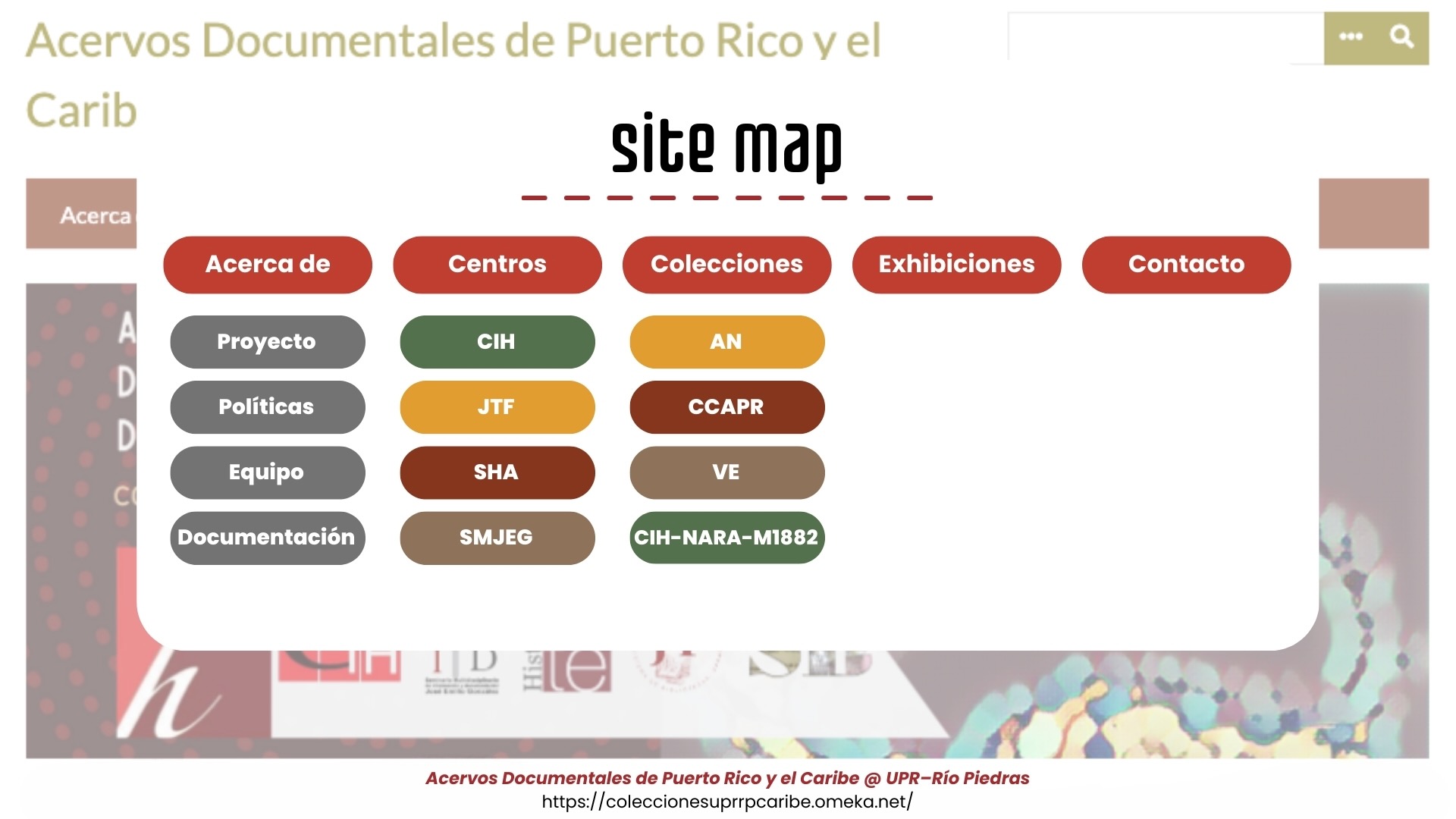
Lastly, from October 2023 to December 2023, the project team held a series of dissemination events to foster widespread awareness of the Omeka site (https://coleccionesuprrpcaribe.Omeka.net/)[33] as an open resource for education and research. Activities included an official digital archive launch at UPR-RP,[34] a presentation on culturally-rich name authority records in RDA for Puerto Rican artists at the American Library Association’s Interest Group Week,[35] and a project presentation in The Caribbean Digital X Conference held at Yale University.[36]
Acervos Documentales’ Digital Collection Stats
At the end of our project’s grant period, a great array of archival resources from our four featured collections has been digitized, catalogued, and made accessible through our open-access digital platform:
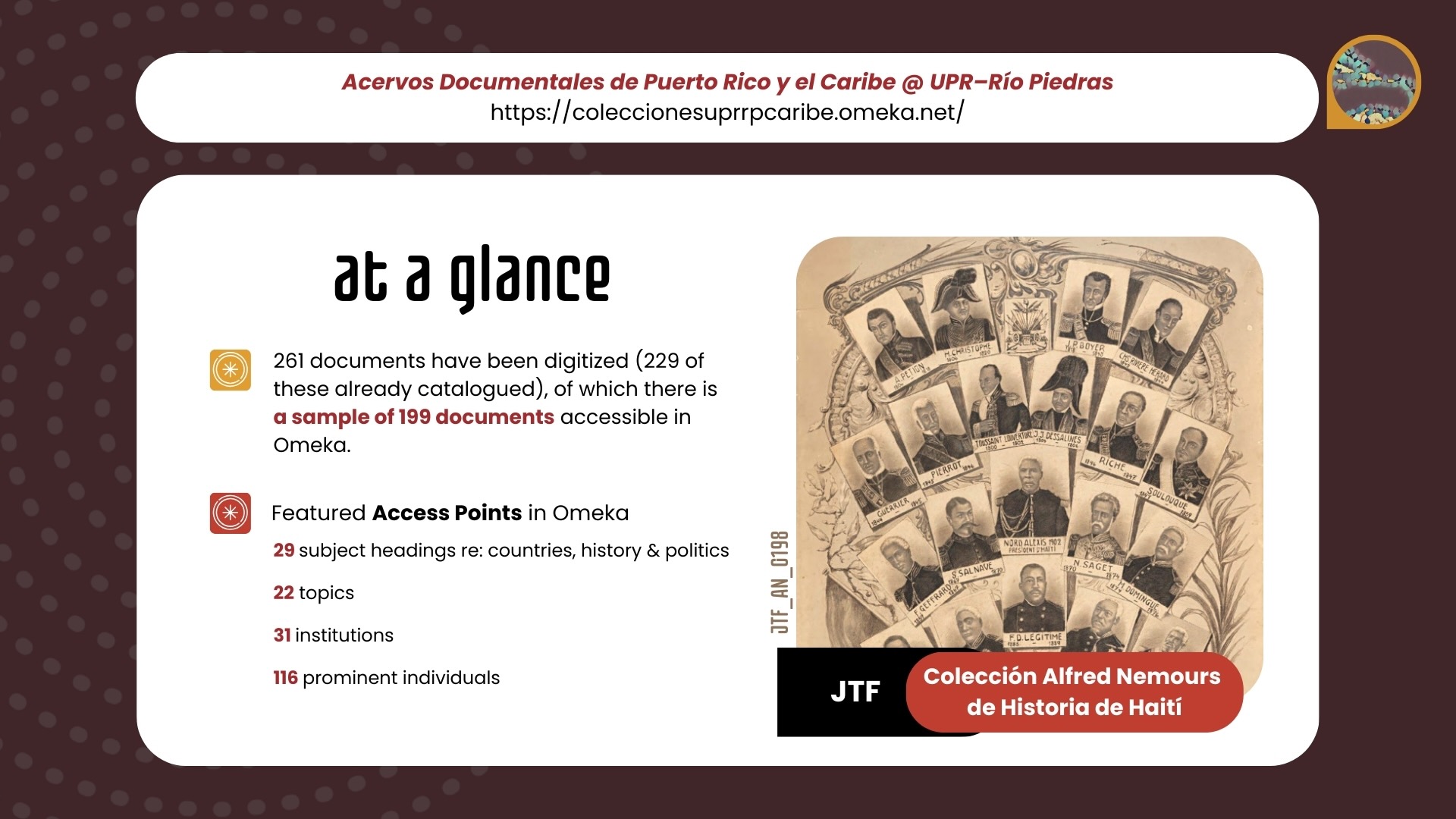
Alfred Auguste Nemours Collection of Haitian History: 261 documents were digitized, of which 229 were fully catalogued. A sample of 199 documents is accessible online through the Omeka site. Featured access points on the digital platform include: 29 subject headings regarding countries, history and politics; 22 topics; 31 institutions; and 116 prominent individuals.
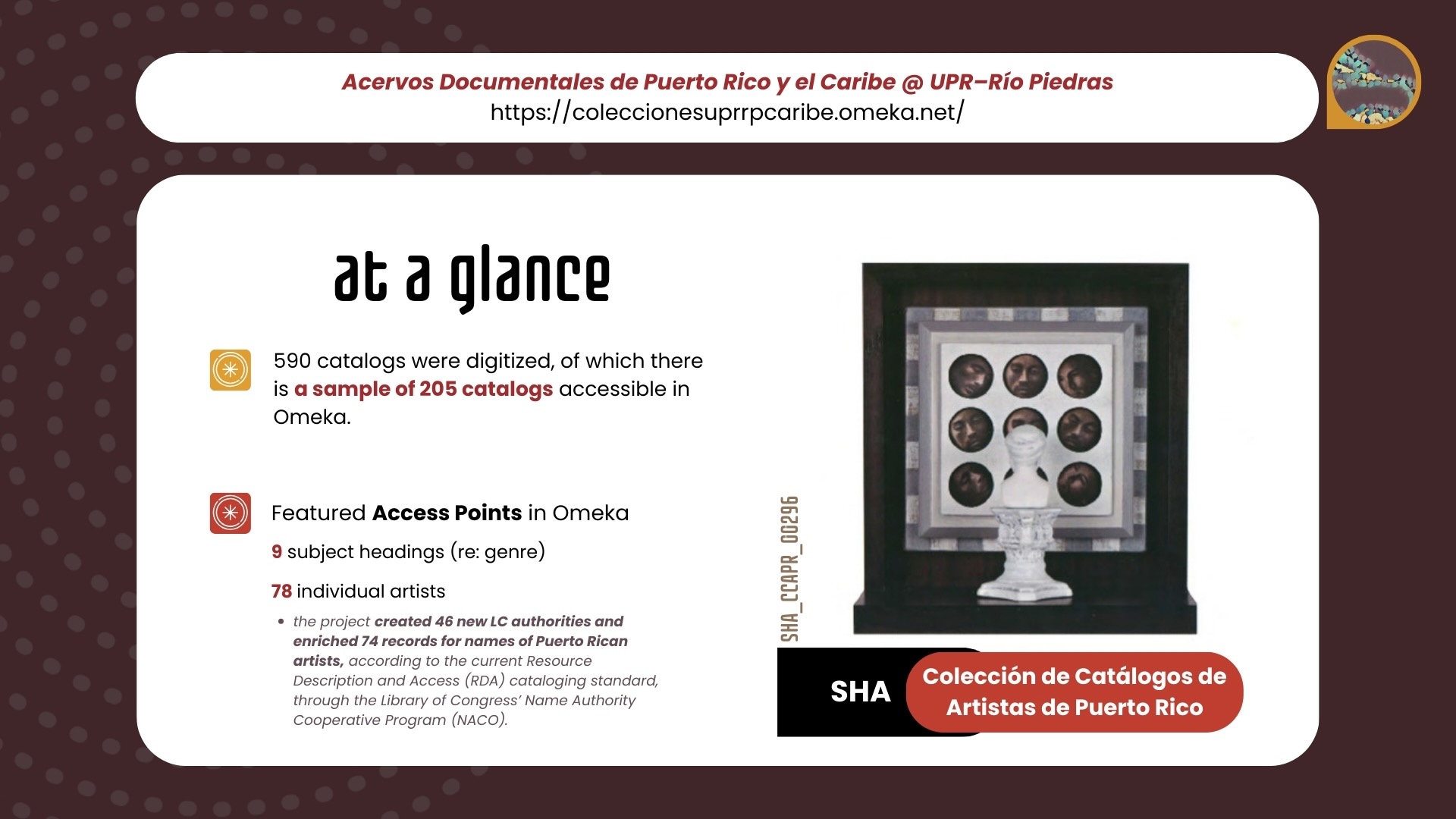
Collection of Catalogs of Puerto Rican Artists: of the 590 catalogs that were digitized, there is a sample of 205 catalogs accessible online through the Omeka site. Featured access points on the digital platform include: 9 subject headings regarding artistic genres and 78 individual artists. The project created 46 new Library of Congress authorities and enriched 74 records for names of Puerto Rican artists, according to the current Resource Description and Access (RDA) cataloging standard, through the Library of Congress’ Name Authority Cooperative Program (NACO).
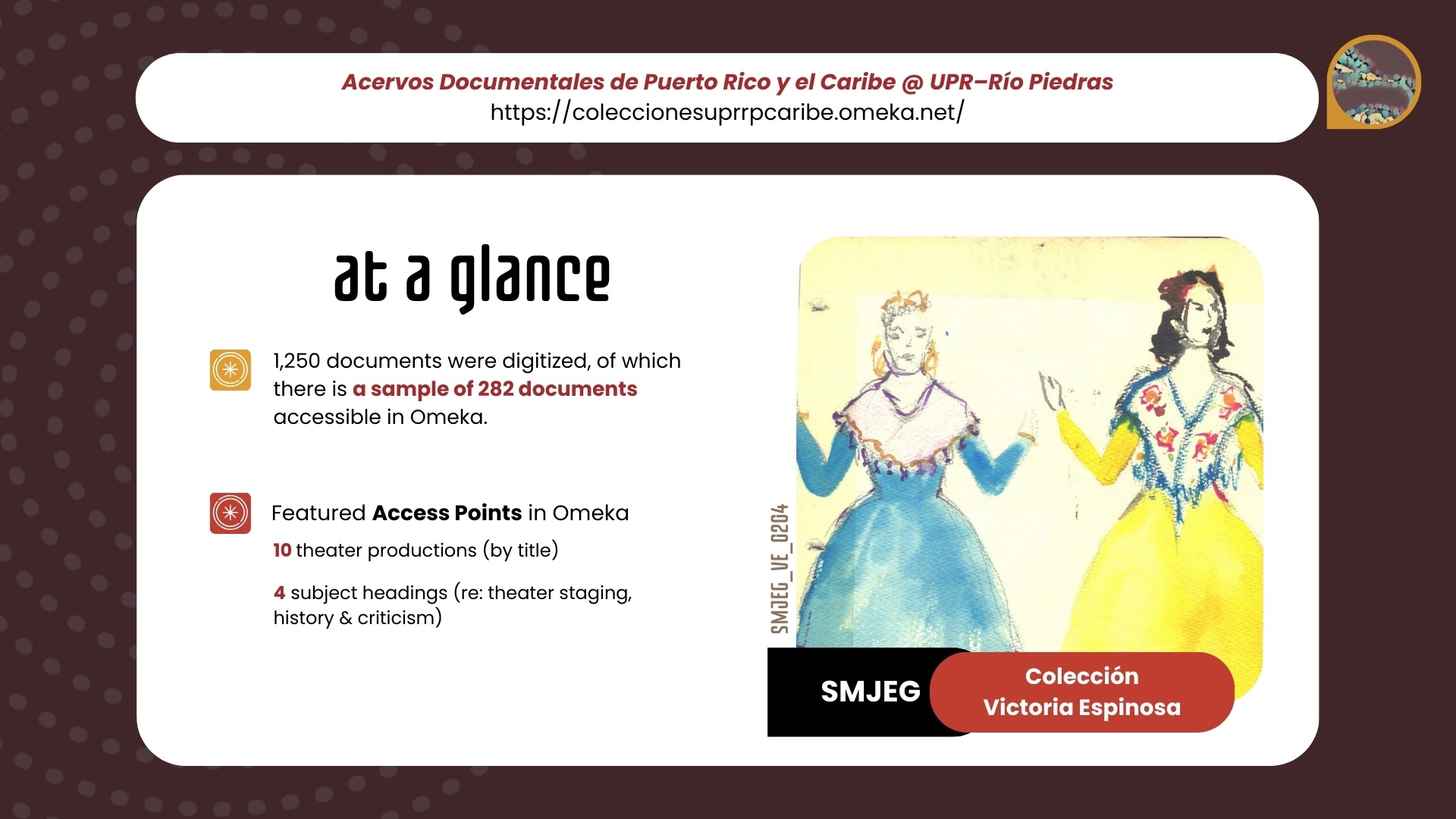
Victoria Espinosa Collection: of the 1,250 digitized documents, there is a sample of 282 documents accessible online through the Omeka site. Featured access points on the digital platform include: 10 theater productions (by title) and 4 subject headings regarding theater staging, history, and criticism.
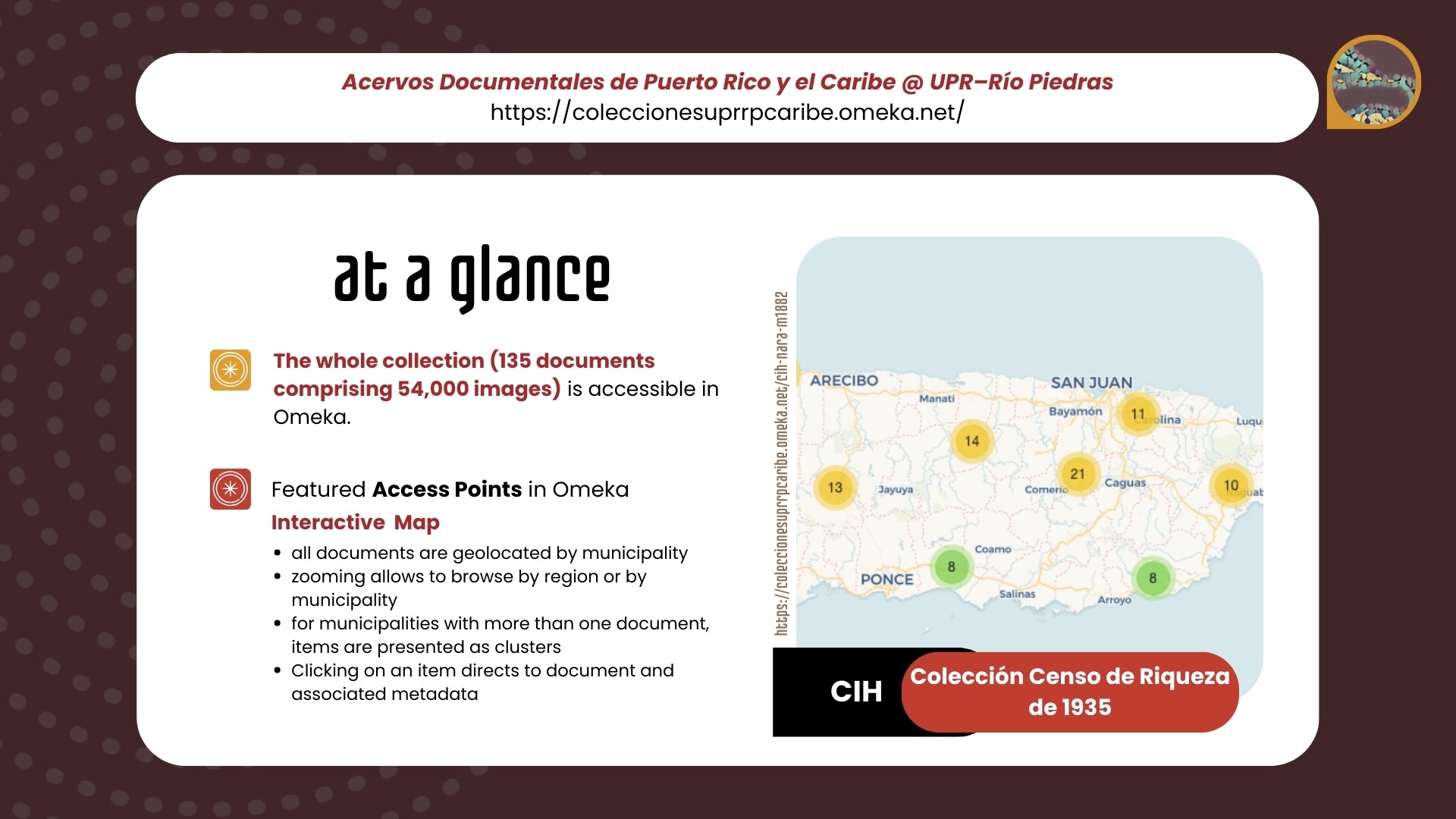
Agricultural Schedules of the 1935 Special Census of Puerto Rico ("Censo de Riqueza de 1935") Collection: the whole collection (135 documents, comprising 54,000 images) was made accessible online through the Omeka site. All the documents were geolocated by municipality, and users can access them through an embedded interactive map that allows zooming and browsing by region or by municipality. For municipalities with more than one related document, items are presented as clusters.
Omeka and the Ethics of Contextualization, Accountability, and Transparency
Access to these digitized collections through our Omeka website was enhanced through the creation and publication of a series of digital exhibits[37] which the coordinators of each collection curated. Haití en la Colección Nemours,[38] curated by Prof. Aura Díaz and Dr. Marcelo Luzzi, showcases documents by key political figures, government records, and archival items on political resistance and how Haitian sovereignty was shaped. Mujeres artistas,[39] curated by Dr. Indira de Choudens, showcases a sample of exhibition catalogs by leading women artists from Puerto Rico. Los Soles Truncos: de concepto a puesta en escena,[40] curated by Prof. Juan R. Soto Rosa, presents the first staging of René Marqués' play "Los Soles Truncos," directed by Victoria Espinosa, through the design and implementation of diverse aspects of a theater production. The Censo de Riqueza exhibits,[41] curated by Dr. Miriam del C. Lugo Colón, cluster the census forms as they relate to specific agricultural production (sugar, tobacco, coffee, among others); and an exhibit on the agricultural production in 1935 Río Piedras, El Río Piedras agrícola,[42] also curated by Dr. Lugo Colón, gives a historical glimpse of the transformation of our UPR-RP campus' environs.
To foster robust access and responsible use of the materials available through our open-source, open-access platform, all items are displayed with their associated metadata, and bilingual descriptions (in Spanish and English) are provided for each item. All digitized items are presented as downloadable PDF documents (with embedded metadata), and a citation format is offered for each item. The Omeka platform provides key web accessibility features in its public-facing interface,[43] such as: ARIA landmarks for tabbing through page content when not using a mouse or using a screen reader; the ability to skip the navigation menu (SkipNav) and go straight to the page content when using a keyboard or screen reader to navigate the site; and semantic HTML5 markup.
With the goal of fostering responsible contextualization, accountability, transparency, and interaction with the materials comprising the digital collections, we also incorporated a series of supporting content to the Omeka site. To underscore the relationship between the items and their respective collections,[44] the digital platform includes contextual information, showcases items from the collection through an interactive carousel, lists featured (hyperlinked) access points to engage with digitized materials from the collection, and proposes complementary information resources for further study. To support accountability and transparency, and to foster responsible usage of the digital resources, each information center has a dedicated page[45] offering contextual information, stating the terms of use for their collections, and listing their respective locations and contact information.
Key documentation on the inception, development, goals, and funding is publicly available through a Documentation[46] page, and a list of personnel involved in our transdisciplinary team is available on the Project Team[47] page. Lastly, all the project's policies, such as Fair Use, Intellectual Property, Preferred Citation, Takedown Policy, Privacy and Cookies, Participation Code of Conduct, and Accessibility, are available through the Policies[48] page.
To encourage research and study of the collections comprising the Omeka archive, we integrated Hypothes.is,[49] a free and open-access tool that enables the annotation of online resources by adding a layer of social annotation to content published on the Web. Users can annotate the project's various web pages, highlight text, and add annotations and tags (individually or in collaboration with other users), which they can then share, search, edit, publish, and/or delete. These annotations can be generated publicly or privately. We also published reference and teaching materials, such as slide decks used in training workshops,[50] as well as the bilingual metadata creation guidelines[51] developed for the project.
In addition to the ingestion of curated digital items into Omeka, the project is in conversations to start ingesting our digital files into the online digital collections management infrastructure offered by dLOC. Our digitized collections will also be openly accessible through UPR’s institutional digital repository ( [https://repositorio.upr.edu/); the items will be discoverable and searchable through UPR’s Online Public Access Catalog (OPAC). Additional data include project’s planning materials, reports, training materials, meeting notes, and research files that accompany the repository materials in other formats (e.g., digital files for newspapers, images, audio, video, archival correspondence, books, etc.). All permanent data in the repository will be retained in perpetuity. As the technical host for UPR-RP's College of Humanities, the Division of Academic Data Technologies (DTAA) is committed to long-term digital preservation of all materials.
While many digital projects nowadays focus on broader regions or national narratives, Acervos Documentales de Puerto Rico y el Caribe @ UPR-Río Piedras emphasizes the specific cultural and historical context of Puerto Rico and the Caribbean, filling a gap in the digital landscape. The project places a strong emphasis on preserving cultural patrimony and materials from the Caribbean, addressing historical oversights in digitization efforts. Moreover, our initiative incorporated training and capacity-building components to empower local archivists and students. This sustainability strategy counters common institutional practices of relying on outsourcing services.
Self-Assessment and Core Insights: Challenges, Opportunities and Lessons Learned
As team members assessed the project, there was a consensus regarding key takeaways and significant achievements. Among these are:
1. The Centro de Investigaciones Históricas’ Agricultural Schedules of the 1935 Special Census of Puerto Rico ("Censo de Riqueza de 1935") Collection was made accessible to the public, providing a preservation tool for this and other collections, as well as a research space utilizing documentary sources. The project offered guidance for metadata creation, digital curation, established a collaborative agreement with the National Archives of the United States (NARA) for current and future projects, engaging facilitated mentorship opportunities for student assistants.
2. In the Colección Josefina del Toro Fulladosa’s Alfred Nemour Collection of Haitian History, we updated the existing inventory and corrected descriptions, serving as a preservation assessment.[52] We created name authorities in the Library of Congress Catalog, enabling us to use subject headings specific to this collection. This project made a unique collection of resources accessible, which had previously relied on a cursory inventory for search purposes. It highlighted little-known primary sources, promoting new knowledge creation through research. It emphasized collaborative and transdisciplinary work, integrating fields such as history, information systems, paleography, archival science, library science, conservation, and preservation.
3. The Seminario de Historia del Arte’s Collection of Catalogs of Puerto Rican Artists saw the successful completion of a major group project, facilitated by collaboration among university professionals and the invaluable assistance of student assistants. The online dissemination of these art catalogs serves as a teaching and research resource that transcends mere text to function as a primary source, marking the beginning of a project to digitally display the Art History Seminar's resources, which had previously only been accessible in physical format—an essential step given the precarious conditions of the collection.
4. Lastly, the Centro de Documentación de las Humanidades José Emilio González’s Victoria Espinosa Collection provided insights into documentary collections from other areas of humanities scholarship related to analyzing dramatic texts and performance practices in context, particularly acting, directing, design, theatre history, dramaturgy, and performance art in Puerto Rico. This work allowed us to explore alternative perspectives on organizing information outside traditional frameworks and offered a model for organizing, describing, and digitizing other documentary collections within this unit.
One main benefit of this project is its usage of redundant digital archives, and its adherence to proven standards, and rigorous quality control methods to protect digital objects. With the help of consultants, the project has followed a comprehensive approach to digital preservation, including technical support, reference services for both online and offline archived files, and support services by providing training and consultation for digitization standards for long-term digital preservation. The project shows a commitment to long-term preservation and continued access to important cultural documents and artifacts by adhering to guidelines and best practices such as FADGI[53] for digitization, LoP Matrix 2.0[54] for digital preservation, and WCAG 2.0[55] for web accessibility. In practice consistent with all digital projects and materials supported by the UPR-RP's College of Humanities, redundant copies are maintained for all online and offline files in each research seminar, using external servers. Consultants in digital preservation and data management provided the project director with knowledge on software available to support the digitized items uploaded to Omeka as well as the resulting Humanities Digital Repository of all collections on the widely accepted Open Archival Information System. A second benefit of the project is the development of digital preservation management plans for each seminar that includes information on environmental controls, routine preservation actions, and digitization practices for reformatting and conservation. Finally, a third benefit includes capacity building by training of staff and personnel in areas related to the development of thematic bibliographies, workshops on digital collections and digital exhibits, as well as in content management systems to optimize user experience.
In terms of user engagement, we incorporated Google Analytics into the project’s Omeka digital platform as a measuring tool. It reports that, since its official launch in November of 2023, and with an end period of mid-September of 2025, the digital repository has received 554 users, mainly from Puerto Rico, United States, Spain, Colombia, Dominican Republic, Mexico, Argentina, Cuba, and France. The system has logged 5,302 page views, and 4,305 user engagements/interactions with the platform and its contents.[56]
Acervos Documentales: Moving Forward
The project team, along with new team member Dr. Cláudia De Souza (College of Communication and Information), is currently requesting NEH funding for a three-year project focused on building capacity for the effective use and improved access to the unique digitized humanities collections curated by UPR-RP, made openly accessible through our Omeka digital platform. The project will provide structured educational and training experiences for humanities practitioners, organized in 1-year cycles, for three separate cohorts of 15 participants each (for a total of 45 participants). Participants will be a mix of librarians, archivists, digital curators, cultural patrimony managers, university faculty, K–12 educators, and staff from cultural heritage organizations across academic, public, and community institutions in Puerto Rico.
The anticipated outcomes of the project include strengthening the capacity of educators and cultural patrimony workers to engage with digitized humanities collections in meaningful and sustainable ways. Participants will take part in in-person workshops and asynchronous mentoring sessions, to explore, model, and create Open Educational Resources (OERs) based on the four digitized collections already accessible via our Omeka-based digital platform, while also developing key skills in metadata creation, digital curation, digital preservation, and pedagogical content design. By showcasing how digital tools and digitized content can transform educational activities as applied practices in the humanities, the project promotes interdisciplinary strategies for improving both access and preservation. As a result, participants will not only contribute to expanding the visibility, accessibility, and educational value of these collections, but also model practices that can be adopted by other institutions and educators, and with other cultural heritage documentary collections in our region. The project’s outcomes will ultimately foster capacity building for digital literacy as well as a stronger culture of reuse, curation, and digital engagement with humanities collections across Puerto Rico and beyond.
Concluding Remarks
The project began by proposing new approaches, from a digital humanities perspective, for the preservation and dissemination of items that are part of the rare and unique collections in the humanities, particularly considering the COVID-19 pandemic and the effects of climate change in the Caribbean region. As the project developed, the team engaged in more fundamental discussions that led to the articulation and implementation of ethical principles for digital curation, along with a commitment to essential digital preservation efforts based on minimal computing requirements.
Given that the URP-Río Piedras is in the Caribbean—a region prone to extreme climate events due to climate change—decisions were aimed at safeguarding the effectiveness of digital preservation, dissemination, and the sustainability of the project. We hope this initiative will serve as an example for future efforts to preserve unique, rare, and priceless collections, as well as those related to the digital heritage of Puerto Rico and the Caribbean.
An added value of this project is its transdisciplinary team, composed of librarians, faculty members, researchers, and both undergraduate and graduate students in digital humanities, who share a particular interest in the preservation of collections related to Caribbean and Puerto Rican studies. The team continues to work collaboratively to add new items to the existing Omeka collections and assess potential new collections. Efforts are underway to identify funding to support the allocation of necessary human resources to advance our objectives.
Acervos Documentales de Puerto Rico y el Caribe @ UPR-Río Piedras demonstrates that transdisciplinary teams are effective in the execution of digital projects, from its conceptualization, development, and functionality, to its full deployment. The project proposes new approaches to the experience of archives from the perspective of digital humanities, from postcolonial assessments to the concepts of "memory," "voice," "curatorship," and "custody" of documentary collections from Puerto Rico and the Caribbean.
This project validates that digital preservation is an area of academic value, both for research and for the creation and professional management of cultural projects. Acervos also addressed the "ecological footprint" of digital scholarship by preserving archives based on their value to their users. Our decision-making processes regarding dissemination were centered in user experience and open access. We hope this initiative will serve as an example for future efforts to preserve unique and priceless collections in the Caribbean region.
Seminarios are academic special collections research centers (SCRC) that manage rare, archival, or special collections, and provide tailored research support, subject specialist staff, and unique materials to faculty, students, and external researchers. ↩︎
Acervos Documentales de Puerto Rico y el Caribe @ UPR–Río Piedras https://web.archive.org/web/20250905012138/https://coleccionesuprrpcaribe.Omeka.net/ ↩︎
Roopika Risam and Alex Gil. “Introduction: The Questions of Minimal Computing.” Digital Humanities Quarterly 16 (2), 2022. https://doi.org/10.63744/b49fzhuz9hhz. ↩︎
Biblioteca José M. Lázaro https://web.archive.org/web/20250922031701/https://www.upr.edu/biblioteca-rrp/ ↩︎
It is the first and only academic center within the UPR system that specializes in the study of the humanities and serves around a thousand undergraduate and graduate students who complete academic degrees in thirteen different programs --three of them lead to doctorates, and eight to masters. For more information, please consult: https://web.archive.org/web/20250924200704/http://humanidades.uprrp.edu/ ↩︎
Las Bibliotecas de la Universidad de Puerto Rico https://www.upr.edu/red-ici/?page_id=639 ↩︎
Due to the COVID Pandemic, on March 13, 2020, the UPR System declared the remote operation of all academic and administrative work, allowing for limited in-campus activities using social distancing protocols. Around 20,000 members of the UPR-RP community were impacted by this action, including undergraduate and graduate students, researchers and creative workers. ↩︎
UPR Caribe Digital - Center of Digital Humanities https://web.archive.org/web/20250922031918/https://uprcaribedigital.org/ ↩︎
UPR: Caribbean Diaspora DH Center [collection]. (n.d.). dLOC: Digital Library of the Caribbean. Retrieved September 22, 2025, from https://dloc.com/collections/diasporaproject ↩︎
Digital Library of the Caribbean (dLOC),https://web.archive.org/web/20250922032126/https://dloc.com/ ↩︎
Caribbean Diaspora Collection https://web.archive.org/web/20260420171840/https://caribbeandiasporaproject.org/ ↩︎
Archivo de Respuestas Emergencias de Puerto Rico (AREPR) https://web.archive.org/web/20260420172735/https://arepr.org/s/en/page/index ↩︎
“The Alfred Auguste Nemours Collection of Haitian History,” Acervos Documentales de Puerto Rico y el Caribe @ UPR–Río Piedras https://web.archive.org/web/20250922032422/https://coleccionesuprrpcaribe.Omeka.net/jtf-an ↩︎
Jane Toth (Comp.) and Aura Díaz López, (Rev.) , Nemours Collection of Haitian History / Colección Alfred Nemours de Historia de Haití (Rev. Ed.). Colección Josefina del Toro Fulladosa – Sistema de Bibliotecas UPR-Río Piedras. (Originally compiled in 1976) 2023. https://repositorio.upr.edu/handle/11721/4318 ↩︎
Colección Josefina del Toro Fulladosa https://web.archive.org/web/20250922032941/https://www.upr.edu/biblioteca-rrp/2017/07/05/libros-raros/ ↩︎
“The Collection of Catalogs of Puerto Rican Artists,” Acervos Documentales de Puerto Rico y el Caribe @ UPR–Río Piedras https://web.archive.org/web/20250922033308/https://coleccionesuprrpcaribe.Omeka.net/sha-ccapr ↩︎
Indira d e Choudens Martínez, Listado de artistas del Archivo de Catálogos de Artistas de Puerto Rico. Seminario de Historia del Arte – Universidad de Puerto Rico, 2021. https://repositorio.upr.edu/handle/11721/4317 ↩︎
Seminario de Historia del Arte in Acervos Documentales de Puerto Rico y el Caribe @ UPR–Río Piedras https://web.archive.org/web/20250922033617/https://coleccionesuprrpcaribe.Omeka.net/sha ↩︎
“Colección Victoria Espinosa,” Acervos Documentales de Puerto Rico y el Caribe @ UPR–Río Piedras https://web.archive.org/web/20250922033902/https://coleccionesuprrpcaribe.Omeka.net/smjeg-ve ↩︎
Seminario Multidisciplinario de Información y Documentación José Emilio González https://web.archive.org/web/20250922034407/https://www.upr.edu/biblioteca-uprrp-semmulti/ ↩︎
“The Agricultural Schedules of the 1935 Special Census of Puerto Rico ("Censo de Riqueza de 1935") Collection,” Acervos Documentales de Puerto Rico y el Caribe @ UPR–Río Piedras https://web.archive.org/web/20250922034527/https://coleccionesuprrpcaribe.Omeka.net/cih-nara-m1882 ↩︎
Centro de Investigaciones Históricas, https://web.archive.org/web/20250922034726/https://humanidades.uprrp.edu/historia/?page_id=148 ↩︎
“Equipo,” Acervos Documentales de Puerto Rico y el Caribe @ UPR–Río Piedras https://web.archive.org/web/20250922035018/https://coleccionesuprrpcaribe.omeka.net/equipo ↩︎
“Taller de Conservación,” Acervos Documentales de Puerto Rico y el Caribe @ UPR–Río Piedras https://web.archive.org/web/20250922035331/https://coleccionesuprrpcaribe.omeka.net/items/show/1533 ↩︎
“Digitalización de colecciones especiales en Puerto Rico y el Caribe: Aspectos prácticos sobre su organización y recuperación,” Acervos Documentales de Puerto Rico y el Caribe @ UPR–Río Piedras https://web.archive.org/web/20250922035537/https://coleccionesuprrpcaribe.Omeka.net/items/show/1534 ↩︎
“Talleres de Digitalización [fotos],” Acervos Documentales de Puerto Rico y el Caribe @ UPR–Río Piedras https://coleccionesuprrpcaribe.omeka.net/items/show/1576 ↩︎
“Dataset QC,” Acervos Documentales de Puerto Rico y el Caribe @ UPR–Río Piedras https://web.archive.org/web/20250922040218/https://coleccionesuprrpcaribe.Omeka.net/items/show/1535 ↩︎
“Cómo preparar nuestros derivados de divulgación,” Acervos Documentales de Puerto Rico y el Caribe @ UPR–Río Piedras https://web.archive.org/web/20250922040212/https://coleccionesuprrpcaribe.Omeka.net/items/show/1536 ↩︎
“Documentación,” Acervos Documentales de Puerto Rico y el Caribe @ UPR–Río Piedras https://web.archive.org/web/20250922040630/https://coleccionesuprrpcaribe.Omeka.net/documentacion ↩︎
"Cartas de acuerdo de colaboración UPRRP/NARA," Acervos Documentales de Puerto Rico y el Caribe @ UPR–Río Piedras https://web.archive.org/web/20250922040814/https://coleccionesuprrpcaribe.Omeka.net/items/show/1531 ↩︎
"Creación de autoridades para artistas puertorriqueños," Acervos Documentales de Puerto Rico y el Caribe @ UPR–Río Piedras https://web.archive.org/web/20250922050425/https://coleccionesuprrpcaribe.Omeka.net/items/show/1591 ↩︎
“Políticas,” Acervos Documentales de Puerto Rico y el Caribe @ UPR–Río Piedras https://web.archive.org/web/20250922040947/https://coleccionesuprrpcaribe.omeka.net/politicas ↩︎
Acervos Documentales de Puerto Rico y el Caribe @ UPR–Río Piedras https://web.archive.org/web/20250905012138/https://coleccionesuprrpcaribe.Omeka.net/ ↩︎
“Conversatorio sobre Acervos Documentales de Puerto Rico y el Caribe @ UPR Río Piedras,” Acervos Documentales de Puerto Rico y el Caribe @ UPR Río Piedras https://web.archive.org/web/20250923231136/https://coleccionesuprrpcaribe.Omeka.net/items/show/2576
For a video recording of the presentation, please consult either https://coleccionesuprrpcaribe.Omeka.net/documentacion#:~:text=Conversatorio%20sobre%20Acervos%20Documentales%20de%20Puerto%20Rico%20y%20el%20Caribe%20%40%20UPR%20R%C3%ADo%20Piedras or https://youtu.be/XPjzbgowsvk. ↩︎
“Culturally Rich Name Authority Records in RDA for Puerto Rican Artists,” Acervos Documentales de Puerto Rico y el Caribe @ UPR Río Piedras https://web.archive.org/web/20250922042033/https://coleccionesuprrpcaribe.Omeka.net/items/show/1592 ↩︎
“Schedule,” The Caribbean Digital X Conference. https://web.archive.org/web/20250922042402/https://thecaribbeandigital.org/2023/schedule/ ↩︎
“Exhibiciones,” Acervos Documentales de Puerto Rico y el Caribe @ UPR Río Piedras https://web.archive.org/web/20250922042819/https://coleccionesuprrpcaribe.Omeka.net/exhibiciones ↩︎
“Haití en la Colección Nemours,” Acervos Documentales de Puerto Rico y el Caribe @ UPR Río Piedras https://web.archive.org/web/20250923203742/https://coleccionesuprrpcaribe.Omeka.net/exhibits/show/haiti-en-la-coleccion-nemours ↩︎
"Mujeres Artistas," Acervos Documentales de Puerto Rico y el Caribe @ UPR Río Piedras https://web.archive.org/web/20250922043317/https://coleccionesuprrpcaribe.Omeka.net/exhibits/show/mujeresartistas ↩︎
"Los Soles Truncos: de concepto a puesta en escena," Acervos Documentales de Puerto Rico y el Caribe @ UPR Río Piedras https://web.archive.org/web/20250922043426/https://coleccionesuprrpcaribe.Omeka.net/exhibits/show/los-soles-truncos ↩︎
"Censo de Riqueza exhibits," Acervos Documentales de Puerto Rico y el Caribe @ UPR Río Piedras https://web.archive.org/web/20250922043531/https://coleccionesuprrpcaribe.Omeka.net/search?query=agr%C3%ADcola&query_type=keyword&record_types%5B%5D=Exhibit&submit_search=Entregar ↩︎
"El Río Piedras agrícola," Acervos Documentales de Puerto Rico y el Caribe @ UPR Río Piedras https://web.archive.org/web/20250922043654/https://coleccionesuprrpcaribe.Omeka.net/exhibits/show/rio-piedras-agricola ↩︎
“Accessibility,” Omeka.net https://web.archive.org/web/20250922044035/https://info.Omeka.net/signup/accessibility/ ↩︎
"Colecciones,"Acervos Documentales de Puerto Rico y el Caribe @ UPR Río Piedras https://web.archive.org/web/20250922044219/https://coleccionesuprrpcaribe.Omeka.net/colecciones ↩︎
“Centros,” Acervos Documentales de Puerto Rico y el Caribe @ UPR Río Piedras https://web.archive.org/web/20250922044332/https://coleccionesuprrpcaribe.Omeka.net/centros ↩︎
“Documentación,” Acervos Documentales de Puerto Rico y el Caribe @ UPR Río Piedras https://web.archive.org/web/20250922040630/https://coleccionesuprrpcaribe.Omeka.net/documentacion ↩︎
“Equipo,” Acervos Documentales de Puerto Rico y el Caribe @ UPR Río Piedras https://web.archive.org/web/20250922035018/https://coleccionesuprrpcaribe.Omeka.net/equipo ↩︎
“Políticas,” Acervos Documentales de Puerto Rico y el Caribe @ UPR Río Piedras https://web.archive.org/web/20250922040947/https://coleccionesuprrpcaribe.Omeka.net/politicas ↩︎
hypothes.is https://web.archive.org/web/20250922044702/https://web.hypothes.is/ ↩︎
“Talleres,” Acervos Documentales de Puerto Rico y el Caribe @ UPR Río Piedras https://web.archive.org/web/20250922040630/https://coleccionesuprrpcaribe.omeka.net/documentacion#talleres ↩︎
“Guías,” Acervos Documentales de Puerto Rico y el Caribe @ UPR Río Piedras https://web.archive.org/web/20250922040630/https://coleccionesuprrpcaribe.omeka.net/documentacion#guias ↩︎
A preservation assessment " evaluates the policies, practices, and conditions in an institution that affect the preservation of all or specific collections and considers the general state of the collections being evaluated, what is needed to improve that state, and how to preserve the collections long-term. It must identify specific preservation needs, recommend actions to meet those needs, and prioritize the recommended actions" (J.H. Teper, “What are preservation assessments and surveys? Why do they matter?” Preservation Self-Assessment Program: User Manual. University of Illinois Library. Accessed April 20, 2026. https://psap.library.illinois.edu/manual ). ↩︎
“FADGI Guidelines,” Federal Agencies Digital Guidelines Initiative https://web.archive.org/web/20250922045144/https://www.digitizationguidelines.gov/ ↩︎
“Levels of Preservation Matrix,” National Digital Stewardship Alliance (NDSA) https://web.archive.org/web/20250922045348/https://ndsa.org/publications/levels-of-digital-preservation/ ↩︎
"Web Content Accessibility Guidelines (WCAG) 2.0," World Wide Web Consortium (W3C) https://web.archive.org/web/20250922045535/https://www.w3.org/TR/WCAG20/ ↩︎
Google Analytics. (n.d.). Report overview for "Acervos Documentales de Puerto Rico y el Caribe @ UPR–Río Piedras" (Stream ID: 6107900376) for time period 20231108-20250913 [Measurement ID: G-7GFFT6NF0P]. Accessed 14 Sept. 2025. ↩︎
Authors' Bios
Mirerza González-Vélez
Mirerza González Vélez, Ph.D. is a Professor at the Department of English, College of Humanities, UPR-Río Piedras. Her research focuses on social imaginaries and community-based, postcolonial Caribbean digital cultures. She is a Co-PI of the Caribbean Digital Scholarship Collective and collaborates with the Archivo de Respuestas de Emergencias de Puerto Rico and the Digital Preservation Coalition. Additionally, she co-chairs the Scholarly Advisory Board of the Digital Library of the Caribbean and is a member of the Red Iberoamericana de Preservación Digital de Archivos Sonoros y Audiovisuales. Her projects, including the Caribbean Diaspora Project and the Archivo Digital de Culebra, have received funding from the Mellon Foundation and NEH. She has authored several articles in journals such as Sargasso, Reviews in Digital Humanities and The Journal of Communication Inquiry, Political Communication.
Mila Aponte-González
Mila Aponte-González is a Puerto Rican digital humanist, archivist, educator, and scholar. An alumna of the University of Puerto Rico–Río Piedras and New York University, she holds degrees in Comparative Literature, Drama, Performance Studies, and Information Science. Aponte-González plays multiple roles in cultural management and archival studies as a consultant and mentor for innovative Digital Humanities initiatives in the Caribbean. She co-creates community and cultural heritage digital archives and teaches in the graduate programs at UPR-Río Piedras. Her collaborations include projects with the Hemispheric Institute Digital Video Library, Archivo Histórico de Casa Pueblo, and the Digital Library of the Caribbean. Her work emphasizes scholarly research, critical pedagogy, and the ethical management of digital collections, aiming to safeguard cultural heritage and enhance access to unique educational resources while fostering interactive dialogues within communities.