Tun Up: Building Digital Dancehall Fashion Archives from an Artist’s Perspective
Abstract
This article investigates the opportunities and challenges of building a dancehall fashion archive with particular emphasis on the transition from the material to the digital. As an artist-scholar, I use my own dancehall fashion collection as a case study to explore the process of digitizing material artifacts (in this case, fashion and textiles). I focus on dancehall fashion in particular because it speaks to themes of resistance, self-fashioning, and creativity in the global fashion market. Throughout the article, I highlight what the transition between material and digital affords scholars and public audiences. In particular, I ask: "How do we retain the integrity of the material in digital archives? How do we make digital projects on Caribbean fashion both informative and accessible? How do fashion archives create community and cross-collaboration between academics and public audiences? How might dancehall fashion databases create community between those in the Caribbean and Caribbean diaspora? After examining various opportunities and challenges, I expand this article by outlining the ways that Caribbean fashion archives can be implemented in classrooms and art galleries and museums as a form of education for public audiences. The article speaks to Caribbean studies, fashion studies, digital studies among others. This article is inspired by the work of Kevin Adonis Browne; Carolyn Cooper; Lesley Ferris; Donna P. Hope; Siobhan Meï; Deepthi Murali; Sonjah Stanley Niaah; Meha Priyadarshini; and Jonathan M. Square among others. I also draw from the ongoing work of current digital humanities and archival projects such as Boston Archives; Connecting Threads Project; Fashioning the Self; and Rendering Revolution. My article addresses topics such as digital accessibility; cross-collaboration; creative modes of resistance and allyship; and women in media. Overall, this article argues for the importance of media technologies as a way to archive material culture to ensure the futurity of textile education and Caribbean culture.
Introduction: “Batty Rider, Mesh Marina”
On April 12th, 2023, dancehall artiste Spice released “Queen of the Dancehall” on YouTube.[1] In this two-minute music video, viewers watch dancehall fashion on display as Spice and her dancers dress in mesh marinas, fishnet stockings, gold, pink, blue, purple, orange bodysuits, and gold headpieces and jewelry.[2] In many ways, Spice’s music video becomes reminiscent of a fashion show, and the viewers are her audience. The video concept is particularly interesting to me as an artist whose own clothing collections are inspired by dancehall fashion trends and aesthetics.
Scholarship on how dress and style function as expressions of culture, resistance, and personal agency has been undertaken by scholars such as Elspeth H. Brown (2005), Judith Butler (1990, 1993), Joanne Entwistle (2000), Tanisha C. Ford (2015, 2019), Stuart Hall (1990), Valerie Steele (1996, 2001), and Carol Tulloch (2004, 2016). Dancehall fashion occupies a unique space within fashion discourse specifically and scholarship on dancehall culture more generally. I say this because much of the scholarship on dancehall culture focuses on its musical aspects. However, my project intervenes in dancehall culture by focusing on its sartorial features. In doing so, my work aligns with scholars who engage with dancehall fashion such as Bibi Bakare-Yusuf (2006, 2020), Steeve O. Buckridge (2004), Carolyn Cooper (1995, 2004), Andrea Shaw Nevins (2020), Sonjah Stanley Niaah (2010, 2020), and Carol Tulloch (2016).
Fashion in dancehall has been prevalent since its inception in the 1970s. Various materials and designs, such as velvet, lace, leather, suede, different shades of denim, rubber, PVC (polyvinyl chloride), and animal prints, are combined to produce vibrant, bold, and defiant styles. Revealing mesh tops, cut outs, cheap lace, jeans with rips and holes, and sequin bra tops are essential parts of women’s dress.[3] The “bling-bling” aesthetic (wearing big and flashy jewelry to indicate status and wealth) is extremely prominent among dancehall artists and participants alike.[4] Between the 1970s and 1980s, women in the dancehall wore platform shoes, bell-bottom pants, dresses below the knees with sleeves and high neckline, and Afros. In the early 1990s, golden braids, colored wigs, gold cargo necklaces and earrings, mesh top with one-inch holes, transparent low-cut blouses, transparent leggings or stockings, g-string panties, gloves, nail extensions and spectacles were common. Today, current fashion trends include athletic jerseys and shoes from Tommy Hilfiger, Ralph Lauren, Fubu and Nike.[5] As a site of creativity and empowerment, dancehall fashion has become a mode of self-fashioning. In dancehall, the body is what Donna P. Hope describes as “the ultimate cultural capital.”[6] It is performance; it is theatre. Thus, Spice’s music video which was released on YouTube, a digital and social media platform, inspires the question : “How does the body retain its cultural capital in digital processes?”
Like most art forms, the physical nature of dancehall fashion poses a challenge in its transition from the material to the digital. Here, I define “transition” as the labor and processes that convert garments from material/physical pieces that someone can touch to digital pieces that audiences can view. In this article, I explore the opportunities and challenges of creating a dancehall fashion digital archive from an artist’s perspective. To do so, I use my own fashion collection entitled “Tun Yuh Hand Mek Fashion” as a case study to examine the possibilities of preserving material artifacts in digital form as well as the ways that digital archives can enhance access, engagement, and community-building around Caribbean culture through the creation of digital-based public humanities project called “Tun Up: Documenting Dancehall Fashion in Diaspora.” The core questions that emerge from this project include: How do we retain the integrity of material objects in digital archives? How can we make digital projects on Caribbean fashion both informative and accessible to diverse audiences? In what ways can fashion archives foster cross-collaboration between academics and the public, especially within the Caribbean diaspora? Finally, how might the digitization of dancehall fashion create a space for education and dialogue in classrooms, art galleries, and museums?
After analyzing various opportunities and challenges of transitioning from the material to the digital, I outline the technical dimensions of building “Tun Up: Documenting Dancehall Fashion in Diaspora” using a combination of digital tools such as Omeka, ArtSteps, and CLO 3D. Finally, I end this article by examining the ways that Caribbean fashion archives can be used in classrooms, art galleries, and museums as a form of education for public audiences. Thus, this article speaks to Caribbean studies, fashion studies, and digital studies. I am inspired by the existing work of Jeanette A. Bastian, Carolyn Cooper, Donna P. Hope, Sancha Medwinter, Siobhan Meï, Lorraine M. Nero, Sonjah Stanley Niaah, Tannuja Rozario, Jonathan Square, and Valerie Steele among others. I also draw from the ongoing work of current digital humanities and archival projects such as Connecting Threads, Fashioning the Self in Slavery and Freedom, and Rendering Revolution.
Overall, this article showcases the potential of digital archives in preserving the futurity of textile education and Caribbean cultural expression. At the same time, it acknowledges the significant challenges involved in ensuring that the integrity of these digital representations reflect the rich material culture they aim to document and preserve.
Transitioning from the Material to the Digital: Opportunities and Challenges
The ephemerality of fashion (eg. shifting trends; the degradation of fabric overtime due to wear and exposure; the ability to mend and alter clothing according to one’s individual tastes and needs; etc.) makes digitally preserving garments compelling. Projects focused on the transition of fashion from the material to the digital offer multiple opportunities such as global accessibility, preservation of fashion history, increased cultural representation and inclusivity beyond Western fashion brands, and the integration of new technologies. Despite its many advantages, building digital fashion archives come with practical challenges. These dilemmas include the loss of tactile experience, the high cost of digitization, copyright and intellectual property issues, and technological obsolescence and increased rate of decay if the archive is not actively maintained. At the core of this transition lies the question: How do we take garments and represent them digitally while retaining their integrity and physical qualities?
Digital archives provide an opportunity to preserve and share fashion as cultural artifacts. In an interview between Mina Roces and Valerie Steele, Steele calls for a “truly global fashion history” and points out that “there are a lot of small gaps” in fashion studies scholarship.[7] By creating a digital archive on dancehall fashion, I respond to Steele’s call. A digital archive of dancehall fashion increases accessibility and engagement among wider audiences, builds diasporic connections, and showcases Caribbean creativity and culture globally. It also intervenes in archival research more generally. Writing on Carnival as a living archive, Jeanette A. Bastian notes that since the mid-twentieth century, archivists have shifted their focus from preserving “master narratives of society” to highlighting “the minor narratives, the untold stories, […] and the expressions of marginalized identities.”[8] She goes on to observe that “to truly capture the essence of our global society and remain relevant in a decolonial world, […] archivists must actively pursue the records of the many marginalized and often unrecognized communities within that society.”[9] Clothing and fashion, for example, push against traditional understandings of archival material (such as paper documents, letters, maps, photographs, and ledger books) and encourage more inclusive conceptualizations of records and record keeping. By extending this expanded understanding of the archive, it is necessary to consider what is preserved and how cultural knowledge is embodied beyond traditional archival forms.
Bastian asserts that cultural performances are embodied archives.[10] Dancehall fashion can be understood as a cultural performance and embodied archive for two reasons. First, dancehall culture – from the music, to the events, to the fashion, and everything in between – are performances of Jamaican culture. Second, dancehall fashion can be conceptualized as an embodied archive because participants embody the culture through their bodies and clothing. This idea relates to Steele’s approach to fashion as an embodied phenomenon where the body and dress are connected. According to Steele: “[fashion isn’t] just about the body, but include[s] also the self, who you are, your identity.”[11] In this way, dancehall fashion is inextricable from the bodies and people that wear the fashion and embody the culture.
One of the most exciting opportunities that a digital dancehall fashion archive offers is cross collaborations between dancehall practitioners, artists, researchers, and designers. Hope categorizes the visual creators as affectors who “engage in activities that result in the creation and dissemination of visual images of the dancehall culture.”[12] Involving affectors is crucial to this project because it centers the bodies and input of people doing grassroots work. Without localized input and community collaboration, there exists the risk of losing control over how Caribbean identities and cultures are represented. In other words, this digitization work aims to make visible the bodies and labor of affectors who advocate for dancehall. In addition, cross-collaborative work allows for strengthened connections between people living in Jamaica and the Caribbean diaspora.
Digitizing fashion artifacts is not without its challenges. First, there is the question of the technology used to capture these objects. High-resolution photography, 3D scanning, and interactive virtual tools are just a few resources available to document material culture. However, clothing is touched, worn, and constantly in motion. While high-resolution images preserve the visual appearance of a garment, they cannot fully capture its tactile qualities. For instance, the weight of a garment, the feel of the fabric, or the way it moves with the body gets lost in translation from the material to the digital. Scholars such as Sophie Woodward and Tom Fisher argue that fashion is “always material.”[13] Thus, digital representations struggle to replicate this embodied experience.
Moreover, digitization is not a neutral process. Curators, designers, and artists must consider the ethical questions of ownership and representation that come into play. Whose sartorial stories are being told? Who owns the digitized images and stories? How do we ensure digital archives do not commodify nor fetishize the stories they seek to preserve? These questions and concerns make it even more paramount to consult affectors of dancehall to ensure that integrity is maintained throughout the process. Archivists must collaborate with artists, designers, and the broader community to verify that their representations align with the cultural narratives and meanings embedded in the garments. This is particularly important in the context of Caribbean fashion where colonial legacies and postcolonial power dynamics have shaped material culture and the way it is understood. These concerns extend to dancehall fashion’s place in the global fashion industry, especially as Caribbean designers navigate what Veerle Poupeye describes as the “cultural penetration” of European and North American fashion centers such as Paris, Milan, and New York.[14] To tackle this concern, Lorraine M. Nero notes that “[a] collaborative rather than competitive collection development among institutions ensures that all relevant materials are collected and best use is made of the human and financial resources.”[15] This observation also brings into consideration the dynamism of dancehall culture itself. Speaking on Carnival, Bastian observes that no one group of photographs, videos, nor song recordings can capture any cultural event.[16] Additionally, Carnival costumes as primary source materials are often outside conventional cultural institutions such as libraries and archives; instead, costumes are either kept by the costume designer or discarded by owners which makes documenting difficult.[17] Dancehall fashion faces a similar dilemma to Carnival costumes in that garments often remain in the possession of their owners, are circulated among friends and/or discarded, and outfits are highly individualized based on the person’s fashion taste. Like all cultures, dancehall culture is continuously evolving which makes community involvement and multiple avenues of documentation a priority.
Most importantly, dancehall fashion is a cultural form of expression deeply intertwined with the body itself. In this way, digitizing fashion is not just about preserving clothing, it is about representing a lifestyle and culture with sociopolitical meanings inscribed on the body. Patricia Joan Saunders notes that dancehall music is “a wonderfully ambivalent and complex mode of cultural expression” as well as “an invaluable barometer for the social and political climate in Jamaica.”[18] I would also apply this claim to dancehall fashion. I return our attention to Steele’s conceptualization of fashion as an embodied phenomenon where dress and the body are connected to communicate ideas about one’s selfhood and identity.[19] Steele’s understanding of fashion brings up ethical considerations that are two-fold: How do we retain the integrity of the bodies and people wearing and designing dancehall fashion? How do we keep the voices of dancehall affectors at the forefront when building these archives? With these questions in mind, curators must consider which items to digitize and how they will be displayed. Will the garments be shown in motion or on static mannequins?
A possible answer might lie in the types of archival material included in such a digitization project. Dancehall events as cultural sites are comprised of many kinds of records that showcase dancehall fashion such as traditional photographs and posters alongside performance arts and artifacts. Aside from the use of mannequins, photographs and videos are especially useful in cases where physical bodies cannot be displayed. Pairing images of dancehall fashion with music videos, performance clips, or interviews help communicate the lived experience behind the clothing. These multimodal archives allow for cultural continuity, education, and global engagement. Bastian describes how cultural performances like dancehall culture are “records of the essence of the community itself, archives of the community ethos.”[20] As a coherent cultural whole, the archive is both historical and dynamic.
Projects like Fashioning the Self and Rendering Revolution offer multi-sensory digital experiences to mitigate these issues. Through the integration of oral histories, video footage, sound, and community storytelling, these archives do not just preserve garments. They situate those garments within their cultural, social, and political contexts. For example, Fashioning the Self uploads zines that explore the intersections between fashion and ancestry. Using Instagram as its main platform, Jonathan Square models how the intersection of fashion, identity, and culture can thoughtfully be analyzed and circulated in the digital spaces like social media. Similarly, Rendering Revolution is a wonderful example of archival and digital materials at work. Founded by Siobhan Meï and Jonathan Square, Rendering Revolution is a bilingual (English and Haitian Creole) digital humanities project that traces the aesthetic, social, and political impacts of the Haitian Revolution on fashion and material culture. What emerged out of the project was a brick-and-mortar exhibition entitled Rendering Revolution/Revolisyon toupatou on view at the Kellen Gallery in Manhattan, New York from January 1st to February 15th, 2025. Combining fashion, textile art, and installations, Rendering Revolution/Revolisyon toupatou showcased contemporary artists and fashion designers of Haitian descent that explore the legacy of the Haitian Revolution.[21] Building on these digital archive examples, I take my own garmenting collection in the following section as a case study to demonstrate how the shift from the material to the digital happens in real-time.
A Case Study in Process – “Tun Up: Documenting Dancehall Fashion in Diaspora”
My clothing collection, “Tun Yuh Hand Mek Fashion,” takes its name from the Jamaican phrase which refers to the ability to take what you have and turn it into something new. It focuses on innovation and resourcefulness. I employ the expression “tun yuh hand mek fashion” in this collection by literally making fashion (designing and constructing garments) out of old pieces of clothing and fabric and transforming them into something new or different. The garments speak to various themes such as the shared aesthetics between dancehall, Carnival, and Jonkonnu, Afro-Asian intimacies in dancehall, and dancehall’s relationship to the global fashion industry. In doing so, I take on Carol Tulloch’s idea that dancehall clothing is a “form of freedom [and] self-invention.”[22]
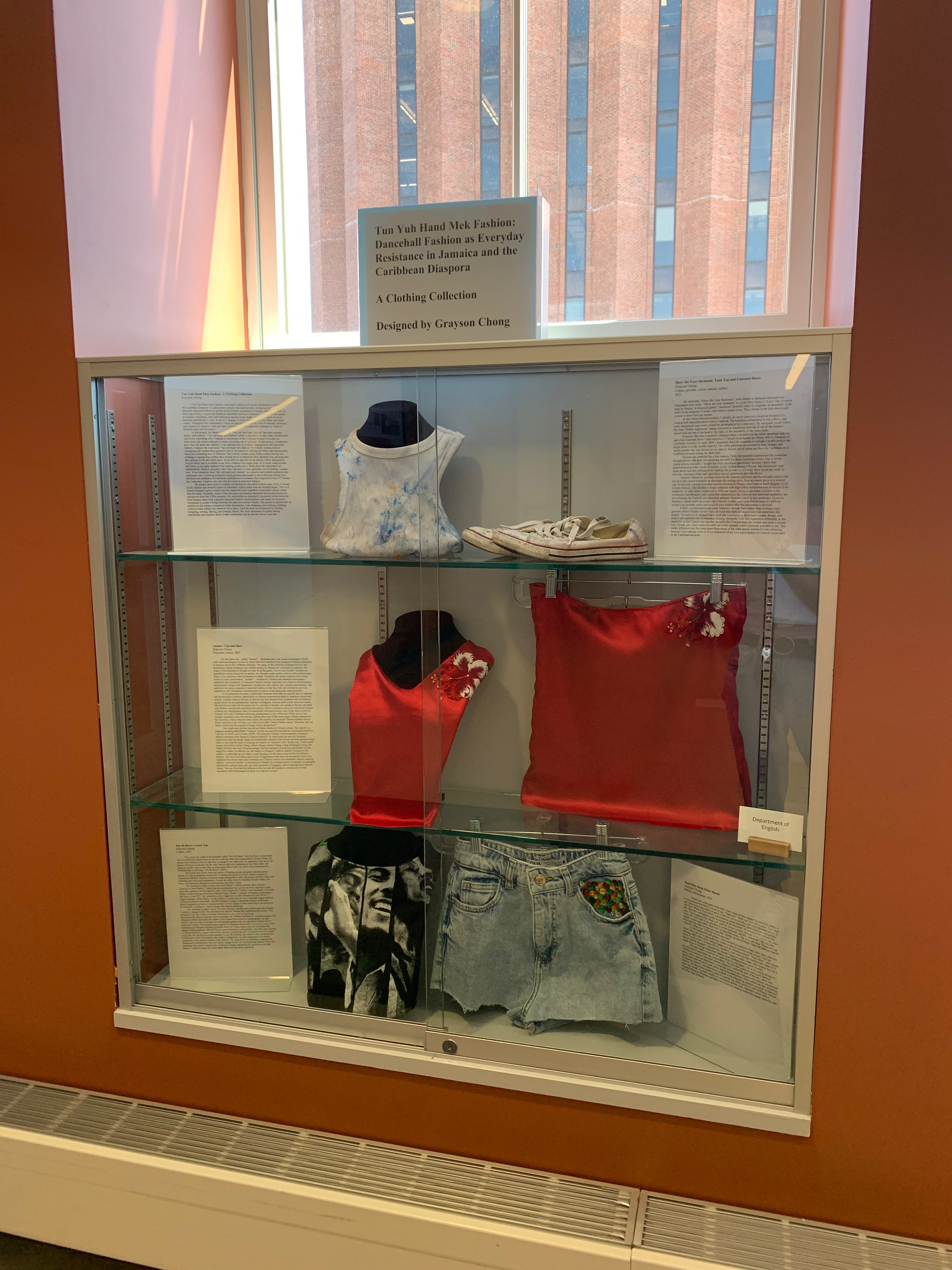
This project argues that dancehall fashion can be understood as a living, diasporic archive, and that digital tools can extend the embodied and material practices through which fashion is created and performed. This intervention is necessary because dancehall fashion has been historically underrepresented within traditional fashion archives and institutions which often privilege European and North American designers. Therefore, “Tun Yuh Hand Mek Fashion” as a clothing collection becomes a useful case study in the transition between the material to the digital. More importantly, it opens the possibility of digital archival work in the Caribbean and the Caribbean diaspora.
Part of this research focuses on the diaspora because of my own positionality as a Jamaican-Chinese woman living in the Jamaican diaspora. Both the clothing collection and digital project stems from my personal desire to remain connected with my Jamaican heritage through dancehall culture and fashion. In her essay on diasporic identity and the use of art, photography, and memory as tools used to mediate distance between oneself and the homeland, Grace Aneiza Ali writes: “My mother is my strongest connection to Guyana, stronger than the land itself. It is a remarkable thing I am often in awe of—that in our mothers, grandmothers, great grandmothers, and oldest mothers are our deepest and most tangible connection to our ancestral lands.”[23] I quote Ali at length because her words resonate with me as a Jamaican-Chinese woman living in Canada. My great-grandmother and my grandmothers are – to take Ali’s words – my strongest connection to Jamaica and my reason for becoming a textile-based artist.[24] What was once a personal way to honor my Jamaican ancestry (through the material) has shifted to a communal endeavor (through the digital) which continues to put Caribbean women at the forefront.
What transpires from this clothing collection is a digital-based public humanities project in its very early stages that I have tentatively titled “Tun Up: Documenting Dancehall Fashion in Diaspora.” This project documents and archives dancehall fashion in the North American diaspora (eg. Toronto, New York, and Miami). Spanning the inception of dancehall culture in the 1970s to the present-day, this archive will include a compilation of videography, photographs, microfilm, and newspapers. It will also feature artists that engage with dancehall using digital technologies (eg. animation, film, etc.). The purpose of this project is to collect and consolidate information and materials related to dancehall fashion history.
Beyond its archival function, this project is grounded in Caribbean feminist and decolonial thought. “Tun Up: Documenting Dancehall Fashion in Diaspora” engages with Caribbean womanism, a decolonial, Caribbeanist, and womanist theoretical framework proposed by Sancha Medwinter and Tannuja Rozario which “re-imagines the intellectual and community engagement of the Caribbean diaspora toward region-facing consciousness, research, pedagogy, and activism that centres Caribbean women and the specificity of the Caribbean context.”[25] Caribbean womanism prioritizes community-facing dialogue, activism, and the survival of one’s entire community. “Tun Up” pays homage to memory and ancestry. For instance, it memorializes contributions of past and present trendsetters of dancehall culture such as the dancehall queens like Carlene Smith, the dancehall moves created by Bogle and Latonya Style, and the current work of Maria Hitchins and Joelle Powe.
I am inspired by Carolyn Cooper, Maria Hitchins, Sonjah Stanley Niaah, Joelle Powe, L’Antoinette Stines, and Latonya Style who have been instrumental in preserving, documenting, and advocating for dancehall culture. I am also inspired by The Dancehall Archive and Research Initiative.[26] My project aligns with the work of these scholars and artists by asking: “What are the ways that we can document dancehall culture as it relates to fashion and clothing?”
Given the scope of my project, I am not simply designing an archive, but a hybrid experience that is part scholarly database, part cultural exhibition, and part immersive participation. Thus, I envision using Omeka, ArtSteps, and CLO 3D as the digital platforms that will accomplish these various goals because of the different purposes they serve. My project can be understood in three layers: archive, exhibition, and garment visualization.[27]
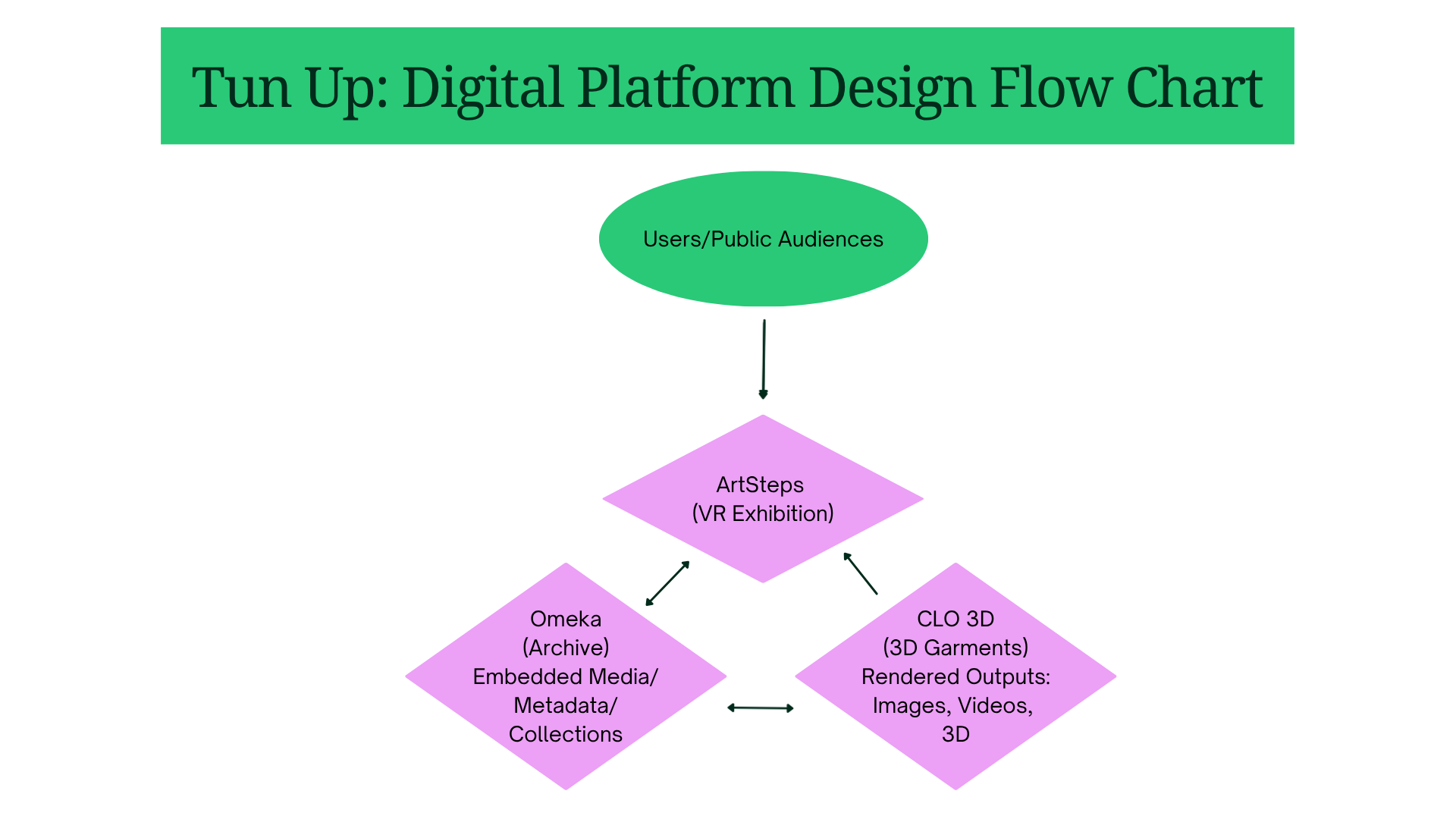
Omeka, built for public humanities projects and used by institutions, serves as the archive and backbone of this project. It is the place where I will house and store all the archival materials (eg. photography, videos, lyric texts, interviews, open access readings, and metadata). “Tun Up” as a digital project stretches across the borders of form (with its combination of text, multimedia, and resources) and cultural geography (its open accessibility to those in the Caribbean and the Caribbean diaspora). Since dancehall fashion (and dancehall culture more broadly) is a mutable and dynamic series of cultural events and practices, the archival materials must reflect this through multimedia documentation rather than static records alone. I lead with the same understanding as Bastian that “[n]o one group of photographs, no single video of a parade, no recording of one set of songs can capture […] any cultural event.”[28] In addition to spotlighting artists, designers, and creators of dancehall culture and fashion (eg. Ebony G. Patterson, Latonya Style, Popcaan, Shenseea, and Vybz Kartel among others), I imagine showcasing garments worn by famous dancehall artists or digitizing part of a music video alongside archival footage or oral histories to provide context that cannot be conveyed through static images alone.[29] For example, in digitizing the fashion associated with the iconic "dancehall queen" persona, I might pair photos of the fashion with videos of the performances and soundbites from interviews or lyrics that highlight the garment's cultural significance. An example of this creative decision would be the inclusion of Dancehall Queen (1997), a film directed by Don Letts and Rick Elgood.[30] Additionally, I envision including open-access readings on dancehall fashion. I am inspired by Connecting Threads, a digital history project focused the history of the Madras handkerchief on 18th and 19th century dress, which includes lesson plans and open-access readings for educators teaching undergraduate and postgraduate students.
In this project, documenting the process is just as important as showcasing the final garments. Omeka’s ability to support multiple media types appeals to me as an artist who relies on photography and videography to capture the process of making dancehall-inspired garments. Aside from traditional photographs and videos of clothing, a dancehall fashion digital archive allows for showcasing the process that goes into constructing garments. When constructing “Tun Yuh Hand Mek Fashion”, I filmed the process in its entirety:
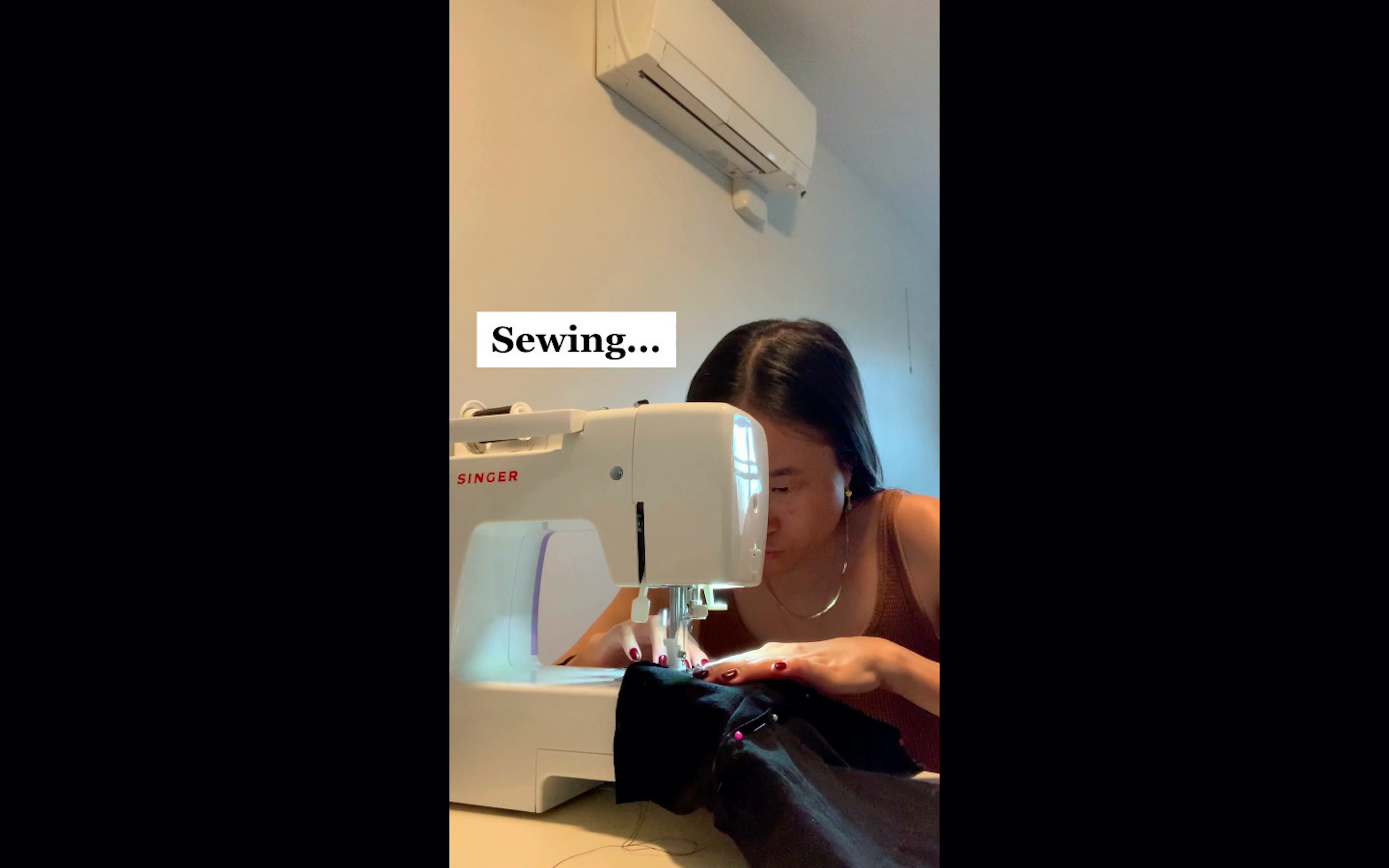
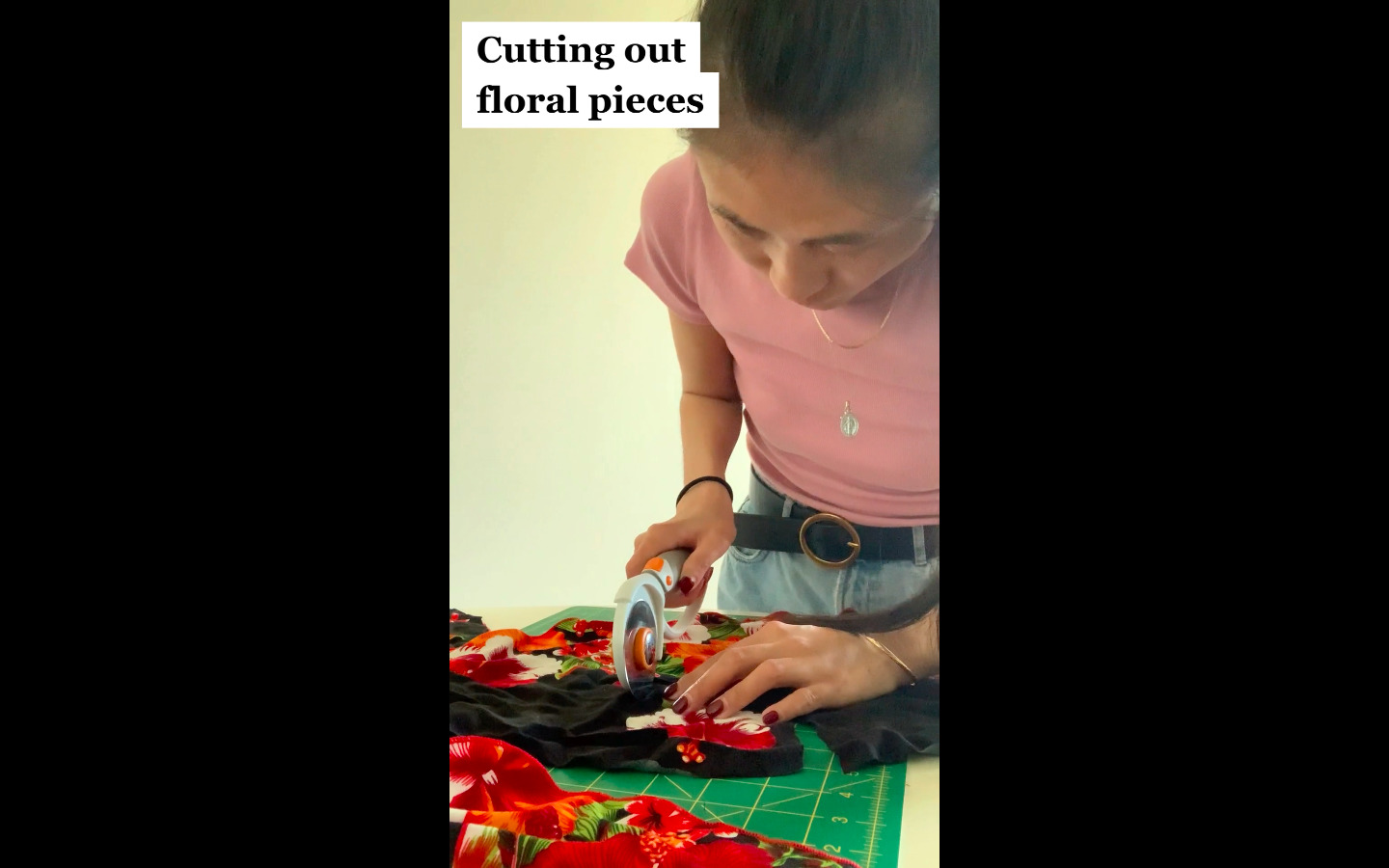
Focus on process is crucial because it shifts focus away from the finished product and centers the labor, materials, bodies, and time required to create the clothing (see Figure 3 and Figure 4). My project overall attempts to make visible the people and labor that goes unnoticed.[31] This filming and documenting are also a form of archiving the work that goes into creating this project. This impulse to document my own process echoes Nero’s observation that “carnival costumes are designed to be worn and performed. A photograph may show what it looked like at a particular moment in time, but that photograph is only one part of the story of that costume. As the costume moves through the carnival season and the parade, it develops its own story.”[32] The behind-the-scenes video documents the development of each garment’s story from its initial moodboards to their construction to their final product. This digital documentation allows viewers to visualize and appreciate the process and labour it takes to conceptualize and construct garments on a whole. In other words, by documenting the full lifecycle of each garment, the archive (in this case, Omeka) captures its transformation over time rather than a fixed end point (eg. the final garment).
Despite being the archival backbone of this project, Omeka has its limitations. Its primary constraint lies in its lack of immersive and 3D capabilities which limits the ability to effectively convey the spatial and embodied experiences of dancehall fashion. One of the highlights of “Tun Up” is its ability to be rendered into a virtual exhibition. However, Omeka does not have digital infrastructure needed to support the type of “walk through a gallery” immersion nor 3D garment visualization of “Tun Up”. Additionally, Omeka’s default design might feel too academic which is no fault of its own given that it is oriented towards scholarly communities and museums. I bring this up only because it might not embody the vibrancy and aliveness of dancehall culture without heavy customization. This is where virtual reality (VR) programs like ArtSteps is useful.
Patricia Mears and Valerie Steele remind us that designing exhibitions is like storytelling that requires multiple design and communication strategies.[33] In its most basic form, “Tun Up” is a digital exhibition that describes the history of dancehall fashion and celebrates the people who have and continue to showcase the importance of dancehall culture. The decision to create a digital archive emphasizes how dancehall fashion is a cultural expression that can continuously be expanded upon. To take Bastian’s words, dancehall fashion is “a living cultural archive.”[34] I am inspired by digital mixed media exhibitions such as fi di gyal dem (2022) hosted by the Doris McCarthy Art Gallery (University of Toronto Scarborough) and Bags: Inside Out (2021-2022) exhibited at the Victoria and Albert Museum. The layout of the “Tun Up” exhibit is inspired by The Set Girls: None So Fine virtual exhibit hosted at the African Caribbean Institute of Jamaica.[35] What I particularly admire about “The Set Girls” exhibit is its use of virtual reality (VR). When the viewers access the exhibit via a link, they are immersed into a 360-degree view of the space, allowing them to navigate the rooms and closely examine dresses, costumes, and accompanying wall text by moving their cursor. This interactive experience effectively mimics the feeling of touring a physical gallery or museum. Drawing on this approach, “Tun Up” would use the VR capabilities of ArtSteps to create a 3D curatorial experience where each room is dedicated to one of the four central themes: History, Adornment, Brand, and Lyrics.
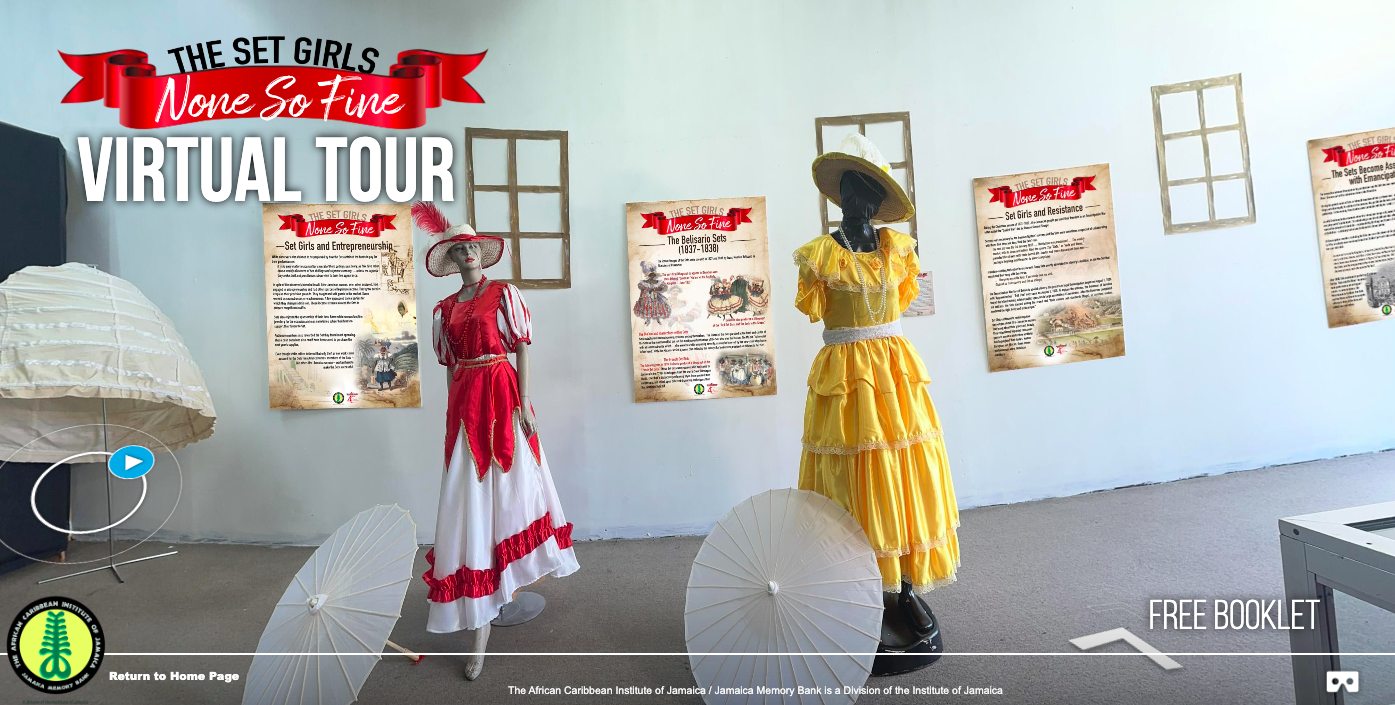
“History” focuses on dancehall fashion trends, highlighting a timeline that starts from platform shoes, bell-bottoms, and argyle in the 1980s to the streetwear, luxury brand logos, and mesh shirts of the today’s fashion. It pays homage to the designers of dancehall fashion as well as the choreographers of dancehall movement. Archival material would feature photographs, documentaries, and videos from dancehall events and music recording studios. “Adornment” attends to how everyday people who participate in dancehall events engage in dancehall fashion and adorn themselves in the bling aesthetic. This section showcases how people in Jamaica and people in the Caribbean diaspora are connected through similar fashion trends. “Brand” tells two narratives. First, it pays homage to the Dancehall Queens who, through a combination of their skills that include dress, dance, and charisma, become a personal brand in themselves.[36] Archival documents would centre on music videos, interviews, and documentaries. The second narrative of “Brand” focuses on the significance of dancehall fashion within the global fashion industry. Finally, “Lyrics” pays homage to dancehall music lyrics that focus on dancehall fashion. Text would include lyrics of Spice’s “Queen of the Dancehall,” Popcaan’s “Freshness” and “Skeleton Cartier,” and Vybz Kartel’s “Clarks.” I envision the lyrics being accompanied by videos of those artists wearing the fashion they sing about in their songs. I take my cue from The Culture: Hip Hop and Contemporary Art in the 21st Century exhibition which was on view at the Art Gallery of Ontario (AGO) from December 4th, 2024 to April 6th, 2025.[37] The exhibit is divided into five themes: Language, Brand, Adornment, Tribute, Pose, and Ascension and featured clothing brands influenced by hip hop music such as Too Black Guys, Baby Phat, Telfar, Willy Chavarria, Adidas, and Nike among others.
ArtSteps would act as the public-facing entry point of the “Tun Up” project where viewers can peruse through the dancehall exhibition space and navigate through the four themed rooms. I would curate each room with text, images, and videos from the archival materials stored in Omeka. I appreciate how it is accessible and browser-based which means that no heavy VR equipment is required. However, ArtSteps has limited archival depth which creates scalability issues for complex metadata and large collections. There are also customization constraints since I am working within a preset system. With this drawback in mind, ArtSteps might be useful curating a pilot exhibition until I decide what VR program will better suit the needs and scope of this project.
As a designer, the use of CLO 3D becomes paramount in helping me tie together existing archival documentation with the process of dancehall fashion creation. CLO 3D is a 3D fashion design software program that allows designers to create virtual, true-to-life garment visuals. While it is not an archive platform like Omeka or (at a degree) ArtSteps, CLO 3D helps artists like myself facilitate the transition of the material to the digital. It has high-quality 3D garment simulation and captures movement and drape. This is particularly important in recuperating the tactile qualities of the garments being recreated for the digital sphere. Additionally, the visuals can be exported as images and videos that can be added to Omeka and ArtSteps. Incorporating the designs from CLO 3D are paramount in retaining the 3D quality of the “Tun Up” virtual exhibition in ArtsSteps.
I will use CLO 3D to re-create the garments designed for “Tun Yuh Hand Mek Fashion” and showcase them digitally on models. These models are avatars within the program. If “Tun Up” prioritizes the body, the avatars become stand-ins for the physical bodies that would wear the garments in everyday life. Thus, CLO 3D as a design software ensures that bodies (or more accurately, the 3-D representation of bodies) continue to remain at the forefront of this digital archiving process.
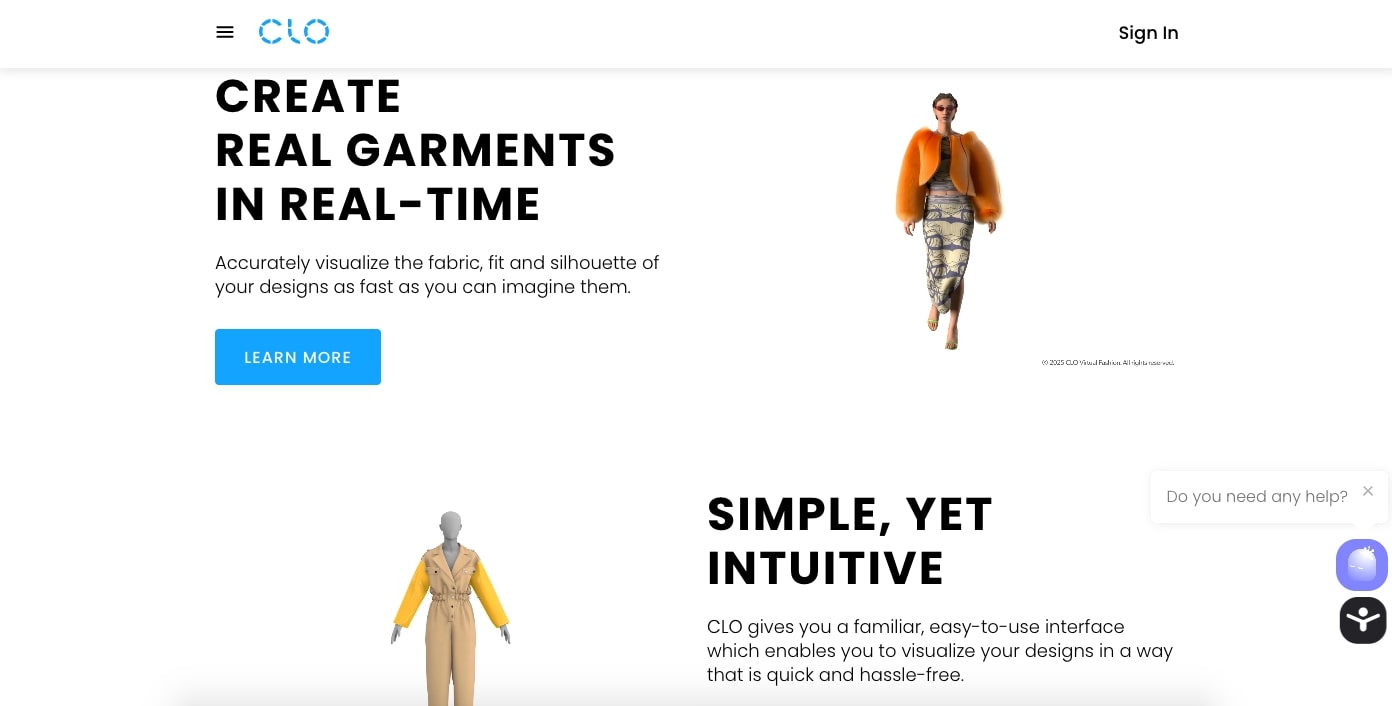
As a multi-layered digital infrastructure, Omeka, ArtSteps, and CLO 3D work together accordingly. Omeka serves as the archival backbone of the “Tun Up” project, housing media-rich collections of images, videos, and texts. Content and archival material will be manually transferred from Omeka into ArtSteps. ArtSteps acts as the public-facing aspect of “Tun Up” as an immersive virtual exhibition that allows users to navigate the curated 3D rooms in a gallery format. CLO 3D is used primarily to experiment, reconstruct, and visualize garments in order to capture the movement and materiality of dancehall fashion. The visual materials developed in CLO 3D will be exported as renders for upload into Omeka while also being embedded directly into ArtSteps to add to the 3D immersive experience for viewers. At the moment, I envision that Omeka will be the central hub/main entry point for “Tun Up” with ArtSteps linked as “Enter Exhibition Here.”
A project of this scope requires multiple collaborations to bring it to fruition. At the time this article is being written/published, the project is self-authored due to the limitations of funding and precarity of institutional support. When I had presented this project at The Caribbean Digital XII conference in December 2025, Dr. Kelly Baker Josephs asked the panelists to share how their projects were impacted by institutional limitations, funding, and support. At the time, I had just finished graduating from my PhD program and navigating the academic job market which rendered me an independent scholar. Thus, my institutional support was zero. However, because I was not affiliated with an institution, I had (and still have) full control over my project. I jokingly described myself to Dr. Josephs as being “head, cook, and bokkle washa,” someone in charge of managing everything related to “Tun Up.”[38] I outline these limitations, not from a place of lack, but to make transparent the very real circumstances for early career researchers that delay the progress and process of projects like this that are so expansive in scope.
That being said, it is my vision to collaborate with programmers, web developers, and students to get “Tun Up” off the ground. While I have basic web development and design skills, it may not be sufficient enough to sustain the project. Additionally, CLO 3D has a steep learning curve and requires technical skill in 3D modeling. Thus, I would need to hire someone with greater fashion design software knowledge to help create the virtual design visuals. Like all cultures, dancehall culture is constantly evolving. Thus, the rate of decay is rapid if not regularly maintained. In the future, I want to employ undergraduate and graduate students to, for example, maintain the metadata in Omeka. Funding is also a necessity to keep pay for the programs (or consider updating programs) and keeping domains active. It is also necessary to continue to employ the collaborators. Thus, a team of collaborators will ensure the viability of the project’s sustainability. Alongside these logistical considerations, ethical questions surrounding data ownership, consent, and access are equally critical to the development of this project.
Although “Tun Up” is a project conceived by me, I consider myself a facilitator and custodian of the archival materials rather than the owner. My goal as the facilitator of “Tun Up” is to center, expand, and credit the community of dancehall artists and designers that make dancehall fashion possible in the first place. Thus, I want to ensure that participants retain full ownership of their work and stories. As I begin to incorporate oral histories and interviews, I am committed to developing an informed consent process that allows participants to determine how their stories are recorded and shared. This process includes allowing participants to decide whether they want to be named, anonymous, or use a pseudonym. Being able to include these materials is a privilege. Thus, contributors will have the option of requesting revisions or removal over time. I do this to ensure that participants retain authority over their narratives that they are generously sharing with this project. The only pieces that I will have full copyright and ownership of are my own garmenting pieces, pictures, videos, and the accompanying 3D visuals of the garments created on CLO 3D. As this project develops, I plan to consult with archipelagos to refine my approach to the informed consent process, fair use, copyright, and permissions.[39] Attending to these questions of digital ethics and ownership reinforces "Tun Up"s broader aim to build a collaborative, community-centered archive that extends beyond documentation.
Overall, the multilayered methodology of “Tun Up” bridges archival research, curatorial practice, and digital design to create both a scholarly resource and an interactive public experience. If Steele calls for a more comprehensive global fashion history, “Tun Up: Documenting Dancehall Fashion in Diaspora” responds to that vision. Cheryl Buckley and Hazel Clark note that museums have (until recently) underrepresented the importance of everyday fashion while focusing on the activities of select designers, celebrities, wealthy consumers, and avant-garde cultural practices.[40] Dancehall fashion (and dancehall culture more broadly) pushes against the overrepresentation of certain designers by focusing on its affectors and its social, political, and cultural impact on everyday people. This digital archive puts the bodies and people wearing dancehall fashion at the forefront while focusing on a historically underrepresented fashion history and expanding digital access to both academic and public audiences. Without projects like “Tun Up,” dancehall fashion risks remaining underdocumented within formal archives despite its global influence and cultural significance to Caribbean and diasporic communities. It is my ultimate hope that the project will serve designers, researchers, students, and (ultimately) those in the Caribbean and in the Caribbean diaspora alike.
Digital Dancehall Fashion Archives as Public Resources
Digital fashion archives like “Tun Up” hold potential for education, cultural preservation, and community engagement, especially for marginalized and diasporic communities. Steele notes that exhibitions and digital archives are important because more people visit (and engage with) these sites rather than reading academic books and articles.[41] Within the context of Caribbean fashion (dancehall fashion included), these archives safeguard and share cultural heritage. However, for digital archives to achieve these goals, they must go beyond simply digitizing garments or building websites. Accessibility, educational utility, and collaboration must be central to their design process and execution. “Tun Up” responds to these goals as a public-facing, multi-layered digital resource rather than functioning solely as an academic archive. By using Omeka, ArtSteps, and CLO 3D, this project is designed to support multiple forms of access and engagement. For example, Omeka serves as an open-access scholarly database where users can browse archival materials, metadata, and curated collections. ArtSteps allows users to “walk through” 3D themed galleries, making the archive legible to public audiences. And CLO 3D extends this accessibility further by translating garments into dynamic, 3D visualizations that showcase movement, texture, and embodiment. These elements are central to dancehall fashion but are often lost in traditional archives. Together, these platforms ensure that “Tun Up” operates simultaneously as a research tool, teaching resource, and interactive cultural exhibition.
One of the most significant advantages of digital archives is their ability to broaden access to cultural materials. Caribbean fashion has long been underrepresented in traditional museum collections and scholarship. By creating digital archives, Caribbean communities are able to reclaim, interpret, and disseminate their histories on their own terms. Similarly, Saunders notes that increased access to online technology allows artists to challenge mainstream representations of Caribbeanness.[42] “Tun Up” builds on Saunders by foregrounding dancehall fashion as a diasporic, community-driven practice and making its materials freely accessible online. However, we cannot ignore the ongoing inequalities in access to digital technologies due to limited internet infrastructure and high connectivity costs.
To address this challenge, digital fashion archives like “Tun Up” must prioritize technological accessibility. This includes ensuring websites are mobile-compatible and lightweight enough to load on low-bandwidth connections which is particularly important given the high rates of smartphone use in the Caribbean. Additionally, offering content in multiple languages can significantly broaden reach and cultural relevance. “Tun Up” responds to these technological considerations through its lightweight web design in Omeka, mobile compatibility for smartphone users, and integrating media formats that can be scaled depending on bandwidth (eg. low-resolution video options alongside high-resolution files).
“Tun Up” draws inspiration from digital archives such as Rendering Revolution and Fashioning the Self which utilize accessible platforms (eg. social media) and media-rich content to engage diverse audiences. Rendering Revolution and Fashioning the Self’s digital accessibility through their Instagram platforms (which is the primary platform used for sharing information and archive building) speak to Nero’s claim that “[h]istory is happening in social media.”[43] She goes on to assert that social media becomes a way to document heritage and encourages archivists to rethink traditional ways of archiving.[44] While social media is an option, it is something I will consider later given that building a solid digital foundation for “Tun Up” is my current goal. What I do admire about digital fashion-focused initiatives like Rendering Revolution and Fashioning the Self is how they use social media platforms (eg. Instagram) to advocate for technological accessibility for audiences across national borders while expanding the reach of archival and artistic work.
Accessibility also extends to the archive’s capacity to act as an educational resource. Art galleries and cultural institutions can use digital archives to create exhibits that bring attention to underrepresented fashion histories. “Tun Up” is structured to be used in classrooms, museums, and public programming, offering curated thematic sections ( History, Adornment, Brand, Lyrics) that can be incorporated into lesson plans on Caribbean culture, fashion studies, history, and diaspora. For instance, educators can draw on archival materials, music videos, images, and garment visualizations to teach how fashion intersects with race, gender, postcolonial identity, and performance. My pedagogical approach aligns with digital initiatives like Connecting Threads which has developed teaching resources that incorporate archival materials. However, “Tun Up” extends this model through its technological infrastructure. Connecting Threads primarily operates as a 2D web-based archive, whereas “Tun Up” incorporates immersive and 3D elements using ArtSteps and CLO 3D. This allows users to read about fashion and experience it spatially and visually. By doing so, I address Steele’s observation that fashion studies lacks a stable institutional home in the academy.[45] “Tun Up” responds to Steele by creating a flexible, digital space where research, teaching, and public engagement converge.
Perhaps the most transformative feature of digital fashion archives is their capacity to foster cross-collaboration between scholars, artists, curators, and the public. Traditional archives have often privileged academic and institutional authority over community knowledge. By contrast, “Tun Up” adopts a participatory model that privileges contributions from designers, performers, dancers, and choreographers who actively shape dancehall culture. Writing with a focus on documenting Carnival costume construction and collections, Nero advocates for recording the experiences of masqueraders for collection development since masqueraders are the ones that give the costumes life.[46] The same goes for including the voices of participants wearing dancehall fashion in digital archives. This participatory approach positions “Tun Up” as a dynamic public resource. Users can access materials while actively contributing to the archive over time. For example, community members can share personal stories, style influences, and the cultural significance of specific looks or trends, offering insights that scholars or curators may overlook. This type of community-informed curation ensures that the archive reflects lived experiences rather than external interpretations. Such collaboration can take many forms. Fashion designers, artists, dancers, and performers who are involved in dancehall culture can share their insights and personal stories, adding depth and nuance to the archive. Scholars and curators can collaborate with community members to ensure that the archive accurately reflects the lived experiences of those who shape dancehall fashion. Artists might respond to the archival materials by creating new works that can then be added to the archive, creating a feedback loop of cultural production and preservation. This feedback loop between creation and documentation reflects the dynamic nature of dancehall itself.
Ultimately, “Tun Up: Documenting Dancehall Fashion in Diaspora” showcases how digital fashion archives (when thoughtfully designed) serve as tools for education, access, empowerment, and community-building. By embracing accessibility, prioritizing participation, and fostering collaboration between academics and the communities with lived experiences through an open-access database (Omeka), an immersive exhibition (ArtSteps), and 3D garment visualization (CLO 3D), this project bridges the gap between academic research and public engagement. In doing so, “Tun Up” makes the study of dancehall fashion more accessible, inclusive, and culturally relevant to various audiences.
Conclusion: “Dancehall Cyaa Stall”
Digitizing dancehall fashion is an intervention that affirms the vitality, creativity, and historical significance of Caribbean style and culture. At its core, dancehall fashion is an embodied archive that speaks to identity, resistance, and community. While digital archives offer possibilities for cultural representation and access, they also raise questions about materiality and data ownership. By investigating these dimensions from an artist’s perspective and using my own dancehall fashion collection as a case study, I have emphasized how digital archives can preserve dancehall fashion knowledge while fostering cross-collaboration and public engagement between academic and public audiences.
Designed as to be collaborative resource, “Tun Up: Documenting Dancehall Fashion in Diaspora” addresses a gap in both fashion scholarship and cultural archiving as a digital project rooted in community collaboration, Caribbean womanist thought, and diasporic memory using digital tools such as Omeka, ArtSteps, and CLO 3D. The significance of this project lies in its refusal to separate fashion from the bodies, histories, and communities that produce it. By highlighting the work of visual affectors, the project centers the knowledge of those that actively embody dancehall culture. This includes a continuous commitment to shared authorship and informed consent where contributors retain control over how their knowledge and creative works are represented and circulated. In addition, by drawing on my own heritage and family legacy of garment-making, I tie intergenerational memory with the construction of a digital archive. The processes of garment-making, documentation, and curation become an artistic, scholarly, and political act. My deliberate focus on process speaks to a dancehall ethos: ever-evolving, participatory, and embodied. Writing on the digital archives of Elis Juliana, Mikayla Vieira Ribeiro sums up this embodied way of being within the context of the Caribbean beautifully: “To exist in several different modes of being simultaneously, to creolize, to speak Creole languages, to communicate across languages, to speak with the body, to code-switch: these survival strategies are found in many Afrodiasporic ways of being and knowing, and thus in Caribbean artistic and archival practices as well.”[47] Ribeiro’s words resonate with “Tun Up” which “code-switches” by operating across multiple modes (the material and digital; the artistic and archival; and local and diasporic landscapes). In this way, the project enacts the creolized, embodied, and adaptive practices that it seeks to showcase and preserve.
Ultimately, digital archives like “Tun Up: Documenting Dancehall Fashion in Diaspora” are platforms invested in cultural futurity and provide opportunities for education, research, collaboration, and celebration. They push back against the marginalization of Caribbean fashion by offering nuanced, multimodal representations that speak to its global impact. By incorporating audio, video, oral histories, and behind-the-scenes documentation, this project invites users to engage with fashion as both artistic works and lived experiences. The integration of digital tools such as CLO 3D ensures that bodies remain at the forefront of this digital archiving process. By foregrounding the embodied realities of dancehall fashion, the project seeks to preserve this dynamic cultural expression. In preserving the essence of dancehall fashion, we both acknowledge the past and imagine possible futures. Digital archives like “Tun Up” emphasize that dancehall culture is limitless. Or as Vybz Kartel reminds us: “Dancehall cyaa stall.”
Acknowledgments
I extend my sincerest thanks to the reviewers and the editorial team for their generous, thoughtful, and insightful feedback on this article. Their comments and questions were just what I needed to think more deeply about the technical infrastructure of my project and ultimately strengthened it in many ways. I am incredibly grateful for the time, expertise, and intellectual generosity they have dedicated to this work.
“Batty Rider, Mesh Marina” is taken from the lyric of Spice’s “Queen of the Dancehall”. ↩︎
To see the costuming and outfits in their entirety, check out Spice, “Queen of the Dancehall (Official Video),” YouTube video, 2:37, April 12, 2023, https://www.youtube.com/watch?v=B8ahgTqlZyU&list=RDB8ahgTqlZyU&start_radio=1. ↩︎
For more on dancehall fashion, see Bibi Bakare-Yusuf, “Fabricating Identities: Survival and the Imagination in Jamaican Dancehall Culture,” Fashion Theory: The Journal of Dress, Body & Culture 10, no. 4 (December 2006): 465-6. For excellent examples of music videos that showcase dancehall fashion, watch Vybz Kartel, “Come Home,” https://www.youtube.com/watch?v=an_ZPYqAkl8 and MOLIY, Shenseea, Skillibeng, Silent Addy, “Shake It to the Max (Fly) (Remix),” https://www.youtube.com/watch?v=UjBhbMMgLzc. ↩︎
The “bling-bling” aesthetic is a response to one’s impoverished economic circumstances. Dancehall artists that lean into the bling-bling aesthetic include Popcaan, Spice, and Vybz Kartel. ↩︎
Sonjah Stanley Niaah, “Ritual and Community in Dancehall Performance,” in Dancehall: A Reader on Jamaican Music and Culture, ed. Sonjah Stanley Niaah (Kingston, Jamaica: UWI Press, 2020), 332-333. ↩︎
Donna P. Hope, Inna di Dancehall: Popular Culture and Politics of Identity in Jamaica (Mona, Jamaica: UWI Press, 2006), 126. ↩︎
Mina Roces and Valerie Steele, “‘Fashion is Changing All the Time, Everywhere’: A Brief Overview of the Field of Fashion and Dress Studies,” International Quarterly for Asian Studies 53, no. 1 (April 1, 2022): 22, doi:10.11588/iqas.2022.1.18158. ↩︎
Jeanette A. Bastian, “‘Play Mas’: Carnival in the Archives and the Archives in Carnival, Records and Community Identity in the United States Virgin Islands,” in Decolonizing the Caribbean Record: An Archives Record, eds. Jeannette A. Bastian, John A. Aarons, and Stanley H. Griffin (Sacramento, California: Litwin Books, 2018), 503-504. ↩︎
Bastian, “‘Play Mas’,” 506. ↩︎
Bastian, “‘Play Mas’,” 506. ↩︎
Roces and Steele, “‘Fashion is Changing All the Time, Everywhere’,” 17. ↩︎
Hope, Inna di Dancehall, 30. Hope describes affectors as creators of dancehall culture whereas affectees are the culture’s consumers. She goes on to note that due to the symbiotic nature of dancehall culture, affectors and affectees can simultaneously be creators and consumers. See Hope, Inna di Dancehall, 28. ↩︎
Sophie Woodward and Tom Fisher, “Fashioning through Materials: Material Culture, Materiality and Processes of Materialization,” Critical Studies in Fashion & Beauty 5, no. 1 (October 2014): 18. ↩︎
Veerle Poupeye, Caribbean Art (London: Thames & Hudson, 2022 [1998]), 20. Writing on how Caribbean culture maintains autonomy “in the context of global cultural and political power dynamics”, Poupeye uses “cultural penetration” to describe concerns of Caribbean policymakers over the influence of North American mass media and social media. I extend Poupeye’s description of European and North American cultural penetration in the Caribbean to the global fashion industry. ↩︎
Lorraine M. Nero, “Documenting Trinidad and Tobago’s Mas,” in Decolonizing the Caribbean Record: An Archives Record, eds. Jeannette A. Bastian, John A. Aarons, and Stanley H. Griffin (Sacramento, California: Litwin Books, 2018), 641. ↩︎
Bastian, “‘Play Mas’,” 520. ↩︎
See Nero, “Documenting Trinidad and Tobago’s Mas,” 641. ↩︎
Patricia Joan Saunders, Buyers Beware: Insurgency and Consumption in Caribbean Popular Culture (New Brunswick: Rutgers University Press, 2022), 10. ↩︎
See Roces and Steele, “‘Fashion is Changing All the Time, Everywhere’,” 17. ↩︎
Bastian, “‘Play Mas’,” 506. ↩︎
The exhibition featured fashion garments by Daveed Baptiste, Waïna Chancy, Stella Jean, Saphyra Saint-Fort, and Jonathan Square, visual art by Madjeen Isaac, Naderson Saint Pierre, and Gina Samson, and Madan Sara, a documentary directed by Etant Dupain. ↩︎
In this interview from Kaleidoscope Media, Felix Petty speaks with Carolyn Cooper and Carol Tulloch. They discuss how Jamaican dancehall culture, music, and style have evolved over the last 30 years. For the full interview, see https://www.kaleidoscope.media/magazine/42/popcaan. Archived at https://web.archive.org/web/20240730204724/https://www.kaleidoscope.media/magazine/42/popcaan. ↩︎
Grace Aneiza Ali, “The Motherland Between Us,” in Black Matrilineage, Photography, and Representation: Another Way of Knowing, eds. Lesly Deschler Canossi and Zoraida Lopez-Diago (Leuven, Belgium: Universitaire Pers Leuven, 2022), 250. ↩︎
I use my late great-grandmother’s sewing machine to construct my garments. Much of my own sewing skills come from watching my grandmothers sew and hem clothes since I was a child. ↩︎
Sancha Doxilly Medwinter and Tannuja D. Rozario, “Caribbean Womanism: decolonial theorizing of Caribbean women’s oppression, survival, and resistance,” Ethnic and Racial Studies 44, no. 14 (November 2021): 2702, https://doi.org/10.1080/01419870.2020.183966. ↩︎
The Dancehall Archive and Research Initiative is the hub for dancehall scholarship and research. My project adds to the stunning work started by this initiative by focusing specifically on dancehall clothing and fashion. ↩︎
I thank The Caribbean Digital XII for providing me an opportunity to share this project in its emerging stages. Witnessing how other participants, scholars, and artists are creating their own digital humanities projects has given me the infrastructure and inspiration to build mine. ↩︎
Bastian, “‘Play Mas’,” 520. ↩︎
My hope to showcase these garments and digitize parts of music videos brings up questions of fair use, copyright, and data/media ownership. Admittedly, I do not have the answers at this stage of the project, but this is something I will seek the guidance on from the archipelagos and The Caribbean Digital (TCD) teams. ↩︎
Dancehall Queen (1997) center s around Marcia (Audrey Reid), a street vendor (higgler) and single parent struggling to earn a living. After seeing Olivine (Patrice Harrison), the current dancehall queen in broad daylight, Marcia realizes that the queen looks ordinary without her elaborate clothing. The revelation that fashion has the capacity to alter the wearer prompts Marcia to compete for the title of Dancehall Queen to supplement her street-vending income. Marcia develops an alter-ego as a dancehall queen named “the Mystery Lady” to win the cash-prize at a dancehall competition to continue supporting her daughters. Throughout the film, we see how clothing and disguise become central to the overall construction of Marcia’s alter-ego: Marcia sketching outfits based on the clothes she sees in a shop called “Ouch;” Marcia cutting her own shirts to mimic dancehall fashion. Marcia also practices wining in her bedroom while her children are asleep. While this comment is not explicitly related to clothing, I bring up this scene in the montage to highlight how dress and dance (particularly wining) becomes an essential part of her disguise as the Mystery Lady. Through the construction of her outfits, Marcia literally employs “tun yuh hand mek fashion” by becoming the designer, artist, and performer. ↩︎
These people include designers, seamstresses, workers that construct the clothes, and those that manufacture fabrics. ↩︎
Nero, “Documenting Trinidad and Tobago’s Mas,” 645. ↩︎
See Valerie Steele, “Fashion Exhibitions: The Power of Communication,” ZoneModa Journal 12, no. 1 (July 11, 2022): 2-3, https://doi.org/10.6029/issn.2611-0563/14883. ↩︎
Bastian, “‘Play Mas’,” 506. ↩︎
The exhibit was on view at the African Caribbean Institute of Jamaica from December 15, 2022 to August 31, 2023. I thank Dr. Rachel Mordecai for informing me about the exhibit. ↩︎
Real-life examples of Dancehall Queens include Carlene Smith, Jamaica’s first National Dancehall Queen. She was awarded the crown in 1992 and held the title until 2001. She is featured in the “Murder She Wrote” music video by Chaka Demus & Pliers and is credited to have created the Butterfly dance move ; Denise Cumberland, known by her stage name Stacey who reigned from 1999 to 2002 ; and Ann Marie McKoy, whose stage name is Mad Michelle and is said to have created the Dutty Wine dance featured in Tony Matterhorn’s 2006 hit “Dutty Wine.” ↩︎
The Culture: Hip Hop and Contemporary Art in the 21st Century exhibition celebrated hip hop’s 50th anniversary, bringing together contemporary artists, musicians, designers, and stylists to showcase the music genre’s global impact on visual culture. Fashion (clothing and accessories), consumer marketing, music, and videos were placed in dialogue with paintings, sculpture, poetry, photography, and multimedia installations as the exhibition “considers activism and racial identity, notions of bling and swagger, as well as gender, sexuality and feminism.” For more about The Culture: Hip Hop and Contemporary Art in the 21st Century, see https://ago.ca/exhibitions/culture-hip-hop-and-contemporary-art-21st-century. ↩︎
I write “bokkle washa” in Jamaican patois instead of “bottle washer” because I have heard the phrase used within the context of my family speaking patois. ↩︎
These considerations regarding data ownership and permissions are especially important given that “Tun Up” is grounded in Caribbean womanism which emphasizes community care, accountability, and ethical circulation of knowledge. ↩︎
Cheryl Buckley and Hazel Clark, “In Search of the Everyday: Museums, Collections, and Representations of Fashion in London and New York,” in Fashion Studies: Research Methods, Sites and Practices, ed. Heike Jenss (London: Bloomsbury, 2016), 26. ↩︎
Roces and Steele, “‘Fashion is Changing All the Time, Everywhere’,” 21. ↩︎
See Saunders, Buyers Beware, 6. ↩︎
Nero, “Documenting Trinidad and Tobago’s Mas,” 646. ↩︎
See Nero, “Documenting Trinidad and Tobago’s Mas,” 647. ↩︎
See Roces and Steele, “‘Fashion is Changing All the Time, Everywhere’,” 22. ↩︎
Nero, “Documenting Trinidad and Tobago’s Mas,” 646-647. ↩︎
Mikayla Vieira Ribeiro, “Digital Afterlives of Elis Juliana’s Multimodal Archivism,” archipelagos: a journal of Caribbean digital praxis 8, no. 1 (April 2025), https://archipelagosjournal.org/issue08/vieira-digital.html#fnref:34, doi:10.7916/aarchipelagos-ewwn-af81. ↩︎
Authors' Bios
Grayson Chong
Grayson Chong is an artist-scholar whose textile-based pieces explore the intersections between fashion, gender, and race in Jamaica and the Caribbean diaspora. Born and raised in Toronto, Canada, she received her PhD at the University of Massachusetts Amherst in May 2025. Grayson is the editorial assistant of sx salon: a small axe literary platform. Her works have been featured in Contemporary Media Arts Journal (2021); the sx salon special issue on textiles (2021); and MaComère Journal (2024). She is also the curatorial assistant for Rendering Revolution/Revolisyon toupatou, a bilingual digital humanities project and exhibit that explores the impact of the Haitian Revolution on contemporary art and fashion. Grayson is the inaugural recipient of the Rendering Revolution Maker-Scholar Fashion Fellowship for 2025-2026. She has a forthcoming chapter entitled “Stitching in Knots: Art-Making as Knowledge-Making in the Chinese-West Indian Diaspora(s)” in an edited volume called Diasporic Womanisms: Introducing Hope and Solidarity from Non Western Sources (Routledge, forthcoming). You can find more about her artworks and scholarship at graysonchong.com.