“Un compromiso con la tierra”: Digital Placemaking in the Art of Rosaura Rodríguez’s Instagram Stories
Résumé (en traduction)
D’une vidéo montrant une fleur rose vif sur un versant de colline brumeux, ses feuilles tremblant légèrement sous l’effet du vent, à l’encre fabriquée à partir de ses pétales et déposée sur du papier cartonné blanc, l’artiste portoricaine Rosaura Rodríguez partage ses processus expérimentaux dans des stories Instagram de quinze secondes. Instagram est une plateforme controversée qui encourage l’homogénéité esthétique et qui, pourtant, continue de fonctionner comme un espace propice au développement de techniques micro-poétiques. Cet article s’intéresse aux Stories Instagram de Rodríguez consacrées à ses projets en cours, et plus particulièrement à la fonction « Highlights », qui lui permet d’archiver ses processus de travail pour deux projets : 1. Temporada, une bande dessinée autoéditée qui réfléchit au rétablissement après les catastrophes provoquées par l’ouragan María ; 2. la fabrication de pigments à partir de matières végétales et minérales trouvées autour de Tabonuco, une ferme de montagne et un centre éducatif de la Cordillère centrale de Porto Rico où elle vit. Ces deux projets montrent comment elle exploite les possibilités offertes par la fonction Story d’Instagram pour pratiquer une forme de digital placemaking qui met au premier plan le rythme et l’échelle des plantes, des animaux et des minéraux qui l’entourent.
Rosaura Rodríguez is a painter, maker, and designer who was born and raised in Puerto Rico near San Juan, now living in Jayuya, in the Cordillera Central, central mountain range of Puerto Rico. Rodríguez has been consistently publishing comics and illustrating Puerto Rican poetry chapbooks since 2013. Her wide-ranging professional experience includes an M.A. in special education focused on working with youths with autism and sensory disorders as well as work in educational programming at the Museo de Arte Contemporáneo in San Juan. These experiences, along with her training in the visual arts, inform her work with art, sustainability, and the education non-profit organization Tabonuco, which she co-founded in 2013 with her colleague Gina Malley Campos, and her spouse Mario Otero. Located in Jayuya, where she and her family now live, Tabonuco is a space to experiment with structures for collective autonomous living as inspired by the materials and needs specific to the site of the farm itself. Rodríguez's artistic projects are shaped by Tabonuco's projects which, as their mission statement implies, were fundamentally transformed by living through the 2017 Hurricane María into a model of learning from the Jayuya community:
En el 2017, vivimos el impacto físico y emocional del Huracán María. Esta experiencia expuso los retos y las necesidades de las personas y fincas a nuestro alrededor. Vimos florecer una red de solidaridad entre la gente y su compromiso con la tierra. Tomamos un tiempo para apoyar a vecinos, recuperar la finca y organizar nuestras prioridades e intenciones. Gracias al apoyo de muchas personas e iniciativas, entramos en ritmo.
In 2017, we experienced the physical and emotional impact of Hurricane María. This experience exposed the challenges and necessities of people and farms all around us. We saw a network of solidarity between people flourish with their commitment to the land. We took some time to support neighbors, to recuperate the farm and organize our priorities and intentions. Thanks to the support of many people and initiatives, we got into a rhythm.[1]
Here they gesture only obliquely to the state's mismanagement of the post-hurricane recovery, their work attempted to fill the gap in recovering basic services left by the state's months-long abandonment of rural mountain communities. Deemed unworthy of support by the state, these communities were exposed to extreme vulnerability. To contest that devaluation, Tabonuco creates placemaking art and educational projects that invite people to practice a commitment to the specific land where they live.
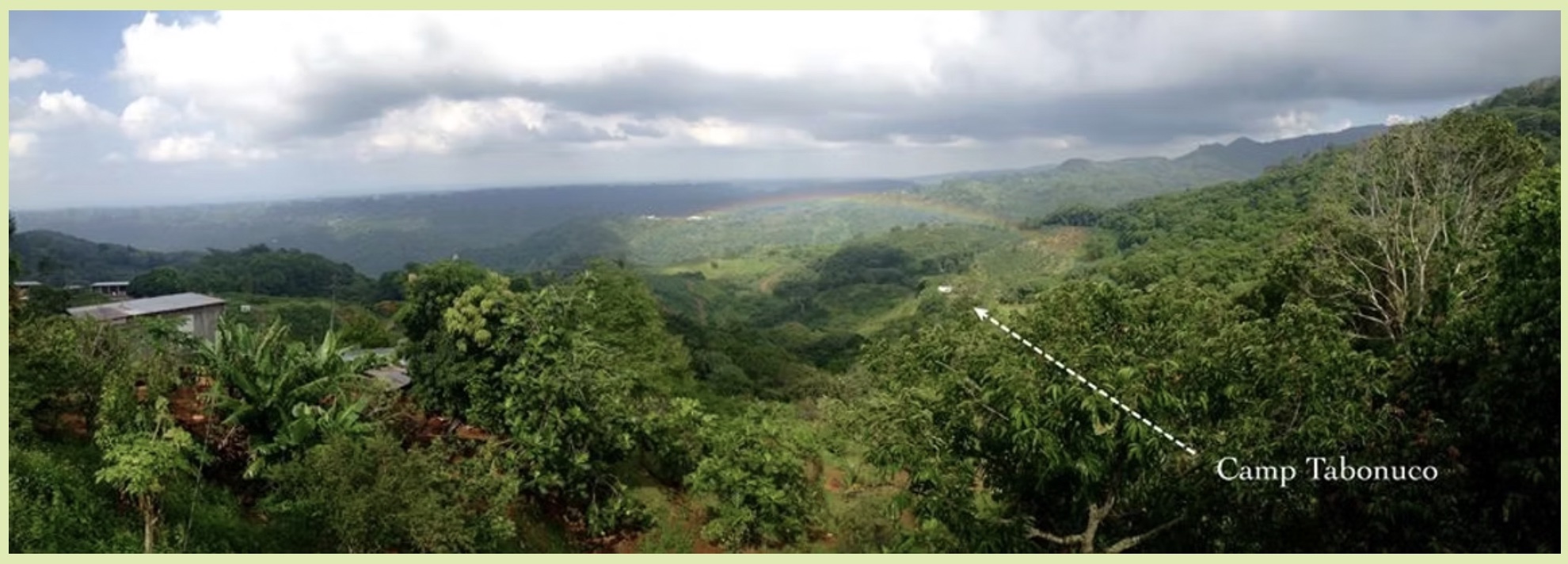
This article focuses on Rodríguez's @cosasrosaura Instagram art as one facet of Tabonuco's experiments in placemaking. Rodríguez's Instagram art consists of photographs and videos of her in-process art projects that use the platform's compositional and editorial affordances. As part of her placemaking practices\—from her grief work in post-hurricane comics to her experiments in making pigments from the plants and rocks found on the walk from the house to the chicken coop, the workshop spaces, or her studio\—Rodríguez uses Instagram Stories and Highlights, two features that the platform promotes as an in-process counterpart to the art gallery format of Instagram posts. I discuss two sets of Stories from her Instagram account: first, a video Story she posted on September 8, 2018 of herself painting the first page of her 2019 Hurricane María comic, Temporada; second, a set of five video Stories of herself making ink from a hot pink "rosa criolla" flower bush, posted on November 10, 2018. Rodríguez's experiments with composition and editing within the Stories feature show her working at the pace and scale of the insect, plant, and mineral life at Tabonuco. As an archive of her behind the scenes artistic production, these born-digital works contribute a digital format to the placemaking work Rodríguez and Tabonuco do to refute the narratives of devaluation in the state's post-hurricane recovery priorities.
Because I focus on how the experience of pace in Rodríguez's Stories is set by the insects and plant matter in Tabonuco, the centrality of hyperspeed in Naomi Klein's "disaster capitalism" is a key concept for my analyses. To summarize briefly: it is the temporality of hyperspeed that converts the destructive force of a natural event into a socially-produced disaster and economic shock.[2] Because the need for international disaster relief can place governments in a state of "limited sovereignty," disaster profiteers take advantage of the need for urgency in supporting recovery efforts to demand urgency in policy changes by bypassing democratic processes.[3] Klein connects disaster capitalism to colonialism, particularly in the real estate schemes that echo terra nullius colonial fantasies. But as Latin Americanist critics of disaster capitalism point out, the plantation itself is a long-time site of disaster in its own right, and it too deploys hyperspeed to set an inhuman pace for production that exhausts the land and the people forced to work it. Yarimar Bonilla has revised the term "disaster capitalism" to "the coloniality of disaster" to emphasize this historical continuity;[4] to assert that destructive recovery projects are not exceptional impositions;[5] and to layer the slow and centuries-long disaster of colonialism onto the hyperspeed of the natural disaster as an event. That is, the social disaster of post-hurricane reconstruction, as managed by the federal and local governments, continues and deepens already extant policies of austerity, displacement, and murderous neglect. Moreover, the consistent dispossession of Puerto Ricans from their homes is not uniquely tied to natural disasters. As Gustavo García López points out, economic development proposals throughout the twentieth and twenty-first century were grounded in an imagination of "Puerto Rico without Puerto Ricans."[6] For example, the leaked Telegram chat of then governor Ricky Roselló and his circle of close advisors included the phrase from his publicist Edwin Miranda, "I saw the future. It's so wonderful, there are no Puerto Ricans." The post-hurricane reconstruction policies of governor Ricky Roselló's government reflected a similar attitude.[7] The state's violence and abusive indifference, enacted at the hyperspeed characteristic of the coloniality of disaster, is the backdrop for Rodríguez's work.
To contextualize Rodríguez's Instagram art within a wide range of strategies for how communities survive plantation economies and the coloniality of disaster, I rely on the work of Haitian sociologist Jean Casimir and his model for how captives living in a situation of slavery created their own worlds and set their own conditions of possibility:
Through peer-group education, the person of the captives eluded the planters and the state's hold. There evolved a form of self-reliance, a condensed version of a heritage in constant renewal, whose goal was to salvage their lives, to protect and to conserve their persons [by …] combining their familiarity with the rules governing plantation society with the development of a parallel set of knowledge that enabled them to protect themselves in the face of the abusive extraction of their labor potential. … The milieus built by the captives and the standpoints from which they evolved were invisible to their masters. These worlds comprised ideas, meanings, beliefs, patterns of social relations, memories, even beings, totally unknown to these masters. With this unsuspected arsenal, captives strove to reinvent their present by systematically activating the absences produced and reproduced deliberately by the plantation compound. They expanded their actual day-to-day living by exploiting all its avenues, and within this new dimension they learned how to move beyond the dominant system. Below the surface, the experience of the oppressed led to the invention of a counter-plantation society: a new narrative fabricated with an appreciation of the contributions made by all actors, without exception, through daily life.[8]
I cite this passage at length because it is in the momentum of accumulating strategies that the counter-plantation society's capacity to surpass slavery's constraints emerges as a collective feeling of placemaking. Casimir stresses the material construction of spaces "beyond the dominant system" and "below the surface," as well as a changed relationship to temporality from the hyperspeed of extraction of "expanded day-to-day living," and a "reinvention of the present." Through the small, repeated actions of daily life, people living with the palpable dominance of coloniality aim to create a distinct lifeworld together.
From among the strategies towards self-reliance and self-invention that Casimir identifies, I highlight autonomous action, mutual protection, a parallel set of knowledge to that of the dominant system, and the creation of new narratives. All of these strategies feature prominently in many different self-organized community projects throughout the Puerto Rican archipelago that are working consistently towards a reinvention of their present. These community actions include "asambleas" (assemblies, or community action meetings), "centros de apoyo mutuo" (mutual aid centers), and "brigadas" (brigades, or project-driven volunteer days and sustained maintenance). As Rocio Zambrana writes about asambleas, while they recognize that the state's priorities aim to dispossess them of their land and sense of belonging, they "aimed to build political power but to do so at a distance from the state" so as to build new political possibilities (286).[9] This tension between resisting the state and turning one's energies in a different direction also motivates Adriana Garriga-López's thinking in her work on art and ecology autogestión: "I am working to discern and describe a different future for Puerto Rico, one that does away with crisis thinking as a point of departure for analyzing the politics of debt without thereby disavowing the real effects of ongoing colonialism, economic recession, and ecological disruption" (122).[10] In framing Rodríguez's digital placemaking projects within the hyperspeed of the coloniality of disaster and post-María recovery, I share the bivalent aim that Zambrana and Garriga-López articulate. I recognize the state's ongoing violent dispossession and also focus on the kinds of projects and political imagination that are possible when taking distance from the state and starting from their community's specific resources and needs.
Foundational to Rodríguez's Instagram art is a practice of inquiry through which she develops a sense of evaluation that is open to what every plant offers--and at the plant's own pace. She starts from learning about "the qualities and behaviors of the sources of pigments in my immediate environment," as she writes about her project on her website.[11] This inquiry is a material craft through which Rodríguez creates new knowledge and new narratives with and about Tabonuco. Rodríguez's Stories point out the small scale of detail and slow pace of her in-process work with the insects and animals, plants and rocks. In this article, I focus on how Rodríguez uses editing and embodied composition to experiment with digital placemaking throughout her Instagram art. I will first set forth the affordances and limits of creating art on Instagram in late 2018--the time period of the Stories I analyze here--as well as the tensions in digital placemaking and Rodríguez's own use of Stories and Highlights collections. I then analyze two sets of video Stories: the first from the Hurricane comic Temporada, and the second, of a pigment-making project. Together, these Stories show how Rodríguez's Instagram art is part of her practice of counter-plantation in daily life.
Digital placemaking in Instagram
The hyperspeed of the coloniality of disaster parallels the temporality encouraged by the commercial media platform in which Rodríguez creates the very work that responds to it. Discussing the affordances of any given commercial media platform requires specifying the periodization of the platform. In the case of the Stories feature, its existence as well as its affordances and dominant aesthetics are conditioned by Instagram’s 2016 Operating System update. The 2016 update changed the feed organization from reverse chronology to an algorithmically-driven display of Posts.[12] Running on black-boxed proprietary codes, an algorithmic structure learns by constantly reviewing its own past-centric predictions. Because the Instagram algorithm seems to reward constant content creation as well as responsiveness to the trends it determines, creators lost traction and visibility even among their followers' feeds.[13] In terms of creator experience, not responding to the trends on the app results in punishment. In terms of user experience, the promotion of Posts that are similar to a concept a user has actively liked are intermingled with advertisements, prominent accounts, or current trends that are unrelated to the users’ likes yet are promoted by the algorithm. As such, the user's feed changes from a site led by their chosen interests to a site for training desire for algorithmically-manipulated aesthetic hegemony and for acclimatizing users to interact with algorithmic decision-making in every facet of their lives.
This drive towards the homogenization of aesthetic trends on users' main feeds has been particularly devastating to visual artists who had come to use Instagram as the preferred platform for advertising their work because of its white box gallery look. Because commercial media platforms never reveal their algorithms' exact metrics, people whose livelihoods in part depend on the circulation of their ideas and artwork on Instagram must constantly analyze their posts' performance metrics in order to reverse engineer the shifts. As Jia Tolentino writes about the feedback loop between Instagram filters and plastic surgery trends, users sense the pressure that "some things just perform well."[14] Among the things that content creators sense are that, by hewing to ever-narrowing aesthetics, their Posts will be promoted and more widely seen. And among the things that just perform well are the data that the algorithm consults in its decision-making to reinforce oppressive social and economic relations, as Safiya Noble has shown.[15] This pressure towards homogenization exacerbated by the 2016 OS update's reorganization of the main feed was one of the reasons Instagram released the "Stories" feature as a counterpart, also in 2016. Created to compete with the rival platform Snapchat's temporary short video format, a Story consists of a still image or fifteen-second maximum[16] video that remains stored in the users' phone and account, but is only available to an account's followers for twenty-four hours. Instagram marketed the feature as a way to "share all the moments of your day, not just the ones you want to keep on your profile," implicitly assuring users that they had a place to share content without the risk of diluting their cohesive brand identity or creating potentially low-performing posts that could result in their account's algorithmic demotion.[17] If users would want to shape their Posts to fit within what they had identified as the algorithm's aesthetic priorities, Stories could be a low-stakes space within the platform for experimentation.
What distinguishes Stories from Posts is that Stories have very robust privacy controls and, due to its twenty-four hour accessibility, are low-persistence by design. To post a Story, users can create a photograph or video within the app, upload a photograph or video from the phone's camera roll, repost one of the user's own Posts, or repost another user's Story or Post. Within the app, all Stories appear in a horizontal band featured above the main feed, and each Story is represented by a small circle with the accounts' profile pictures. In contrast to the expectations of perfectly composed Posts and captions in the main feed, Stories imitate the playful maximalism most associated with Snapchat's ephemerality. Stories' editing affordances encourage users to layer video effects and image filters, emojis, stickers, and GIFs directly onto the photograph or video itself. In addition to typed text captions positioned anywhere on the image or video, users can doodle with a standard brush, translucent highlighter, or custom color palettes.[18] Users can also amplify their visual storytelling by adding extra-diegetic music samples from Instagram's catalog; annotating the image with metadata such as hashtags, geotags to mark the user's location, and tag of other users; or creating a conversational feel with polls, surveys, or slide emoji stickers to which viewers can respond in Direct Messages by clicking on the Story itself.[19] These layers of filters and additions to the videos and images lead to an aesthetic that Leaver et. al. identify as "kitschy or vintage internet ugly."[20] The uses and aesthetics of Instagram Stories are therefore formed through this combination of editorial affordances and compositional modality, the low visibility of their placement of Stories in the app, the low persistence of their temporally-limited availability, and their exclusion from an account's performance metrics.
Rodríguez uses all four types of Stories: screenshots or photographs of her in-process work that she creates with the app's Story feature and that almost always include its maximalist affordances of geotags and color-coordinated captions, often with stickers, filters, or polls. Her Stories also include reposts of her own posts and reposts of friends' Stories and posts that mention her (see Figure 4). Her video Stories include boomerangs, timelapse videos to which she sometimes adds music when creating the Story through the app's feature, and videos filmed with her phone. This last category features the ambient sounds of the house and farm around her as the camera focuses on her hands at work in her studio. Sometimes, her young child is also at play with the materials; on other occasions, Rodríguez is in her home, either at her scratched, wooden desk, or making paint from pigment particles on the marble side table that her neighbor was going to throw out. Rodríguez's Stories document her in-process work with a DIY aesthetic and she uses Stories' affordances to create different affective tones, from playful to reflective.
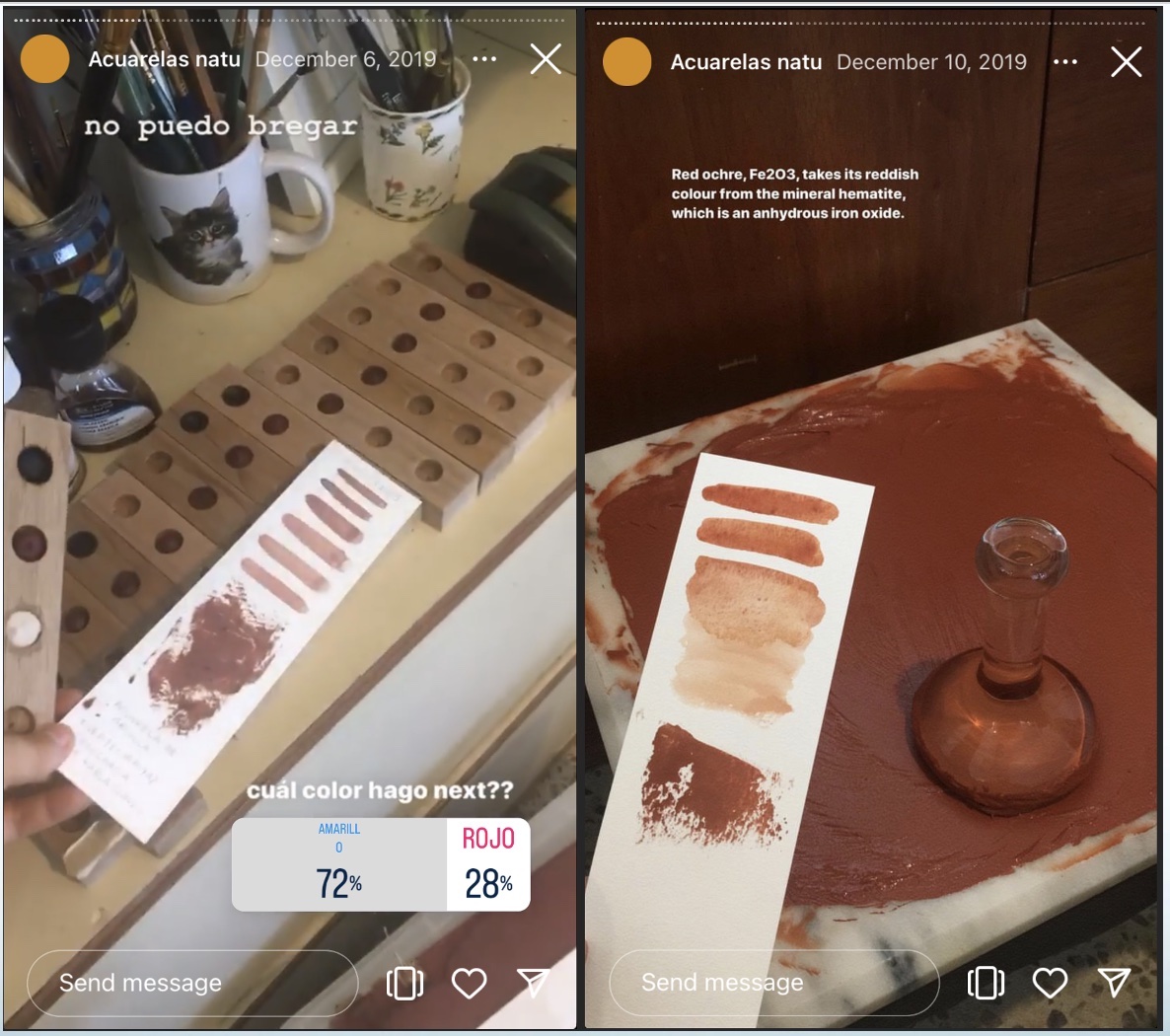
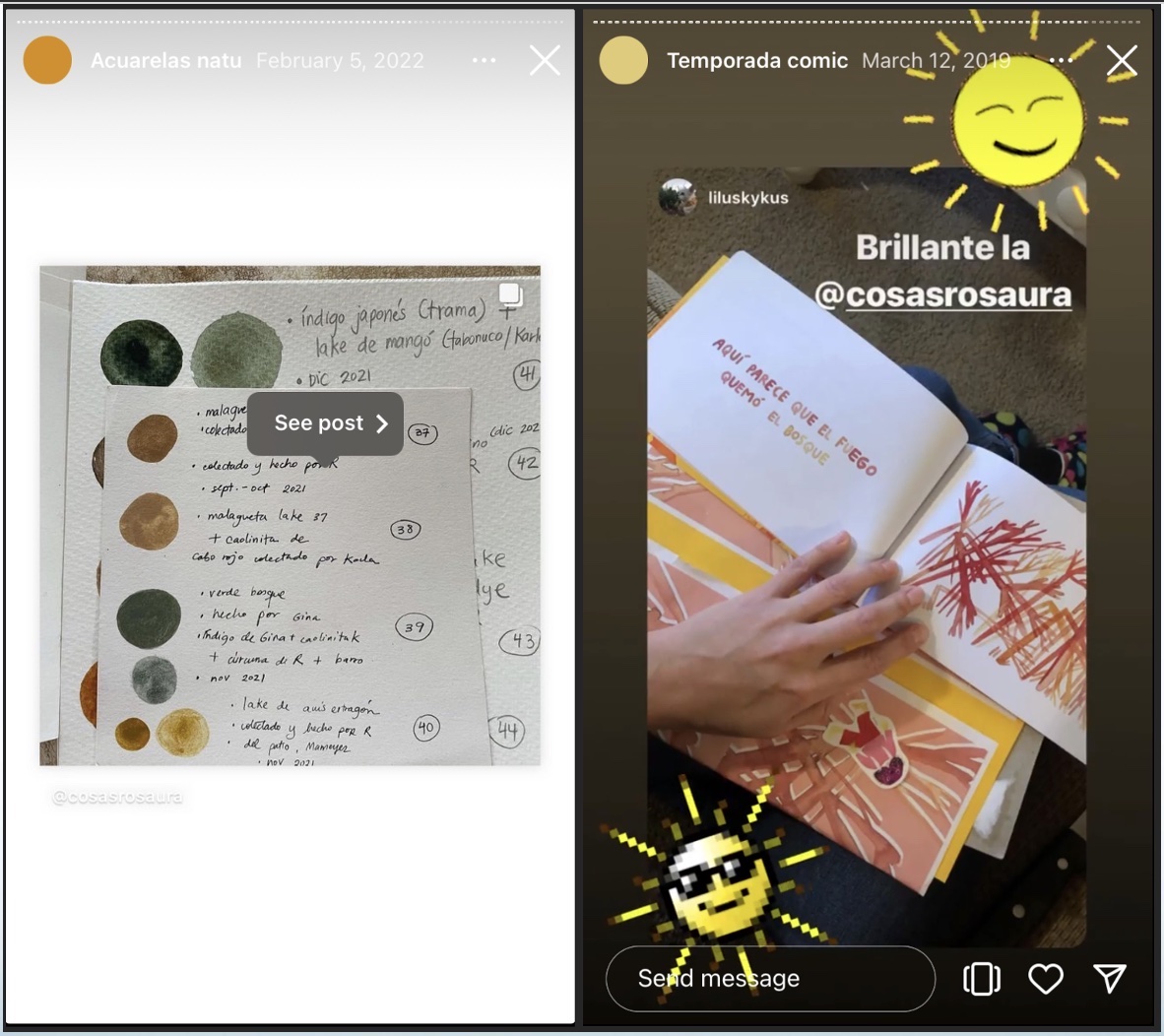
Rodríguez also uses the Highlights feature that Instagram introduced for Stories in 2017. Highlights permit users to select Stories they have previously posted and make them available for view permanently. Because a user can sort through the Stories they've created, and save up to one hundred Stories in each Highlight collection, this feature curates Stories and counteracts the ephemerality of the twenty-four hour limit. For followers to see an account's Highlights, they need to go to the account's page, where the Highlights collections are located in a row of buttons in between the profile and the grid on the user's page, each with a photo or icon and name that represent a different Highlight. By collecting hundreds of low-persistence, low-visibility Stories into Highlights, users create a high-persistence, high-visibility archive from among the Stories that were originally created with the safety of their impermanence. The Stories that the user has now approved for permanent display are a kind of behind the scenes look at the experiences posted on the grid. While both Highlights and Posts are curated, the aesthetic distinction between Posts versus Stories collected in the Highlights remains. Users' grids and followers/’ feeds meet the curatorial gallery aesthetic of spontaneity and maximalist layers associated with its original low-risk feature.
Between 2017 to 2023 Rodríguez created twenty-seven Highlights collections that index her different publications, experiments in technique, and educational projects as she developed them (see Figure 5). The Highlights she has created can be roughly divided into the following categories: 1) publications, like "Temporada comic," "Tinti, el libro," (Tinti, the book), "Obras," (works of art), "Rapiña" (pillage), and "Materia materna" (mothering materials), which collect her process videos and reposts of her now-published comics and paintings on display; 2) Stories about everyday life, like "mountain home" and "Wassup"; 3) Tabonuco-related projects, such as "Domo geodésico" (geodesic dome) and "Talleres" (workshops); 4) different work techniques including her pigment-making projects, such as "Flower pounding," "Témpera de [egg emoji]," "Trabajo de camp" (field work), "Teñidos" (dyes), and "Acuarelas natu" (natural watercolors). This last category of ten collections dominates her Highlights collections. Although she continues to post Stories regularly, in 2023, Rodríguez stopped collecting Stories to Highlights for both practical reasons and emerging questions about the utility of Highlights themselves. First, the nature of her work shifted towards public-facing activities like "gestión cultural, coordinación de actividades educativas, experiencias educativas en escuelas, dar talleres" ("managing cultural events, coordinating educational activities [like] experiential learning in schools, running workshops" my translation) and the quantity and complexity of those projects intensified.[21] By their very nature, the documentation of this type of administrative and teaching work is not focused on her creative experimentation, and performing these activities has taken priority over the time, energy, and labor of filming, editing, posting, and sharing those activities online, and then reviewing those Posts and Stories to evaluate any emerging patterns in order to save them to the appropriate Highlights collection. To create Highlights, Rodríguez synthesizes her Stories to "try to create a story or some sort of continuation [where] you know there's something in which people can engage more authentically and can be part of the process."[22] This requires a commitment to organize and maintain the Highlights as coherent archives. Noticing that her Highlights no longer represented that intentionality to her standards, she stopped using the feature.
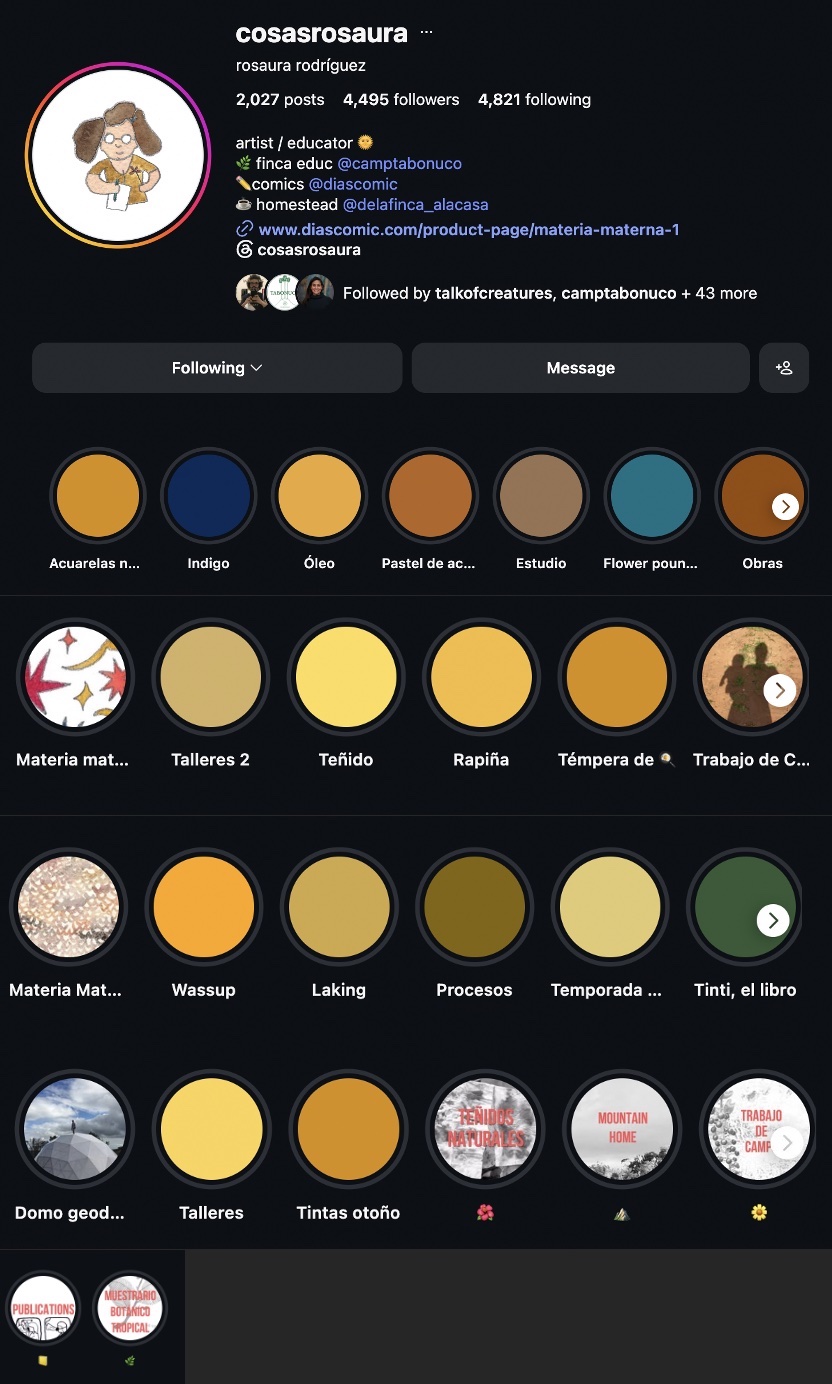
When I asked Rodríguez why she stopped building out her Highlights in May 2026, she mentioned that she had recently considered wiping them altogether because, three years later, she now sees them as "gavetas llenas de cosas random que no uso hace tiempo" (drawers full of random things that I have not used for a while).[23] Wiping sections of one's Instagram account is a traditional signal among artists to mark the upcoming release of new work, so Rodríguez's consideration is in keeping with how to use the platform to indicate career shifts. I would also propose though, that the different categories of archives in her Highlights do remain relevant to her current Posts. First, the two massive catchall Highlights, "Procesos" and "Acuarelas Natu," both usefully demonstrate an arc of how she develops different projects in relation to one another and the consistent points of reference across them; they also underscore the extent to which the different elements of her life--family life and home-making, educational activities, collaborative art projects, and artistic experimentation--are integrated such that they cross over between different Highlights collections. Second, many of the tropes, images, and processes she developed during that period persist in the projects that are now primarily directed to public-facing activities.
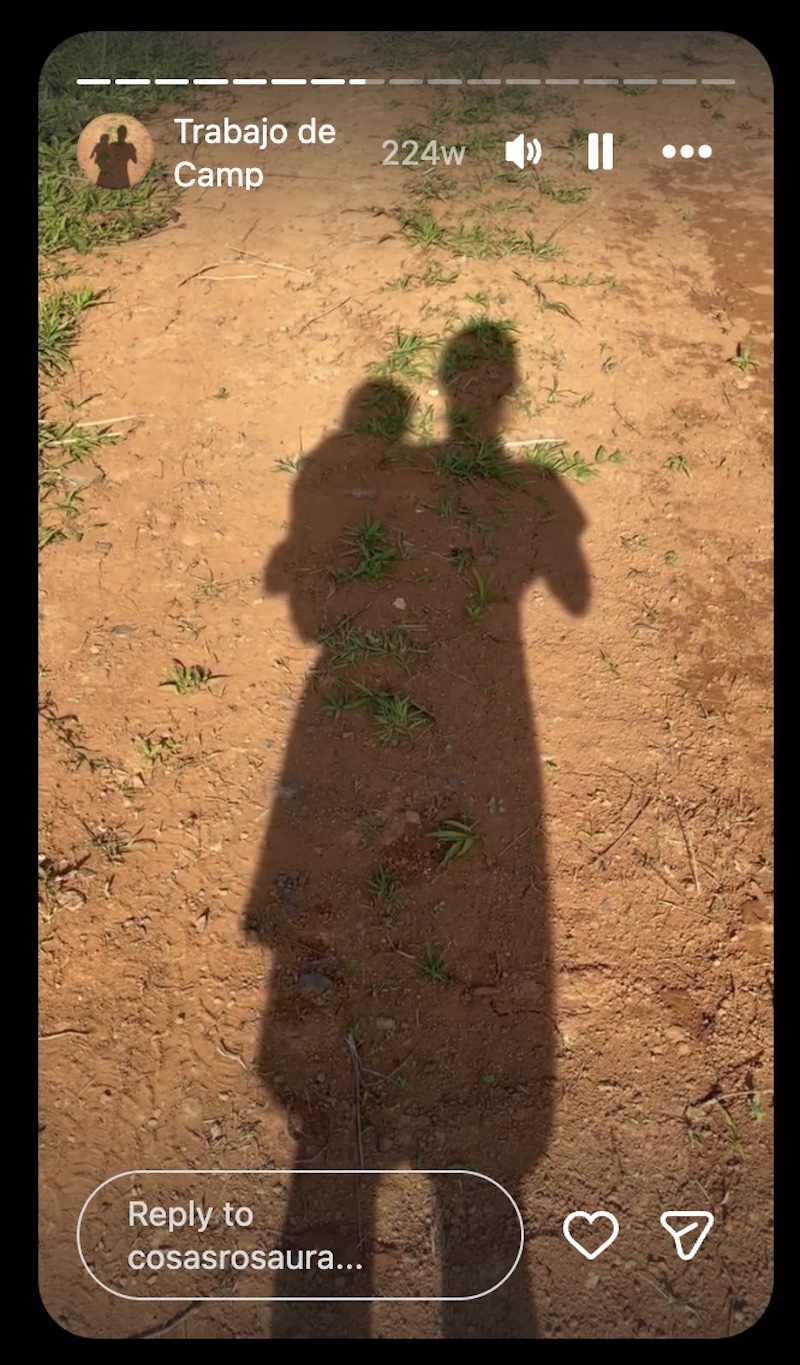
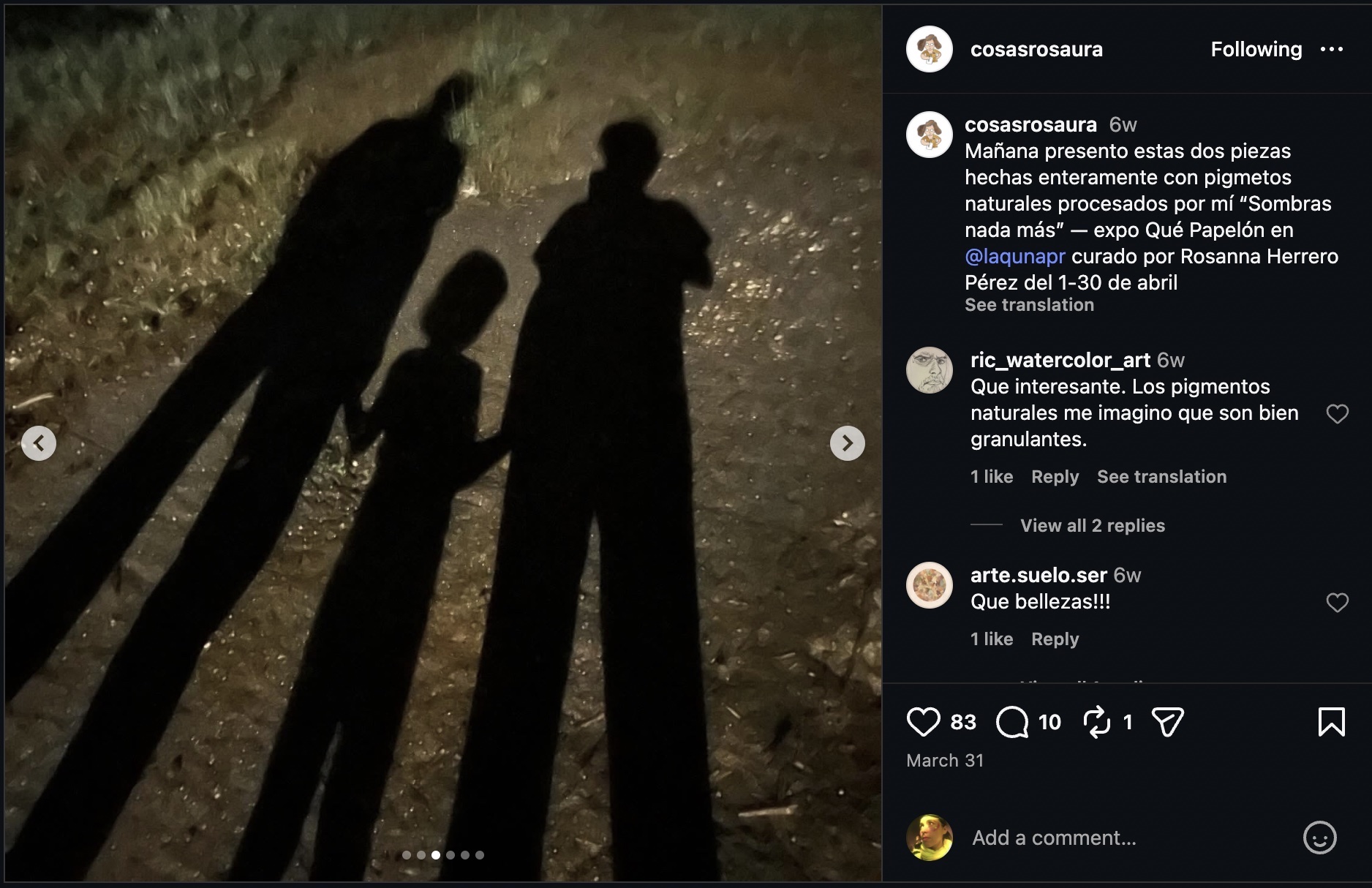
For example, a video Story Rodríguez posted in the "Trabajo de Camp" Highlight, and chosen as the thumbnail for that Highlight collection, is a twelve-second video Rodríguez took of herself walking with her child on her hip, with their shadows' silhouette reflecting on one of the farm's clay dirt paths (see Figure 6). This Story, posted roughly in late January, 2022, uses embodied composition to tie her expansive sense of self with the land where she is raising her child and transforming her artistic démarche. The work in this limited Highlight continues to resonate in recent work as of May 2026, for example, in a six-image carousel Post she posted on March 31, 2026 sharing work selected for a gallery exhibit. This artwork uses pigment she had made, and in the carousel that includes in-process images, the third image is one of her family's shadows onto a clay dirt path (see Figure 7). One of the purposes of Highlights is to link the experimentation of in-process Stories with the Posts that celebrate and publicize finished works, publications, and events. While there is no link embedded in the "Trabajo de Camp" Highlight to this Post, the existence of a similar trope in the Highlight thumbnail connects her 2022 investigations in pigment making to its 2026 iterations as evidence that her earlier work, regardless of its being a different phase of her career, continues to nourish her projects. By having saved some of her Stories' in-process inquiries with the terrain to her Highlights as visual narratives of her experiments in placemaking, Rodríguez locates at the top of her Instagram account an archive of the consistent throughlines driving her artistic commitments as they evolve throughout her career.
These Stories are all examples of how Rodríguez's Instagram art about Tabonuco experiments with digital placemaking. Digital placemaking has two working definitions, both of which are at play in Rodríguez's digital art: one, the sequences of hand movements that cell phone and tablet users perform to move between and navigate within different apps; two, the representation of a physical place on a digital platform which functions as a "digital extension of the physical place [that can] act as a driver for social change and consumer wellbeing."[24] I draw the definition of digital placemaking that takes place within the environment of the app and on the device's screen from Kormelink's and Costera Meijer's research, which argues that the habitual routes users' hands take across the screen functions as a kind of placemaking in itself.[25] Users, they show, learn to "(literally) feel their way through the material object itself and the online environments it provides access to."[26] I draw the definition of digital placemaking that amplifies a physical environment through the device from urban studies scholarship that considers how born-digital genres can contribute to in-person forms of placemaking. Using digital devices and their software programs, including social media, augmented reality, and gaming, digital placemaking "narrates a sense of place into being," as Halegoua and Polson write in arguing that using digital media can, rather than replace physical space with the experience of digital apps, create emotional attachments to place.[27] They particularly emphasize how digital placemaking relies on "embodied composition," where users situate themselves in a particular space and engage their bodies to "communicate with one's embodied experience of space."[28] Reflecting on placemaking in urban sites, Petrovski et al. propose that digital circulations of places "add a new dimension to the space, enabling physical or virtual change of nature and the environment to make it more engaging, attractive or interesting to stakeholders."[29] In this light, the digital demonstration of a place's vibrancy and purpose is a bid for its protection and care.
The contrast between these two definitions lies in their ideological possibilities, between the capacity for digital forms to protectively inscribe the specificity of place, and the ways that platforms explicitly harness users' micro-choreographies of digital placemaking to extend their time on the platform and monetize their attention. The tensions in between these two contrasting uses of digital placemaking are an example of the conflict that underlies any attempt to use commercial media platforms for liberatory interpersonal connection, art work, political organizing, or self expression.[30] To address this tension more broadly, digital literary scholar Claudia Kozak proposes a theory of what she terms "technopoetics": these take a political position towards their technosocial surroundings and, in so doing, they can address the aesthetic and political hegemony created by the very platforms within which the technopoetics work.[31]
En toda arte hay una teoría del hacer, explícita o implícita, o sea su poética. En este caso son tecnopoéticas porque asumen la dimensión técnica y tecnológica y el entorno tecnosocial en el que se inscriben, […] evidencia[n] una toma de posición, una política, en relación con, esa digamos con, ese asumir lo técnico y tecnológico.
In every art there is a theory of its own making, explicit or implicit, that is, of its poetics. In this case, the art works are technopoetics because they take responsibility for the technical and technological dimension in the technosocial surroundings in which they are inscribed […] and they make evident taking a position, a politics, in relation with taking responsibility for the technical and the technological (my translation)
Kozak's argument that born-digital artworks can contribute to decolonizing actions depends on the extent to which they take responsibility for their position within their technosocial surroundings. It is only when they make evident their political position towards those surroundings that Kozak suggests that they can "uncover new sensibilities between bodies and lands" and, in so doing, "interrupt the hegemonic sensoria of the technosocial."[32] I draw on Kozak's theorization of the decolonizing potential of Latin American digital technopoetics in order to stress the fraught and ambivalent nature of working against the extractivist history of the plantation within a commercial media platform that shares the plantation's demand for ceaseless production and homogeneity.
I propose that Rodríguez's Instagram art operates as a technopoetic in Kozak's nuanced sense, not only because the art practices position themselves against the state's attempts at dispossession, but because her aesthetic experiments with the platform's features. Her Instagram art exists within the infinite scroll of a commercial media platform whose modes of capture and cooptation are always evolving. As such, any capacity to interrupt its hegemony, to use Kozak's phrasing, is necessarily limited, and corresponds to the specific limits and affordances of the platform of its periodization. I therefore set the parameters of my analyses following the 2016 OS update to correspond to the fifteen-second limit for video length and the set of maximalist affordances and in-process aesthetics associated with Stories and Highlights. In this combination of limits and affordances, I show how Rodríguez sets forth a political position with respect to the technosocial surroundings of the disaster of coloniality: in contradistinction to the investment in hyperspeed and homogenization shared by the coloniality of disaster and commercial media platforms, Rodríguez's Instagram art creates an ease of pace and specificity of place.
Bug and Brush: The pace of multispecies companionship
Rodríguez positions herself against the state's abandonment in her 2019 comic Temporada, and its forty-four pen-and-ink drawings and watercolors that represent her experience of daily life during this long, destructive recovery.[33] Rodríguez bookends Temporada with two of the most poignant visual tropes of the socially constructed disaster following hurricane María: school buses, and downed electrical poles or streetlights. The comic's last page is a watercolor of an orange school bus splashing through a flooded road as it drives away (see Figure 8).
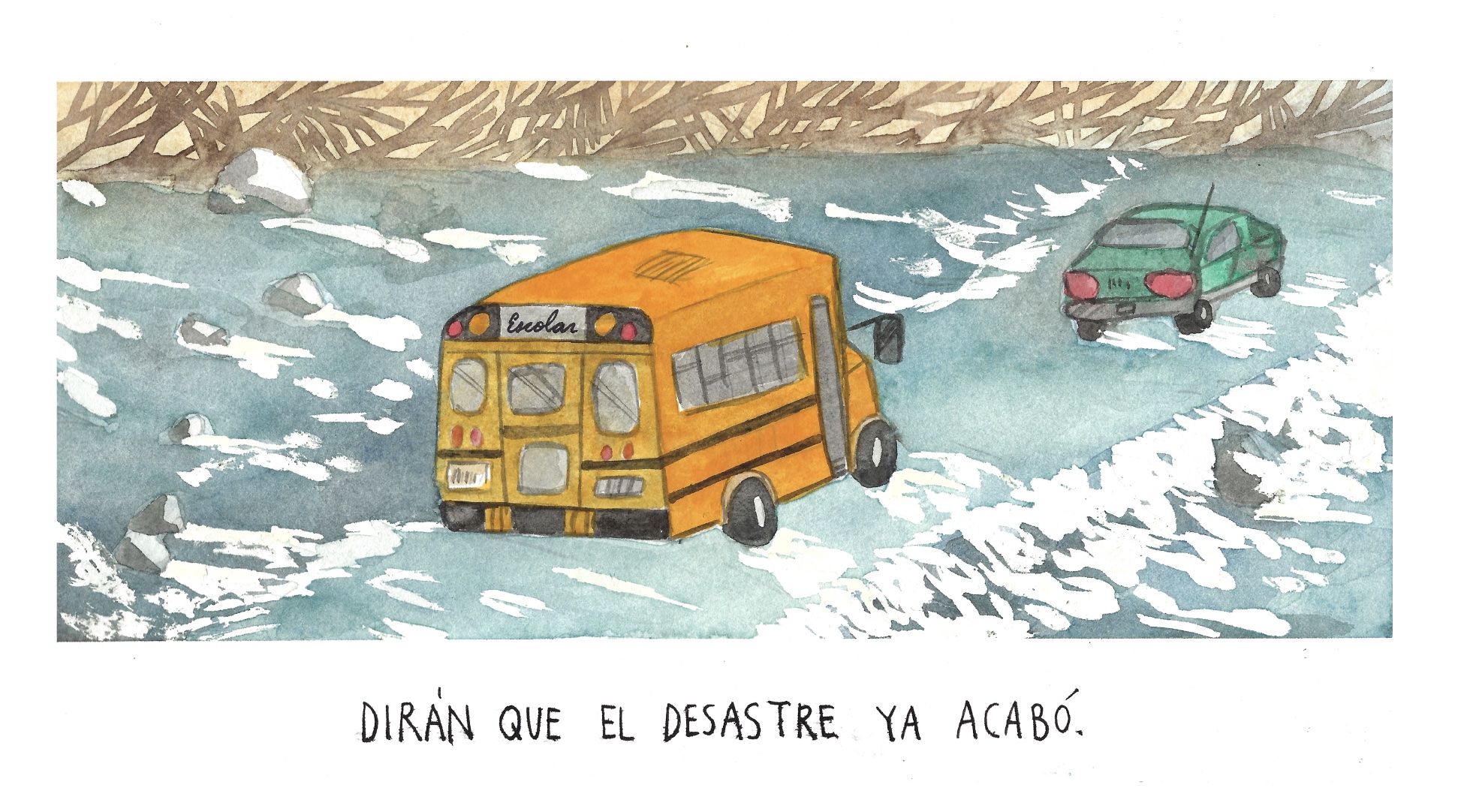
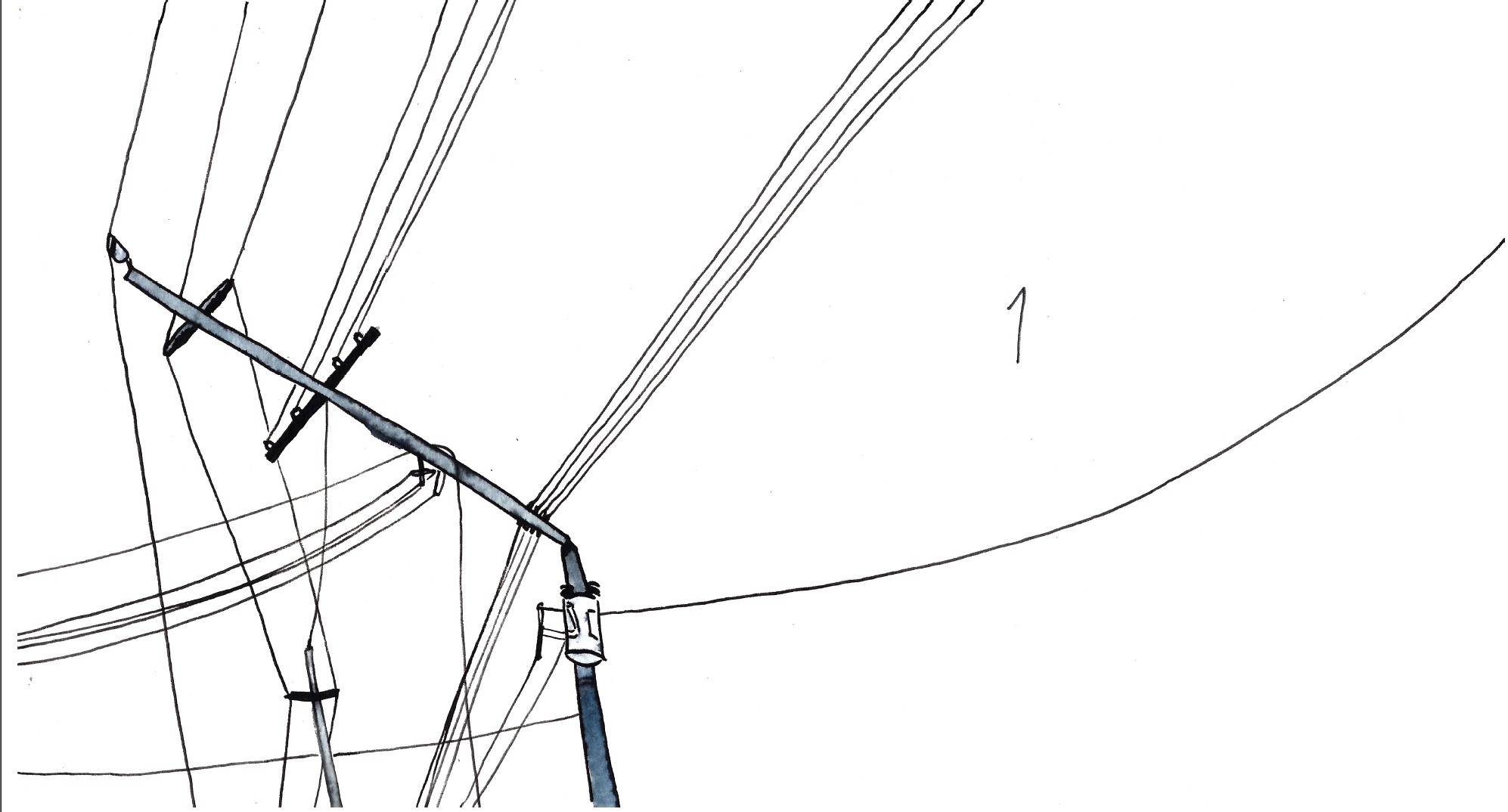
Rodríguez's hand-lettered caption of the last page reads : "Dirán que el desastre ya acabó" ("They'll say that the disaster already ended"). Like the title, which refers to both a period of time and a season that repeats reliably on a yearly basis, the comic's end opens up the ways that the hurricane's recovery as a disaster is not only an event but an unbounded process. As María Fernanda Díaz-Basteris and Daniel Arbino argue, Temporada is also a story of trauma and its grief. Arbino identifies these markers of trauma in the comic's structure of fragmentation, signaled with its different aesthetic styles in each of the three chapters.[34] The comic's structure "recreates a sentiment of disruption" that Puerto Ricans experienced for months after the electrical grid failed (see Figure 9). The first image of Temporada is of one such forlorn electrical pole, thin, slant, and useless, with a busy network of non-functional lines extending to its left, and one limply curving line to the right, desolate in the wide negative space that frames the hand-lettered "1." This image sets Rodríguez's grief work into a collective trauma of living through hurricane recovery as the coloniality of disaster.
In Temporada, multiple temporalities collide: 1) the hyperspeed of dismantling public supports, as exemplified in the decision to close two hundred eighty three rural public schools in favor of centralized charter schools and represented in the trope of the school bus; 2) the unknown, unreliable, and interrupting temporality of an electrical grid repaired in starts, stops, and repeated failures, which anthropologist Greg Beckett has theorized as a permanent intermittence of crisis creating an "ontological insecurity in which people lose autonomy and control over the practices that anchor social life;"[35] and 3) the slow recovery process more broadly, which Rasheedah Phillips theorizes in her concept of "waiting/wading/weighting time" and Black temporalities.[36] Playing off of the shared sonority of the three verbs, Phillips links together the waiting time of deferred emancipation; the weighting time as the way contemporary Black lives are shaped by the "accumulation of [those] historical disparities and systemic inequalities" (277); and within those oppressive experiences, the spiritual temporal transformation of "wading in the water." In the example of Harriet Tubman on the underground railroad, "wading/waiting" in the water is an evasive move that extends one moment of hiding into "infinite possibilities [… and] can be stretched out as long as needed until it is time to change again, to move time along its stream" (270). The comic Temporada evokes the hyperspeed of disaster capitalism, the permanent intermittence of crisis, and the accumulated weight of a just recovery deferred. In the Instagram Stories of her creative process, Rodríguez offers a countering experience of pace that, like wading time, extends time into possibility.
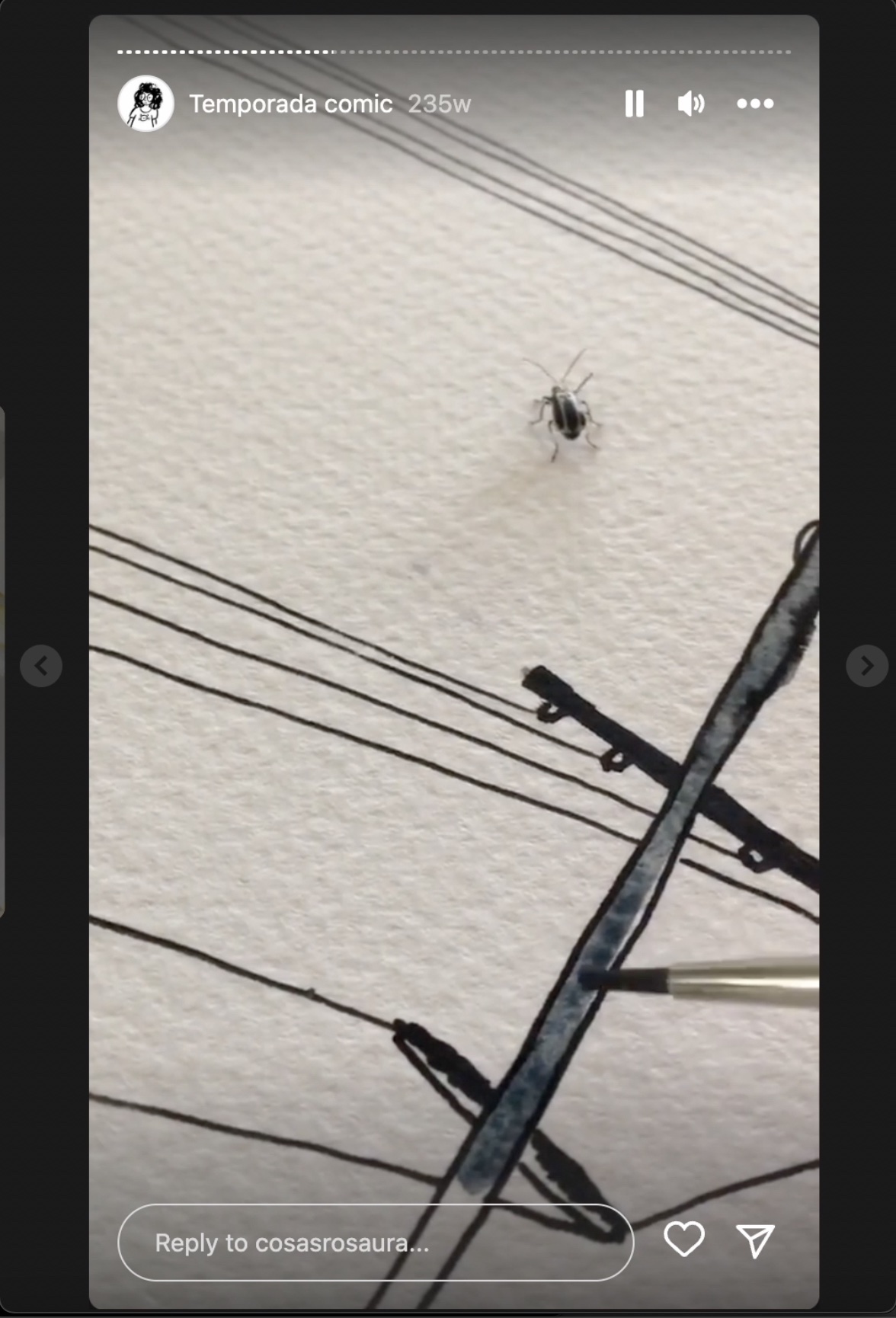
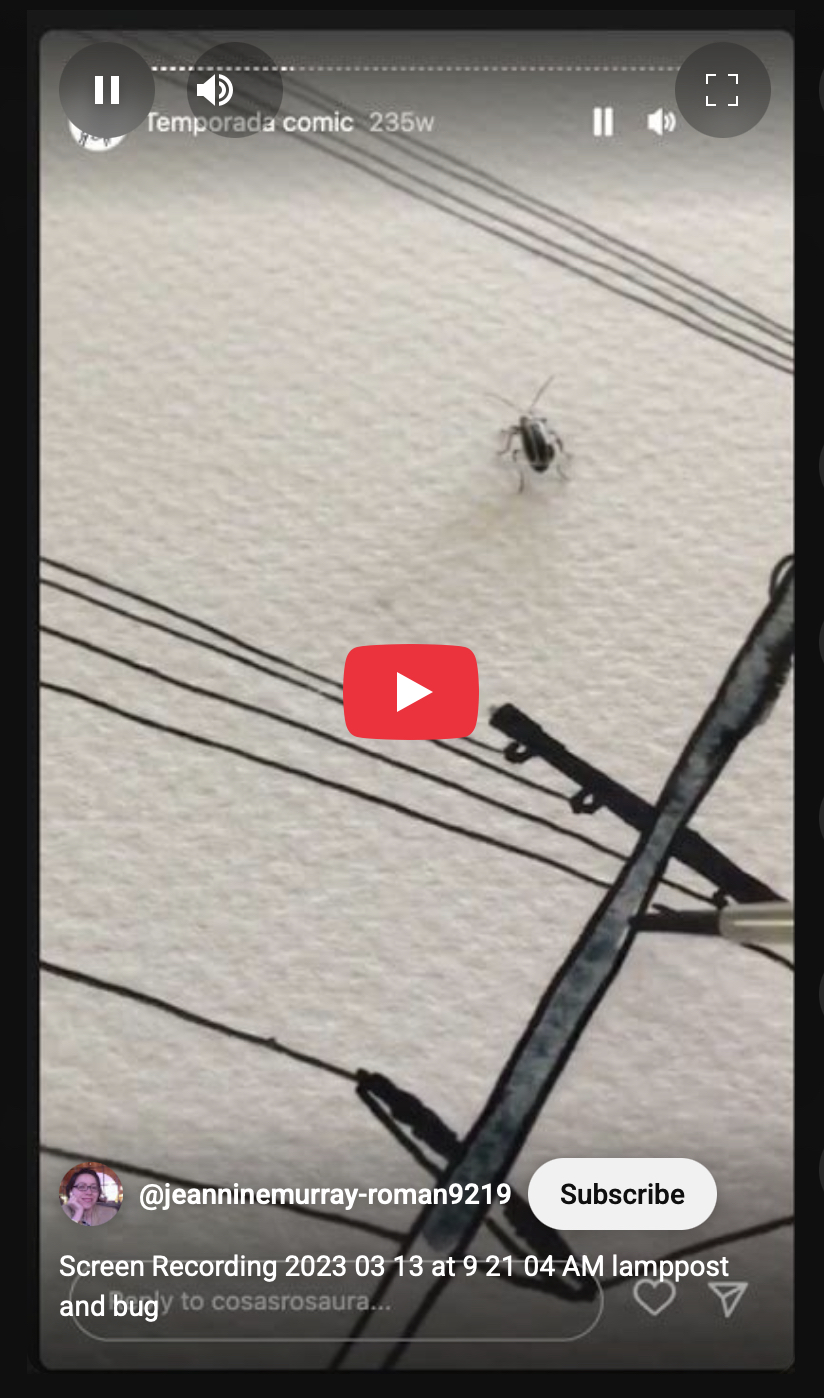
Rodríguez's in-process Stories of creating Temporada evoke waiting/weighting time thematically, even as the process documented in the Stories gestures to an expansive possibility, for example, in a Story shared on September 8, 2018, in which Rodríguez paints Temporada's first page with grey watercolors.[37] She had already drawn the outlines of the pole and the wires still connected to it in crisp black lines, she has the page flipped upside down to watercolor in the grey of the pole with a thin brush. During the fifteen seconds of this video (see Figure 11), a little black bug hangs out next to Rodríguez's brush at work. The bug toggles its delicate antennae such that they bounce gently for five seconds, then it bumps up the back of its rounded, glossy, black shell. Rodríguez's thin brush pools some grey water in between the two lines of the pole and then, with soft, swift strokes, she draws up the water, giving the pole a mottled texture of greys. The bug extends its thin, right front leg tentatively, kicks out a back left leg, and rotates slightly to stalk up the page. Moving at a different speed and variation of gestures than the repetitive movement of Rodríguez's brush next to it, the bug's movements exude playful curiosity. The Story ends with the tip of Rodríguez's brush pressing into the pole's edge, and with the bug standing on the outline of the electrical wires. Together, the micro-choreography of Rodríguez's brush and the bug add energetic moving lines to the useless lines of the unrepaired electrical grid.
In the same vein of analyzing Rodríguez's work as positioned against the hyperspeed of disaster and towards a desire for autonomy, Paul Humphrey proposes that Rodríguez's choice of materials in watercolor and hand-lettering Temporada "indicates a divestment from the technology in daily life" and particularly the ways the state is implementing extractivist and privatizing technology schemes to further dispossess Puerto Ricans from their land.[38] Humphrey's observation points to an unresolvable tension between Rodríguez's placemaking projects that privilege the local and hand-made, and her Instagram art that experiments in digital placemaking. In the case of the bug and brush Story, digitally documenting her hand-made processes produced the raw material that she edited to tell a Story about multispecies companionship. By posting this Story within Instagram's structural demand for hyperspeed, she takes a political position within her technosocial surroundings, to return to Kozak's language. It is because her Stories insist on an unrushable pace and specificity of place in Tabonuco that she can elicit a direct contrast to her technosocial surroundings and contest its values. Rodríguez extends Temporada's critique of how of technology is used to dispossess Puerto Ricans in this ambivalent and compromised engagement with digital placemaking.
Rodríguez edited the Instagram Story to center the bug's movements in the fifteen seconds she had at her disposal for this demonstration of her process. The shot itself was only available because the bug happened to come by when she was already filming at the flatlay. The flatlay genre is a style of photography taken perpendicularly from directly above, and was first popularized on Instagram to share collections of beautifully styled objects on a flat surface. This photography genre then transitioned to one of the genre conventions of maker-demonstration videos on YouTube when, often in the middle of the video, artists, craftspeople, or chefs move from the portrait shot, during which they face the camera to introduce the video, to a bird's-eye view of step-by-step instructions focused on their hands at work with the tools and materials. Rodríguez is at the flatlay. Video records her brushwork from overhead, when the bug by chance wanders into the shot. In doing so, it brings into the Story the element of digital placemaking wherein Rodríguez's use of embodied composition with the bug amplifies the physical environment. The bug's active presence alongside Rodríguez brings Tabonuco and its ethos of “un compromiso con la tierra,” onto her page in a moment of multispecies companionship. The mutual protection of a counter-plantation community, here represented by the bug, supports her creative act of representing collective trauma. The bug's visit and Rodríguez's editing to spotlight its presence transforms the in-process demonstration at the flatlay into a Story about the aleatory companionships that sustain her work.
The bug's endearing companionship offers an ease of pace within the fifteen-second story, a companionship that Rodríguez recalls and archives with the affordances of the Instagram Story Highlight. The Story's short length and presence in the commercial media platform calls forth the parallel between the platform's hyperspeed in parallel with the hyperspeed of the coloniality of disaster, whereas the trope of the electrical pole calls forth the violent interminability of waiting time. But, in between the two, the bug and brush form their own sociality. For a short moment, the bug's unrushed pacing stretches the sensation of time beyond its fifteen seconds of the Instagram Story genre and embeds within the platform the practice of a pace that corresponds to the materials of Rodríguez's artwork and the multispecies community of Tabonuco. In this framing, the repetition of Rodríguez's brushstrokes do not emphasize the neglect that the image they are coloring represents, but are reframed by the bug. Its micro-choreography of stretching out and shaking out every section of its body creates a deliberate pace that counters the hyperspeed of commercial media and disaster alike. Instead, this small being wandering through her work, with its thick, barely-visible lines, brings into attentive focus the small scale of detail.
With Rosas and Coquís : Inquiries inside and outside techosocial surroundings
It is in the attention to the details of Tabonuco that Rodríguez builds a multispecies community that counters the state's abandonment of the central mountain regions. This practice of detailed attention is present throughout her entire work, as the Story of the bug and brush affectionally demonstrates, and she articulates its foundational importance in her long-standing project of making pigments from the mineral and vegetal material in Tabonuco. Through this project, she articulates that politics of attention and puts those politics into practice with Tabonuco's visitors in their art, ecology, and experiential education programming. When I was on a site visit with Rodríguez at Tabonuco in March 2022, she talked with me about making pigment as a practice, and how she positions her creative work within her community. Rodríguez both connected it to the broad framework of coloniality, but also suggested that it is not limited to that framework:
We've been threatened a lot and so it's pretty urgent to create your own resources, your own food. I see that as a theme and as a concern here for people who are farming, for us as well, as craftspeople, in a sense we are also creating resources for ourselves and our community. So I think that concern goes to many things: to create autonomous communities that are self-organized; and to figure out who your neighbors are; what everyone can do; and then do things without having to wait for UNICEF to bring in x or y things […] I love knowing about many things, and knowing how things are made, and how I can make them, and then within that: how can I make it with things that are around me. With pigments, every time I develop something new, or I'm experimenting with something new, then when you look around, you're always looking at the possibilities, like oh! I wonder if that plant—it's like a general search for the mysteries of the materials, what the materials are telling you, what to do with them, how to use them.[39]
"Looking around and looking at the possibilities" is the foundation for creating your own resources towards autonomy. I argue that Rodríguez's pigment project trains you to take notice of your surroundings--plants that are called weeds, land labeled empty, objects that are out of fashion or in disrepair--and to see their possibilities instead of their predetermined disposability. To return to Zambrana's description of the many Puerto Rican communities creating projects of autogestión to distance themselves from the state in order to to build new political possibilities. When Rodríguez pays attention to the mysteries of Tabonuco's materials, she orients the parameters for thinking and redirects the focus from the lack of resources provided by the state to an inquiry into possible resources directly around her.
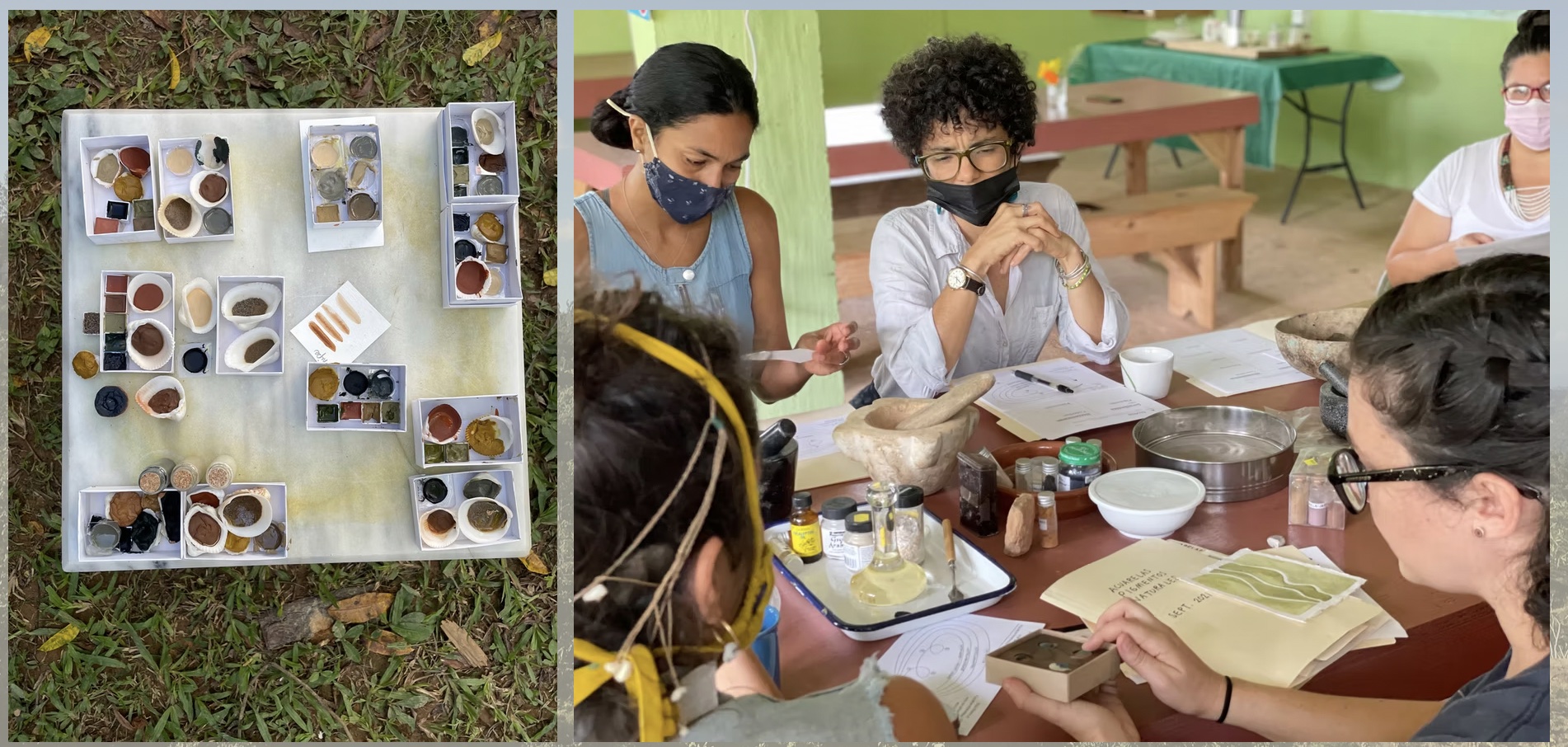
The first stage of the pigment-making process is to consistently walk around the farm to build relationships by noticing over time where different plants are thriving, or to build relationships with colleague-friends living elsewhere by trading plants and materials with them. The second stage is to experiment with what kind of pigment the plant could become. Whether mulling minerals, blending, pounding, and more, the time it takes to experiment with transforming the material cannot be rushed. That extended time of transformation creates a space for conversation. In fact, Rodríguez shared the above ideas with me while she was teaching me to make pigments from rocks and plants we had selected on a walk as part of my site visit to Tabonuco: for two hours in the afternoon, we interspersed her explanations, guidance, questions, and suggestions about making our pigments with many other kinds of connections and conversations. The materials of Tabonuco and the possibilities they offer for creating resources towards a multispecies community therefore oriented our conversation such that, even as we talked about the Caribbean region's comparative experiences of colonial deprivation, the act of engaging a "general search for the mysteries of the materials" placed us in a kind of counter-plantation practice of sourcing resources and possibility from the plants present with us. In all of Rodríguez's artistic experimentation and in the public-facing workshops she creates, working with Tabonuco's materials and participating in Tabonuco's multispecies community guides the conversations for imagining projects towards an autonomous Puerto Rico.
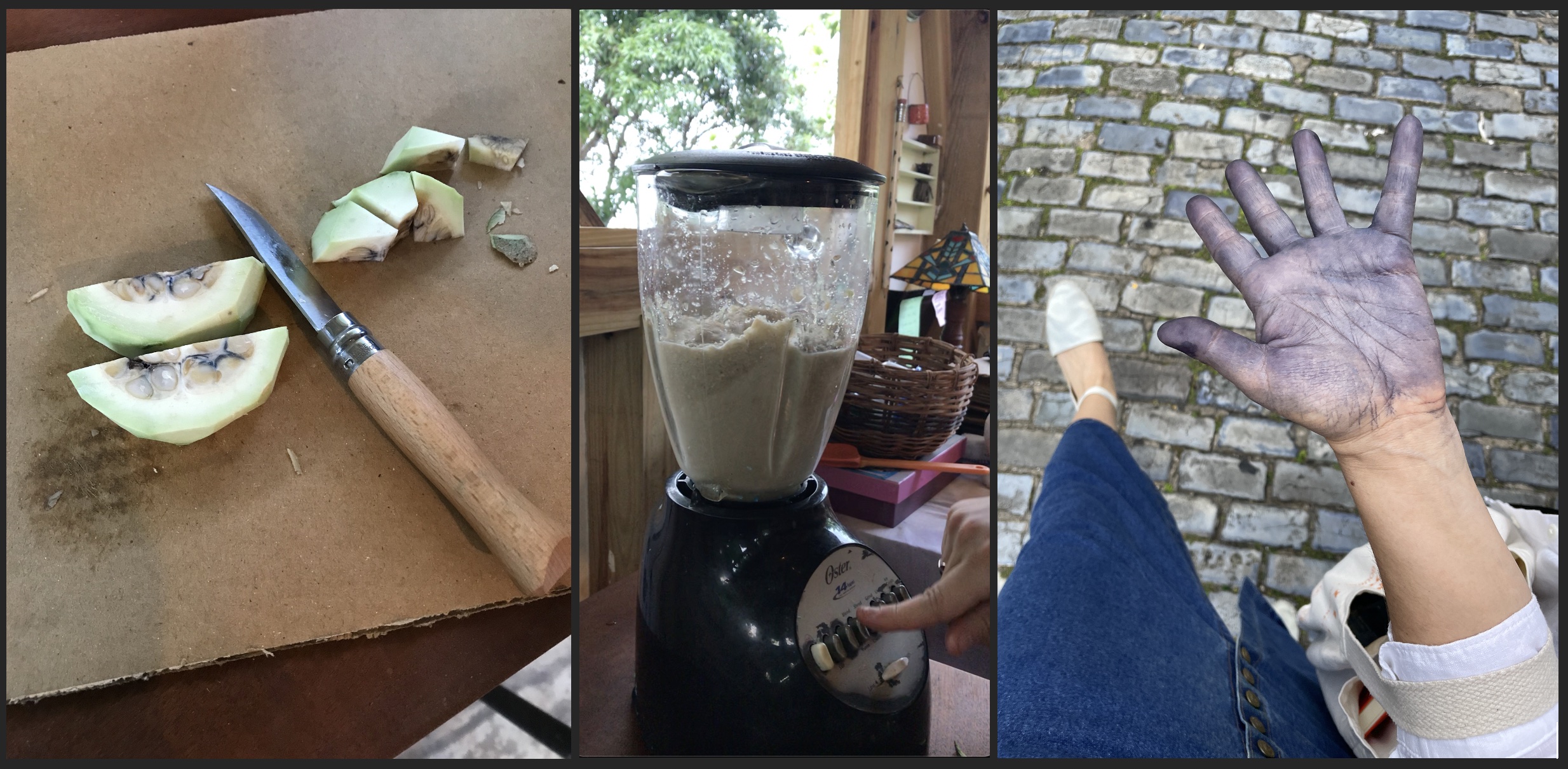
Between the focus on noticing all materials as potential resources, and how those materials guide your physical actions and thoughts while working with them, the politics of attention in Rodríguez's pigment-making project of "looking around and looking at the possibilities" becomes a resource in and of itself. In her pigment-making Stories, Rodríguez uses embodied composition to frame and hold that attention. By placing her body in the shot\— whether her shadow against the ground, her hands pointing to a plant, or her zooming in, or changing the camera angles — she points viewers to what she is also noticing about the process. One sequence of five video Stories, posted together on November 10, 2018 and subsequently saved to the "Procesos" Highlight, shows users how she looks at the possibilities of one bright pink flower: a rosa criolla.
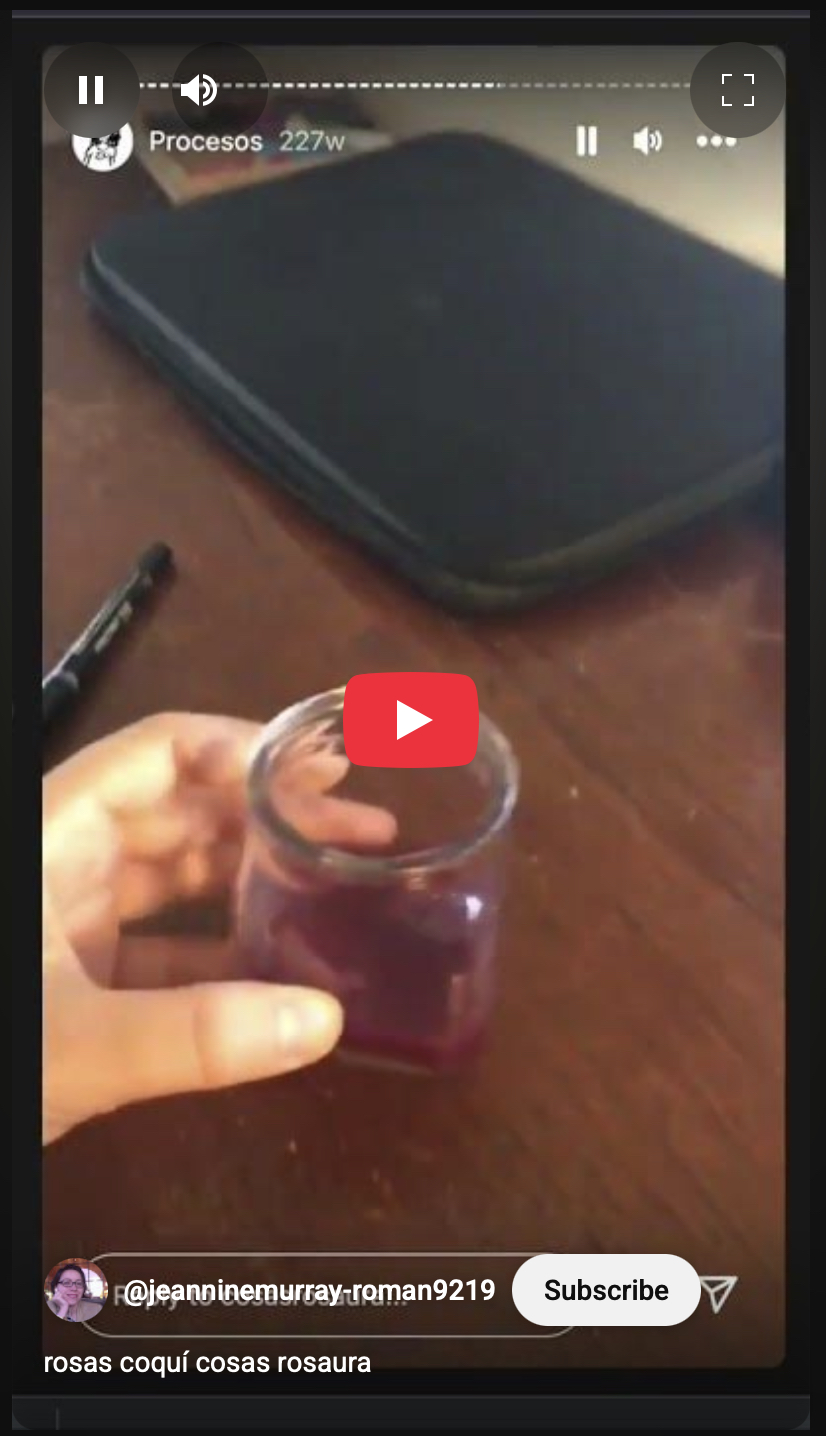
The Stories alternate between video footage shot from above in the flatlay genre, and vertically-oriented videos taken one-handed with her phone within Instagram itself. From two seconds to fifteen, each video is longer than the previous one and moves between different qualities of light, times of day, textures, and soundscapes. The sequence of Stories consist of: 1) the rosa criolla bush swaying against a foggy hillside, 2) its petals in a small glass bowl, 3) a pot on the stove with the petals bobbing to the flow of the roiling water, 4) its purply-maroon ink in a small square glass pot that Rodríguez holds up to the light and slowly swirls, and 5) at night, Rodríguez at the flatlay painting a swatch of the ink it has offered.
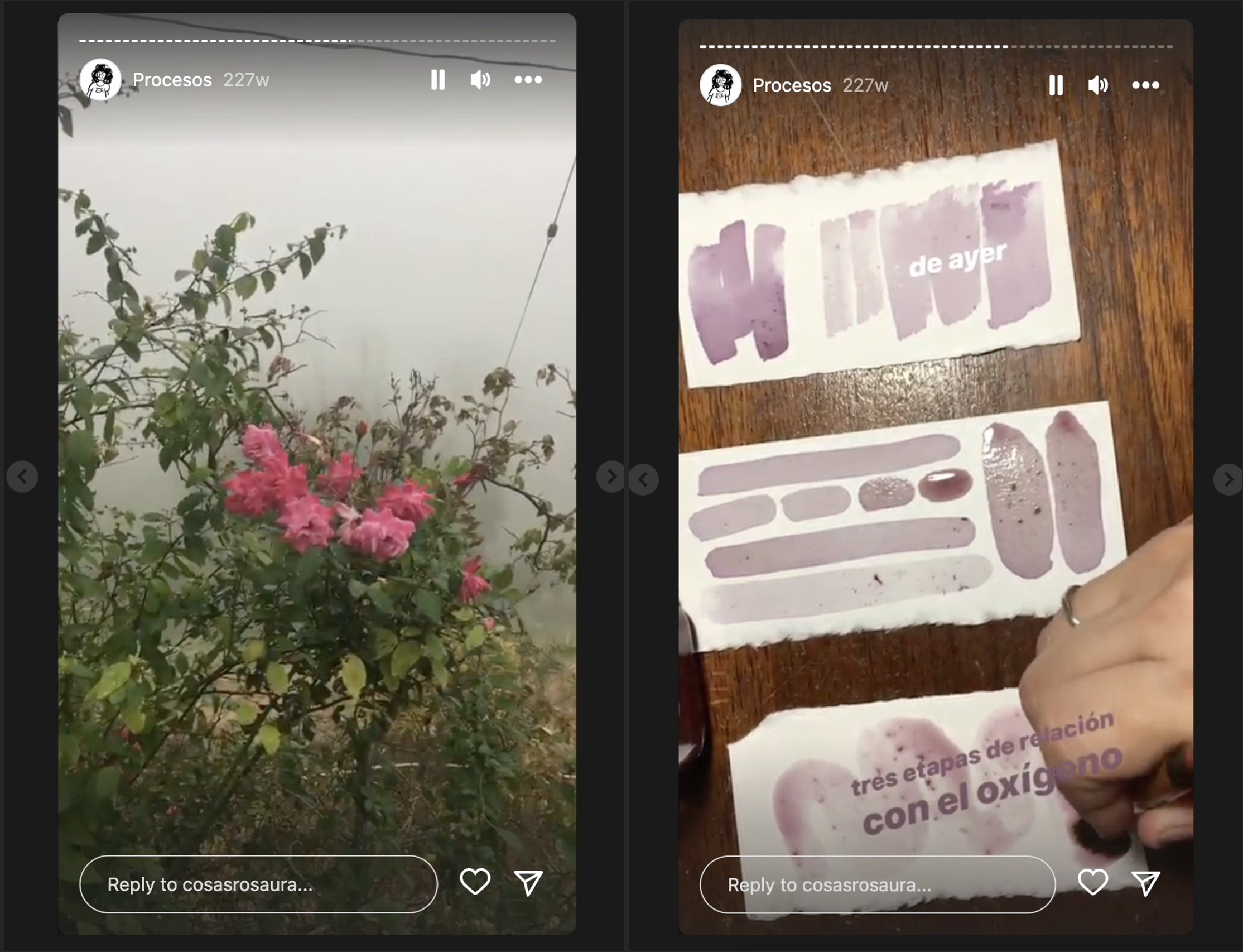
This last Story is filmed at the flatlay of her wooden work table (see Figure 14). The caption, at the bottom of the frame, in italics and color-matched to the purply ink, reads "tres etapas de relación con el oxígeno" (three stages of relation with oxygen) to emphasize the extended timeframe of inquiry. Two doodles on the other swatches read "de hace tres horas" (from three hours ago), which floats over the middle piece for the first half of the video, and the phrase "de ayer" (from yesterday) appears over the top piece for the last six seconds. The earliest swatch is slightly more pink than the more recent stripes of ink which have a greyish-lavender hue. After this Story's filming, each cardstock will have been further exposed to oxygen, and the color documented in this Story will have faded differently from what appears on screen here. There is no color-fastness to the ink, only a continuing relation with this specific bush and this group of flowers whose unpredictable change will continue to set the pace for creation and for her inquiries.
Each of the five Stories records one phase of the rosa criolla's transformation and demonstrates Rodríguez's relationship of shared inquiry with the flower. But it is not until the fourth Story in the sequence that Rodríguez's body shares the frame with the flower, now transformed into ink in a square glass vessel (00:12-00:19 in the link in Figure 13). Filming on her phone with her right hand, her left hand holds the vessel on the desk and changes its angle as the camera lens is pointed directly down into the vessel. She then lifts both ink and phone up to the light, holding the ink at the camera's eye level to show the viewer what to look at as she tilts and swirls the ink. Perceived through the sun flare as the light crosses the camera lens, the color's shades change minutely as she combines her embodied inquiry with digital composition to mediate the quality of light. Here, Rodríguez uses the Story's affordances for digital placemaking that enhances viewers' appreciation of the space by layering digital dimensions onto the space’s plant life. Her use of sound across all five Stories brings to bear a second definition of digital placemaking, where users' hands interacting with the phone turns the screen into a place in and of itself with the potential to supplant the physical location. This combination of two types of digital placemaking occurring simultaneously is where Rodríguez's Stories raise the question of the technosocial surroundings of her Instagram art, and the political position she takes within it.
If the Story of Rodríguez holding the ink in the glass vessel up to the sunlight is evidently filmed with her right hand and viewed through the phone's smooth screen as she films, the auditory sensorium in the five-Story sequence performs the two types of digital placemaking: 1) the first video starts with the dominant sound bird whistles, insect chirps, and low pulses of wind gusts; 2) as Rodríguez moves inside, the sounds of the outside follow her as the insect chirps are even louder; 3) the dominant sound is of loudly boiling water; 4) the sound of family life--faint music, clattering objects--accompanies Rodríguez showing off the bottle of ink; 5) the last video features fifteen seconds of a mechanical buzz, the thick and constant sound of the unmistakable coquís' night-time two-toned call. Against that backdrop, Rodríguez exhales, and the sequence ends. But in between each video, there is a disproportionately loud thump, the characteristic sound of the user's thumb pressing and holding the record button on the phone screen to start the video. It is possible to edit out sounds within the phone's camera app, such that, had she wanted to, Rodríguez easily could have removed them before uploading the videos to Instagram as Stories. Instead, because Rodríguez retains the interruption every few seconds to mark that her site of creation is within the technosocial surroundings of Instagram, just as the coquís function as sonic geotags marking her site of creation within Tabonuco, this sequence of Stories records both the affordances and limits of digital placemaking itself.
As with so many Puerto Rican projects of autogestión, Rodríguez's pigment-making project and its politics of attention are oriented in two directions: in opposition to the state's violence, and also, removing themselves from the parameters for debate set by the state altogether. This doubled approach parallels the unresolvable tensions between artistic experimentation with the platform's affordances, and the limits of working within technosocial surroundings that promote homogenization and hyperspeed. Rodríguez surfaces that ambivalence in her Instagram art such that she recognizes and calls attention to the platform's potential for cooptation, even as she stretches its potential towards what working with Tabonuco's multispecies community sustains: an ease of pace and specificity of place.
From the link to "our history" on Tabonuco's website. https://www.camptabonuco.com/equipo-staff. (my translation) ↩︎
Naomi Klein, "The Rise of Disaster Capitalism," The Nation, May 2, 2002, 10. Klein's Marxist critics rightly point out that, economically, disaster capitalism does not differ from neoliberalism, given the centrality of the exploitation of crises to David Harvey's elaboration of the concept (Schuller and Maldonado, 63); and that, in terms of the hyperspeed Klein accords to disaster capitalism specifically, the density of capitalism's temporality "requires production under constant time compression and crises" (John Preston, Artificial Intelligence in the Capitalist University: Academic Labour, Commodification, and Value (Routledge, 2021): 114). ↩︎
The need for urgency to safekeep populations affected by a natural disaster provides the occasion for institutions like the World Bank and the IMF to require nations in crisis to implement neoliberal policies in exchange for any loans or grants. These include debt financing, transferring state-managed public goods to private transnational entities, and new iterations of accumulation and wealth extraction (see Mark Schuller and Julie Maldonado, "Disaster Capitalism," Annals of Anthropological Practice 40, no. 1 (2016): 62, https://doi.org/10.1111/napa.12088 and Rosemary-Claire Collard, "Disaster Capitalism and the Quick, Quick, Slow Unravelling of Animal Life," Antipode 50, no. 4 (2018): 917, https://doi.org/10.1111/anti.12389). ↩︎
Yarimar Bonilla, "The coloniality of disaster: Race, empire, and the temporal logics of emergency in Puerto Rico, USA," Political Geography 78 (2020): 1, https://doi.org/10.1016/j.polgeo.2020.102181. ↩︎
Héctor Hoyos. "Aftershock: Naomi Klein and the Southern Cone," Third Text 26, No. 2 (March 2012): 220-221, https://doi.org/10.1080/09528822.2012.663969. ↩︎
García López draws on the example of the 1990 Land Use Plan, intended to replace communities with military bases, industrial parks, and mines and make the land uninhabitable. Activists protested this plan by calling it a plan for a "Puerto Rico without Puerto Ricans," a phrase that García López links to the Puerto Rican state's post-hurricane policies. (Gustavo A. García López, "Environmental Corruption and the Colonial Growth Machine in Puerto Rico," Centro Journal 34, No. 2 (Summer 2022): 182-3). ↩︎
Published on July 13, 2019 by Centro de Periodismo Investigativo, this chat thread revealed the close connections between their misogynist and homophobic conversation about how to manage Roselló's approval ratings after Hurricane María, their indifference to the general population's suffering, and their economic stimulus policy proposals. This leaked chat triggered a national revolt in the summer 2019 that resulted in Roselló's resignation. Luis J. Valentín Ortiz and Carla Minet, "Las 889 páginas de Telegram entre Rosselló Nevares y sus allegados," Centro de Periodismo Investigativo, July 13, 2019, https://periodismoinvestigativo.com/2019/07/las-889-paginas-de-telegram-entre-rossello-nevares-y-sus-allegados/. Among the range of excellent work on the summer 2019 protests, see Society and Space's forum on "Decolonial Geographies" edited by Joaquín Villaneuva and Marisol LeBrón, (https://www.societyandspace.org/forums/the-decolonial-geographies-of-puerto-ricos-2019-summer-protests-a-forum), and the series reVolucionA published by Puerto Rico-based publishers Editora Educación Emergente, including José M. Atiles Osoria, Profanaciones del Verano de 2019: Corrupción, Frente comunes y justicia decolonial (Editora Educación Emergente, 2020) and Christopher Powers Guimond, 4645 (Editora Educación Emergente, 2020) ↩︎
Jean Casimir, "The Sovereign People of Haiti during the Eighteenth and Nineteenth Centuries," in The Haitian Declaration of Independence : Creation, Context, and Legacy , ed. Julia Gaffield (University of Virginia Press, 2016), 190-91. ↩︎
On community actions like "asembleas," see Rocio Zambrana, "Checklists: On Puerto Rico’s SoVerano," Critical Times 3, no. 2 (Aug. 2020): 277–299, https://doi.org/10.1215/26410478-8517743; and Karieann Soto Vega, "Puerto Rico Weathers the Storm: *Autogestión *as a Coalitional Counter-Praxis of Survival," *feral feminisms *9 (2019): 39-55. ↩︎
See Adriana Maria Garriga-López, "Debt, Crisis, and Resurgence in Puerto Rico," small axe 62 (July 2020): 122-132, https://doi.org/ 10.1215/07990537-8604538; and Hilda Lloréns, Making Livable Worlds: Afro-Puerto Rican Women Building Environmental Justice (University of Washington Press, 2021). ↩︎
Rosaura Rodríguez, "Trabajo de campo," cosasrosaura.com, 2019, https://www.cosasrosaura.com/trabajo-de-campo. In 2018, Rodríguez received a grant from the National Association of Latino Arts and Culture to support this project, named "trabajo de campo" ("field work"). See https://www.nalac.org/members/rosaura-rodriguez/. ↩︎
Facebook, which by that time owned Instagram, and Twitter made this shift at the same time, as an example of what José Van Dijck has shown in Culture of Connectivity, different platforms began to shift from each having their own particular distinctions--like Twitter for micro-blogs, Instagram for images, Snapchat for ephemera--to imitating the affordances of other platforms in order to retain users within their platform's own vertical integration (José Van Dijck, The Culture of Connectivity: A Critical History of Social Media (Oxford University Press, 2013), 163-64). ↩︎
This constriction has only intensified over time, as Internet researcher Ryan Chayka observes in a July 2025 piece, "The design of social media has discouraged casual posting, with metrics that make users feel inadequate for not getting enough attention, and with algorithmic feeds that prioritize popular accounts that post constantly--not mundane moments, but punditry, provocation, and self-promotion. 'Nobody is seeing their friends' posts in the feed, so it doesn't even count as life updates anymore,' Benton Williams, a student at the University of Georgia, told me. Kele Fleming, an independent musician, summarized her frustration: 'The algo is never in our favor.' Our feeds used to surface undiscovered pearls of content; now only prominent accounts are rewarded." (Ryan Chayka, "Are you experiencing posting ennui?," New Yorker, July 9, 2025, https://www.newyorker.com/culture/infinite-scroll/are-you-experiencing-posting-ennui. ↩︎
Tolentino's ironic refrain in "The Age of Instagram Face," (New Yorker, December 12, 2019, https://www.newyorker.com/culture/decade-in-review/the-age-of-instagram-face) echoes Safiya Noble's work by demonstrating how the algorithmic influence of editing features like FaceTune and CelebFace reinforce already-extant racist and classist aesthetic standards. ↩︎
Safiya Noble, Algorithms of Oppression: How Search Engines Reinforce Racism (NYU Press, 2018), 37. ↩︎
Video Stories are now longer to allow Tik-Tok reels to be cross-posted. ↩︎
See Rebekka Kreling et al., "Feeling Authentic on Social Media: Subjective Authenticity Across Instagram Stories and Posts," Social Media + Society 8, no. 1 (Jan-Mar 2022): 4, https://doi.org/10.1177/20563051221086235; Bo Li et al., "Tell Me a Story: Exploring Elite Female Athletes' Self-Presentation via an Analysis of Instagram Stories," Journal of Interactive Advertising, 21, no. 2, (2021): 115, https://doi.org/10.1080/15252019.2020.1837038. ↩︎
Josh Constine, "Instagram Stories," TechCrunch, August 2, 2016, https://techcrunch.com/2016/08/02/instagram-stories. ↩︎
Elena Villaespesa and Sara Wowkowych, "Ephemeral Storytelling With Social Media: Snapchat and Instagram Stories at the Brooklyn Museum," Social Media + Society 6, no. 1 (2020): 2, https://doi.org/10.1177/2056305119898776. ↩︎
Tama Leaver et al., Instagram: Visual Social Media Cultures (Polity Press, 2020): 60-63. ↩︎
Personal communication with the author, May 1, 2026. ↩︎
Personal communication with the author, May 1, 2026. ↩︎
Personal communication with the author, May 1, 2026. ↩︎
Maria J. Fernandez-Osso Fuentes et al., "Conceptualizing digital placemaking in nature for wellbeing," Technological Forecasting & Social Change 204 (2024): 1, https://doi.org/10.1016/j.techfore.2024.123440. ↩︎
Tim Groot Kormelink and Irene Costera Meijer, "Material and sensory dimensions of everyday news use," Media, Culture & Society 41, no. 5 (2019): 648, https://doi.org/10.1177/0163443718810910. ↩︎
Kormelink, 639. ↩︎
Germaine Halegoua and Erika Polson, "Exploring 'digital placemaking,'" Convergence: The International Journal of Research into New Media Technologies 27, no. 3 (2021): 574, https://doi.org/10.1177/13548565211014828. ↩︎
Rodney Jones and Christoph A. Hafner, Understanding Digital Literacies: A Practical Introduction (Taylor & Francis Group, 2021), 122. ↩︎
Aleksandar Petrovski et al., "Digital tools and digital pedagogy for placemaking," Archnet-IJAR: International Journal of Architectural Research 19, no. 3 (2025): 547, https://doi.org/10.1108/ARCH-01-2024-0036. ↩︎
I use the term "commercial media platform" in part inspired by Jenny Odell's insistence on the fact that social media platforms are a commercial enterprise intent on capturing, manipulating, and monetizing users' attentions. How to Do Nothing: Resisting the Attention Economy (Black Inc., 2019). ↩︎
Claudia Kozak, "Tecnopoéticas latinoamericanas digitales," lecture streamed live, November 10, 2022, by Toda la Teoría del Universo, YouTube, 1:26:00, https://www.youtube.com/watch?v=pDg5X0YJ2l4. ↩︎
"Obviamente entiendo que las prácticas tecnopoéticas no podrían ser agentes directos de la devolución de la tierra. Sin embargo, como en las mejores opciones de las artes, estas prácticas creo que siembran caminos, despliegan nueva sensibilidades, entre cuerpos territorios. Se trata de interrupciones del sensorium tecnológico hegemónico que habitan los lenguajes, todos los lenguajes, desde la lengua natural al código informático, pasando por otros lenguajes." [I obviously acknowledge that technopoetic practices could not be direct agents of land back. Nevertheless, as with the best of all the arts, I think that these practices sow pathways, uncover new sensibilities between bodies and territories. It has to do with interruptions to the hegemonic technological sensorium that dwell in languages, from natural languages to computing languages, passing through other languages.] Kozak, "Tecnopoéticas," 38:54 (my translation). ↩︎
Rosaura Rodríguez, Temporada (pub. by author, 2019). All my thanks to Luis Nestor at La Librería la Esquinita in its Santurce iteration in 2019, who talked with me while I was browsing and when I mentioned that I was working on a post-disaster Facebook thread, put Temporada in my hands, saying that if there was one thing I needed to buy, it was Rodríguez's comic. ↩︎
Daniel Arbino, "The Gifts of the Hurricane: Reimagining Post-María Puerto Rico through Comics," eTropic 20, no. 2 (2021): 172, https://doi.org/10.25120/etropic.20.2.2021.3815. María Fernanda Díaz-Basteris, "Puerto Rican Graphic Narratives and the Colonial Disaster," Latinx Spaces (2021). ↩︎
Greg Beckett, There is No More Haiti: Between Life and Death in Port-au-Prince (UC Berkeley Press, 2020), 170. Writing about Port-au-Prince after the 2011 earthquake, blakawout is "both a disruption in routine and a disruption that has become routine. ↩︎
Rasheedah Phillips, Dismantling the Master's Clock: On Race, Space, and Time (AK Press, 2025). ↩︎
Rodríguez archived this Story in the "Temporada" Highlight. It is the twenty-fifth Story out of seventy-six within the Highlight. Because unlike Posts, individual Stories do not have unique URLs to link back to, I have taken screen recordings and shared them for viewing for the purposes of this article through an unlisted Youtube link. ↩︎
Paul Humphrey, "Framing a Decolonial Future: Hurricane María in Puerto Rican Comics," Latin American Literary Review 48, no 96 (Summer 2021): 66.
Daniel Arbino, "The Gifts of the Hurricane: Reimagining Post-María Puerto Rico through Comics," eTropic 20, no. 2 (2021): 172, https://doi.org/10.25120/etropic.20.2.2021.3815. ↩︎
Rosaura Rodríguez, in discussion with the author, March 2022. ↩︎
Biographies des auteurs
Jeannine Murray-Román
Jeannine Murray-Román is an independent scholar whose research starts in the Caribbean region and is grounded in comparative, performance, and digital methodologies. Since publishing their first monograph, Performance and Personhood in Caribbean Literature (University of Virginia Press, 2016), their research has ranged from Taylor Mac’s manifestos, Roque Salas Rivera’s debt and poiesis, and Fanon’s medical writing. Their current book project, “Changing Imaginaries,” focuses on Caribbean artists’ hand-made cognitive experiments in transforming their political imaginaries.