The Criadas Project: Afro-Puerto Rican Women and Girls in Data and Archival Silhouettes
archipelagos presents The Criadas Project
The Criadas Project is an inspiring new entry in our growing body of digital scholarship for and about the Caribbean. The project centers the lives of Afro-Puerto Rican women and girls, particularly those historically referred to as “criadas,” who worked as domestic laborers in Puerto Rico. Drawing from the Fernando Picó Papers, in which we find a collection of biographical sketches, the project constructs a searchable database that not only preserves but reimagines these women’s stories. By employing speculative historical methods and integrating silhouettes as visual and theoretical interventions, the Criadas Project seeks to illuminate lives often obscured in historical records. This work is a testament to the power of Black feminist ethics and digital scholarship to challenge colonial narratives and create spaces for marginalized voices. Through its innovative approach, the project invites educators, researchers, and the public to engage with Puerto Rico’s complex histories of race, gender, and labor.
From the Criadas Project
The Criadas Project Mission: Taller Entre Aguas and the Diaspora Solidarities Lab
The Criadas Project is a part of Taller Entre Aguas (TEA), a lab and collective anchored in a Black Feminist ethic of care that nurtures data and discourses surrounding Afro-Puerto Rican memory. The Criadas Project, in particular, zooms in on Afro-Puerto Rican women and girls, sifting through what is ruptured in biographical scraps left in the archive and trying to center their lives and stories, what they are and who they could have been. Our work was propelled by the question, what did life look like during pre- and post-emancipation for Black Puerto Rican girls? We aimed to create a searchable database site that contributed to and expanded on the limited scholarship dealing with young Black life in Puerto Rico, and across a wider set of Caribbean discourses that center on the legacies of slavery, how it seeps into our everyday lives and how it materializes within contemporary Puerto Ricans' crafting of presents and futures.
Taller Entre Aguas was a part of the Diaspora Solidarities Lab and LifexCode research networks, and received support from the Caribbean Digital Scholarship Collective microgrant program.As a result, we were fortunate enough to be apart of a larger ecosystem and community that provided resources and discourses about and for Caribbean and Black Digital Humanities projects. It is because of this network that The Criadas Project was able to meet its goal.
The Departure and Intention: Project Becomings
The focus on criadas, or Black women and girls who were domestic workers for no to low wages, came from noticing how the histories of Afro-Puerto Rican women within the Fernando Picó papers were in the background. Fernando Picó was a renowned historian of Puerto Rico, his thorough historiographies of Puerto Rico and its municipalities and painstaking archival research methods are evident in the ways his work continues to speak to and enliven scholars of Puerto Rican history. His breadth of work, as well as the widened scope of surveying Puerto Rico through the governmental and periodical documents in the archipelago's archive are remarkable. I received the Picó papers in 2020 from my undergraduate research mentor, Francisco Scarano. I emailed Scarano, who is Professor Emeritus in the Department of History at the University of Wisconsin-Madison, about his knowledge about possible digital collections of Puerto Rico's archives because the Covid-19 pandemic cut my dissertation research short before I was able to go to the archipelago's archivos. The Picó Papers is a PDF of diskettes Francisco Scarano had received earlier in his career from Fernando Picó and then sent to me.
The Picó Papers is over 1000 pages of biographical sketches that Picó utilized in his seminal historiographies on Puerto Rico. Picó's research notes included census records, police records, church records, and newspaper articles that tethered women and children to men. My research uses bomba, interviews, archival material to construct emotional histories of Afro-Puerto Rican women. I was taken aback by how the data, as it was presented, defined women and girls by their relationships to their fathers, husbands, and even employers. What was apparent in initial overviews and remained consistent, was that Black women and girls within the Picó Papers were in close proximity to domestic work and an overwhelming amount of them were tied to the term, "criada."
Criada holds multiple definitions in current contexts; initially it is a fixed age-race-gender-and-labor category assigned to young Black girls who were given room and board from families as domestic laborers. Within the context of the Picó Papers, criada might refer to this normative legacy of slavery or to domestic laborers, as criada is now a synonym for women who clean houses, wash clothes, and assist around the house. These definitional slippages beckon us to realize how time and colonialism create various contexts that coalesce in archival material. Puerto Rican historian Solsiree del Moral stated in "Una niña humilde y de color," "the question for historians of Afro-Caribbean childhood studies, therefore, is not, 'where are the sources?' but rather, 'how can we cull existing sources to document and write the history of this enormous population [that] did not write or speak for itself and was often ignored by others?'" The Criadas Project decided to focus on these women and represent them in the data that had left them somewhat obscured. We aimed to re-configure an alternative archive, a digital and searchable database that could give Afro-Puerto Rico women and girls free-standing real estate that represents their individual lives.
In order to do so The Criadas team had to re-aggregate the data, and make it available on a web interface. The majority of our research team's time and efforts were spent creating and cleaning our base tables. The web interface was designed and implemented in collaboration with Performant Software. To facilitate this collaboration, and overall project management, we worked in Notion, where we would be able to export our spreadsheet as a .csv.
Colonial agents aggregated and collected much of the historical source material we rely on for historical research. They did so they could better survey and control their territories . In The Criadas Project, as a collective, we were preoccupied with the re-presentation, the accessibility, and scholarly inquiry of data, but first and foremost, we were concerned with the lives we were inputting into our spreadsheets. In "Black Rican Data" Jessica M. Johnson and I argued that "oftentimes, Black Puerto Ricans exist in a type of purgatory within these documents, whether be registries, census records, hygiene bulletins, or policing records" (2023: 600). We work from these records and aim not to extend a purgatory, but rather to offer a space where these women and girls could exist as themselves. We inputted their race, literacy, marital status, employers, whether or not they had their own space in Picó's notes if criada was used to describe them, and the type of domestic work they did. We also drew on speculative historical methods to write in the "other" column. The other column is where the team drew on critical fabulation (Hartman 2008) to speculate what their lives might have looked like if they went to school, if there were instances of violence in the homes they worked in—often found in police records that were noted—, or if their status as homeowners or race or marital status changed throughout the time reported in different years of the census records.
The "other" category in the table allowed us to begin the process of thinking about how these women lived, and what their lives over time and their memory might offer us beyond the typical online database of people. This practice was another way for us to "refuse disposability" (Johnson 2018).
"so then build your memory in the morning out of secrets and intuition. make your archive out of unauthorized claims. craft your knowing out of water and heat. wake up and write down my name." – Alexis Pauline Gumbs
The Choreography of Life and Design: Archival Silhouettes and Implications
Our research questions matured, developing from "what were the lives of Afro-Puerto Rican women and girls like during pre and post-emancipation?" to "how does race-and-gender change for these (Afro)Puerto Rican women over time?" and "what does this demographic information tell us about Puerto Rico's relationship with the United States?". The process of data entry and cleanup led to design and theoretical interventions. We wanted to work with developers to create a site that could hold and represent the robust lives of these women and girls. Performant Software, offered us the software, interfaces, and direction needed to think about our data and project aims in a way that was now user-oriented and visual.
We thought about how the data would be seen, and where it would be viewed, what folks would get on their screens initially vs. what they would see when clicking on a name. Then, we realized that the lack of images could be disconcerting. In our larger lab meetings with Taller Entre Aguas, we were discussing how we were thinking about these women and girls in terms of bringing them from the background to the center stage, but we didn't know how they looked. We discussed shadows, the Hartmian minor figure, and then the co-director Jessica Johnson mentioned a memorial installation led at John Hopkins University by Hard Histories at Hopkins using silhouettes to commemorate the Black orphanage girls who resided where the campus now is. After this, we decided that silhouettes best described our offerings of the lives of the girls and women in The Criadas Project database.
In our design processes the silhouettes were a cornerstone of our design, not just physically, but also to represent how the girls and women entered the Picó Papers. We joined my performance studies background with digital humanities theory to build on what Frederick Charles Staidum was articulating in the essay "Mapping Slavery's Attraction," "the negative space left by the absence of a person, object, or idea is a type of presence, and by studying this residual outline, one yields insight about the contemporaneous conditions by which the absence originated and the current conditions by which the negative space becomes legible (the haunting)." The residual outline or the silhouette on our site is linked to the race and age the woman or girl was when first documented within the data.
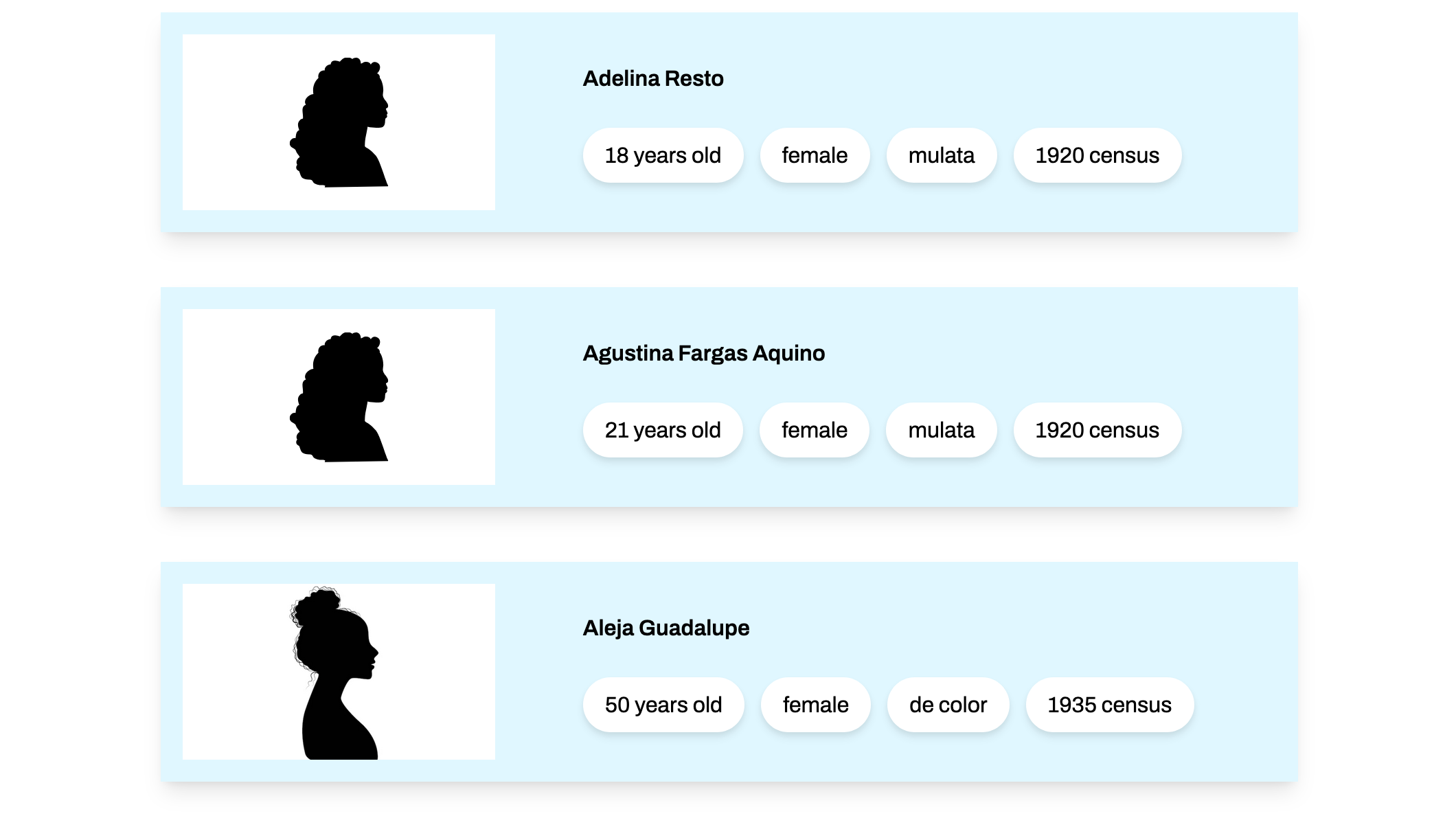
These silhouettes become a way for us to visibilize these girls' and women's lives and their race, particularly for the Afro-descended women and girls, this intervention was a way for us to combat the documental skin bleaching that was apparent in the data. Women and girls would gradually lighten in census records over time, with a new race category of "de color" appearing in the 1930s. In sum, as the imperial relationship between the United States and Puerto Rico continued, and Puerto Ricans were deployed in different ways to attend to the needs of the empire, Puerto Ricans were becoming whiter in documents and in colonial records.
As you can see from the above images, not all of the information for each person is shown initially. This was intentional. As we thought about user experience and who might use the site—teachers, researchers, genealogists—±we decided that the narratives, or speculative glimpses of life that were once our "other" column, would be viewed only by those who want to labor or click through the site. In the same vein, we attempted to make sure to have resources for those who might want to learn more about the Picó Papers, making them fully available on the site, as well as creating a pedagogy page on the site. The pedagogy page will offer resources for more reading and also pedagogical tools that folks can use in the classroom or workshops or to orient themselves as they use the site.
In the initial versions of the site, my priority was the functionality of the criadas page, or searchable database. This original goal expanded to include a visual language, and an "other" section for us to imagine lives lived, all in the service of centering the criadas. There is always room for improvement, of course. Priorities for the future include more attention to accessibility, refining the silhouettes further according to the age of the criadas, to work on translations for the Spanish version of the site, and to make sure all available and relevant datais present on the site.
Response from archipelagos
The Criadas project is a welcome entry into the burgeoning tradition of digitally reconstructing analog historical records in a way that centers the people those records reflect, transforming the structural distortions inherent in them, and creatively pushing the boundaries of our new data-driven media—in doing so, joining the ranks of Vincent Brown et al's, "A Tale of Two Plantations" or Celia Naylor et als, "(Un)Silencing Slavery: Remembering the Enslaved at Rose Hall Plantation, Jamaica." Kudos to Bruno and the rest of the research and development team for an intervention that is recognizably original and salutary into an already creative and generative space.
The Criadas Project can be described in many ways. At the core, the team offers us a database of women and girls who at some point worked for free or low wages in Puerto Rico households in the first half of the 20th Century. These women were first registered by Puerto Rico historian, Fernando Picó. Among his papers, we find the biographical mini-sketches out of which the Criadas Project constructs a database. The database extracts the data from Picó's notes, and in discarding the rest, centers the women and girls already. The data is enriched by both further research and by an imaginative and empathic layer inspired by Hartman's method of "critical fabulation" integrated into a small narrative section woven for each woman or girl. In this sense, the sense project resists the reduction of the original data set. The final touch to the individual data entries comes in the form of silhouettes for each person. Bordering between the artistic and the theoretical, these cut-outs produce the sense of an aporia between an absence and a presence, with an emphasis on "visibilizing"—making visible, in the literal sense, making graphic.
The project is accompanied by a small section on the Picó Papers and a page labelled "pedagogy" with a slideshow providing us with useful pointers and links. The project is still under construction, quickly approaching a polished state. One of the wonderful things about digital scholarship projects like these is that we catch them available for public perusal while we can still give feedback that can inform its development. We offer then the following suggestions in the spirit of constructive criticism, taken to mean suggestions that can help the team continue building to reach publication-level quality and classroom adoption. Bruno already indicates some next steps in her intro—improving accessibility, finishing the Spanish translation of the site, adding more content, etc. We can focus here on refinements to the existing content and design.
The database itself and the silhouettes work really well and are very polished, so there's little we can suggest to make improvements at the core. On the other hand, the contextual material for the database could be expanded on and clarified. Let's take the description of the Picó Papers itself. For the project to be most useful in a classroom setting and to provide a better anchor for a general, educated audience, we recommend an explanation of the importance of Fernando Picó—beyond what we can learn about him on Wikipedia. Once we know who he is, and the place of these notes in his overall output, we would also benefit from an argument, however succinct, about the need to go beyond reading the papers directly. In other words, why the transformation into this project?
The pedagogical section could be improved, clarified and expanded as well. Right now we have a presentation slide without context. Beautifully made and each provocative in its own right, the aggregate slides don't add up to a coherent whole. As we find the "Pedagogy" page today, we find for example a bibliography, an inspirational quote, a breakdown of Hartman's approach, among other tidbits. Each of these slides could be a section, and each of these sections expanded and refined into a true teacher's guide. We can imagine for example that the Picó section can be absorbed as another module into such a reimagined Pedagogy page.
Beyond these useful and generous instruments, we feel that the Project would benefit enormously from a critical essay that goes well beyond the About page and the homepage blurb to dive into an auto-analysis of what the project accomplishes. We recognize many of the elements of that essay already in the beginning of the dialogue we're having here. In such an essay we could learn many things we are hungry to learn. What is the history of the criadas phenomenon? Why are they important to understand the history of Puerto Rico and its trenchant colonialities? What do they teach us about the intimacies of labor and gender? How does the team understand the work of centering? Of recovery? Of reimagining? Why do it? What affordances does a database give us that can take us beyond the material limits of other media?
All in all, the Criadas Project has planted a beautiful seed for many important conversations, and the creators have done a beautiful job of introducing us to these women and girls. We look forward to seeing what other lessons they have to teach us now.
Response from Bruno
Thank you to the Reviewers —
In truth, this project is something I fell into. The digital humanities are expansive, dynamic, and oftentimes intimidating. However, the ethos of which I approached this project, alongside my team, stems from the type of scholarship I want to keep doing and sometimes that means falling into what is required of you to do a decent job. Ultimately, I wanted to make sure the deliverable of the database was completed and also try to be as accessible as possible with our sharing of the Picó Papers and pedagogical materials. This is reflective of the feedback I received. I want to thank the reviewers for seeing that effort and for making the project better with your suggestions and for making visible things I am too close to appreciate about the Criadas Project.
I am currently expanding the pedagogy tab to attend to the suggestion of providing more guidance with the pedagogical materials. I agree that separate sections, in what will be a drop down tab from the pedagogy top-tab with the "Reading List and Inspiration," "Critical Fabulation in Classroom," as well as the addition of the "Picó Papers Module" would be more organized and therefore, more useful for fellow educators. I am continuing to realize that this site mirrors how I teach courses over and over again, each time revising the lesson plan and syllabus to make it better. Similarly to how writing, whether it be a book or an article, is another form of teaching that is confined to the page. Conversely, digital humanities and this site offer the same pedagogical freedoms that the classroom can offer if you take the time to think creatively about them.
This review process is making me realize that there is more I can do to be a teacher via this site. To me, the Picó Papers was the launchpad and trove of the project that I had to find a rhythm in to make sense of the sheer amount of information contained and given to me. I am adding more about his contribution to the field of Puerto Rican studies and also thinking about how to create a lesson plan so that educators could engage with his notes in the classroom so that junior scholars and young minds continue to engage with him.
This project is the fulfillment of an ethical commitment to Afro-Puerto Rican women, and now young girls, to change the field and contribute but also welcome the change that this type of work does to me. I feel accomplished for having completed this much while navigating a pandemic, being on the job market, while adjusting to my tenure-track position. I am still working on my first book-length manuscript and other publications. I explain these circumstances to highlight the very real demands that projects like these require and the resources needed to keep them going. I am hopeful that due to my current positioning in academia I can continue to enrich the site, add translations, and develop a critical essay to highlight the very intentional intervention of the silhouettes and how Black feminism and Afro-Puerto Rican feminists animate the transformation of the Picó Papers to the Criadas Project.
The Criadas Project will not be the last project "I fall into." Even now, I am working with community partners to make their already important work in Puerto Rico and its Black geographies that much more visible and accessible. I echo the reviewers' comments that this is the beginnings of a critical essay on the methodology and praxis embedded at the heart of this project that will carry over into future collaborative projects. It is my hope to make an accessible version available on the site and also to co-author it with my team in a journal in order to assist them in their burgeoning careers.
Thank you again to the reviewers for caring enough to make the Criadas Project and myself better.
Biographies des auteurs
Sarah Bruno
Dr. Sarah Bruno is an Assistant Professor of Afro-Caribbean of Performance and Culture in the Departments of English and African American and African Studies at Michigan State University. She received her doctorate Cultural Anthropology from the University of Wisconsin-Madison in 2021 and held an ACLS postdoctoral fellowship at Duke University and a Latinx Studies postdoctoral fellowship at Rice University. Her research centers on Black popular music and dance, empire, affect, and Puerto Rico. She is working on her first book-length manuscript which is tentatively titled, Black Rican Refusal: Decolonial Postures, Dexterity, and Bomba Puertorriqueña.