Raising History from the Grave: Reparative Archival Pedagogy, International Virtual Exchange, and Community Engagement
Resumen (en traducción)
Este artículo postula que a través de un modelo recíproco para la investigación archivística, la convergencia del intercambio virtual y la pedagogía crítica de archivos empodera a los estudiantes, maestros y archivistas. La pedagogía crítica de los archivos enseña a los estudiantes a identificar los límites del archivo y ofrece la formación y oportunidad para corregirlos. Este artículo detalla dos casos de estudio: un intercambio visual entre las clases en la Universidad de St. George’s (SGU) en Grenada y la Universidad de Florida (UF) y la colaboración entre los estudiantes de UF y la organización civil, Pan-Caribbean Sankofa. Las dos iniciativas se basaron en la colaboración con la Biblioteca Digital del Caribe (dLOC). Las dos exploraron las prácticas funerarias y de la muerte en el Caribe, destacando la proximidad afrocaribeña a la muerte y violencia además de su eliminación en los registros históricos. Ambas ofrecieron a estudiantes y profesores la oportunidad para compartir el conocimiento cultural y colaborar en los proyectos archivísticos a través de las fronteras nacionales. El intercambio virtual entre la SGU y UF estudió la pérdida y profanación de los cuerpos de Maurice Bishop y los otros siete revolucionarios que fueron asesinados en 1893. Esta experiencia les inspiró a los estudiantes de la SGU a realizar más investigaciones sobre las prácticas funerarias en Grenada e imaginar colectivamente las posibilidades de cómo se podría conmemorar la muerte de estos ocho. La clase concibió formas de reparación que enriquecerían los archivos. El compromiso comunitario proporciona a los estudiantes la experiencia de ayudar las organizaciones al investigar su historia y producir los proyectos digitales que dan visibilidad a esa historia y contribuyen a sus archivos existentes. Unir el intercambio virtual y el compromiso comunitario ofrece a los estudiantes experiencias internacionales más allá del aula con organizaciones fuera de la universidad en el país anfitrión. Los estudiantes de la UF que colaboraron con Pan-Caribbean Sankofa y el colaborador de dLOC, la colección del Museo del Canal de Panamá, investigaron las vidas de los trabajadores antillanos en el Canal de Panamá y crearon narrativas digitales. Sus historias se añadieron al archivo e inspiraron a los miembros de la comunidad para contribuir con documentos adicionales.
In this article, we bring together three threads in digital pedagogy: international virtual exchange, archival recovery work, and reparative pedagogy, and argue that their convergence generates a transformative framework for reimaging critical archival practice and transnational collaborations.[1] We propose a framework that leverages international virtual exchange to connect instructors and students across universities and national borders with libraries, civic organizations, and community archives throughout the Caribbean and its diaspora. This model provides students with meaningful experience in archival research, digital humanities (DH), and international collaboration. At the same time, it empowers civic organizations and community archives to develop research-driven public humanities initiatives that document and showcase their communities. For instructors, the framework offers valuable opportunities to develop and refine collaborative, internationally oriented pedagogy. Ultimately, we envision this approach as a sustainable model for building dLOC as a dynamic digital commons that supports collaborative teaching, research, and community engagement.
Our proposal derives from two related pedagogical projects. The first is an ongoing collaboration with Pan Caribbean Sankofa (PCS) and the Panama Canal Museum Collection (PCMC) at the University of Florida (UF).[2] The second is a six-week collaborative online international learning (COIL) initiative that took place between two upper-division undergraduate classes at a university in the Eastern Caribbean and UF in spring 2024: a collaborative research course examining the West Indian workforce on the Panama Canal, with students undertaking primary research and digital projects with PCS and PCMC, and a seminar that analyzed Caribbean popular culture through a sociological framework. To ensure methodological parity and to avoid privileging any single disciplinary or institutional perspective, this COIL project adopted a shared thematic focus on death and mourning practices in the Caribbean and its diaspora. These two projects were closely linked because the Panama project and the international virtual exchange became part of the same course for the UF class.
We selected the theme of death and mourning to support comparative archival research and digitally assisted cultural analysis and to provide a shared theoretical platform for cross-disciplinary student collaboration. Addressing both African influence on diasporic mourning practices and the proximity to death caused by slavery, colonialism, and state violence, the theme extended and deepened students’ understanding of the ways in which mourning practices offer community-centered modes of healing, remembrance, and celebration; and shape broader cultural expression such as music and literature. The theme also provided critical context for understanding the high rates of death experienced by West Indian workers under United States governance in Panama.
Both the collaboration with PCS and PCMC and the international virtual exchange achieved their objectives. In their collaboration with PCS and PCMC, UF students created digital stories about West Indian canal workers who have left scant traces in official records. Their digital stories of West Indians demonstrate Roopika Risam’s assertion that postcolonial DH pedagogy can engage students “in hands-on activities to explore the colonial politics of digital knowledge production” and to redress it by transforming the digital cultural record.[3] By contributing to efforts to make the history of Caribbean people — previously omitted and obscured in the archives — visible and accessible through digital collections, their work performs much the same type of archival recovery work as other digital pedagogy projects in Caribbean studies. These include the headnotes produced by students in the Early Caribbean Digital Archive, digital mapping and unmapping done by students in Annette Joseph-Gabriel’s “Mapping Marronage,” and the historical notes produced by students for “A Colony in Crisis.”[4]
The virtual exchange succeeded in its goals of teaching students intercultural competencies and introducing them to an interdisciplinary study of mourning practices in the Caribbean and African Diaspora as well as to urgent matters concerning burial and justice, such as the loss of the bodies of Maurice Bishop and seven other prominent figures of the Grenada Revolution (the Grenada Eight) following the coup and United States’ intervasion in 1983.[5] Going beyond work in archival recovery, both projects also constituted a form of what Michelle Caswell conceptualizes as liberatory memory work, engendering a sense of empowering self-recognition among communities who had not seen themselves in official archives.[6] Additionally, by proposing public events, sites, and reparations designed to help heal the Grenadian people from the US intervasion and the loss of the bodies of the Grenada Eight, students in the undergraduate class from a university in the Eastern Caribbean engaged in decolonial care, emulating Jennifer Boum Make’s ethics of decolonial care.[7]
Our experience taught us that to achieve these outcomes requires modifying COIL — the model of international virtual exchange which we at first implemented. While COIL is a model of virtual exchange that foregrounds equity and inclusion, virtual exchange with and about the Caribbean requires attentiveness to the imperial relations — past and present — that inform the course content and the history of the two participating countries. Teaching about the United States’s role both in Panama and in Grenada underscored the importance of more fully and responsibly engaging with histories of imperial violence and geopolitical hegemony that shape the contexts in which such collaborations unfold.[8] We therefore incorporated reparative pedagogy into our exchange. Reparative pedagogy is a process through which all learners, including descendants of both perpetrators and victims work to address past harms in the present, opening possibilities for imagining and building more just futures.[9] In our COIL classroom, this meant asking students to critically reflect on their positionality in relation to historical harm. To support this process ethically, we integrated critical analysis, reflection, dialogue, and creative practice to cultivate an environment in which students could engage with confidence and respect while collaboratively exploring how past harms might be acknowledged and repaired.[10] Our COIL approach thus foregrounds relational, affective, and ethical dimensions of learning, centering decolonial care as a means of addressing historical trauma, uneven power relations, and epistemic injustice, while nurturing mutual recognition and shared responsibility across both classrooms.
Below we present case studies on student archival work that bring together the key elements of our framework to illustrate the liberatory potential of reparative pedagogy when it combines international virtual exchange and research collaborations with community organizations and libraries. The first case discusses student collaborations with Pan Caribbean Sankofa (PCS) and the PCMC to demonstrates the effectiveness of such partnerships in advancing reparative archival work. The second case presents a reparative outcome from our COIL initiative: student-initiated, community-engaged, culturally grounded proposals for appropriate commemoration and reparations for the loss of the bodies of the Grenada Eight. Together, these cases illustrate the potential of student collaborations to engage productively with imperial histories and extend archival work by bringing a sense of self-recognition in the archives to communities and developing commemorative practices rooted in local cultural traditions that honor the dead and support communal healing.
Case Study 1: The Pan Caribbean Sankofa Oral History Project: Community Engagement and Critical Archival Studies
Working collaboratively with the PCS and PCMC, UF students created digital stories documenting the lives of West Indian canal workers and Pan Caribbean community leaders who left few traces in the archives or in public memory. They pieced together biographical sketches by searching through birth, baptism, marriage, and death certificates, census records, Canal employment records, sailing manifests, oral histories, and newspaper accounts. Additionally, they contextualized widely shared and important aspects of their subjects’ lives, such as the journey to Panama or the treatment of workers with disability. The students also consulted other sources: literary accounts, government reports, photographs, maps, and memoirs.
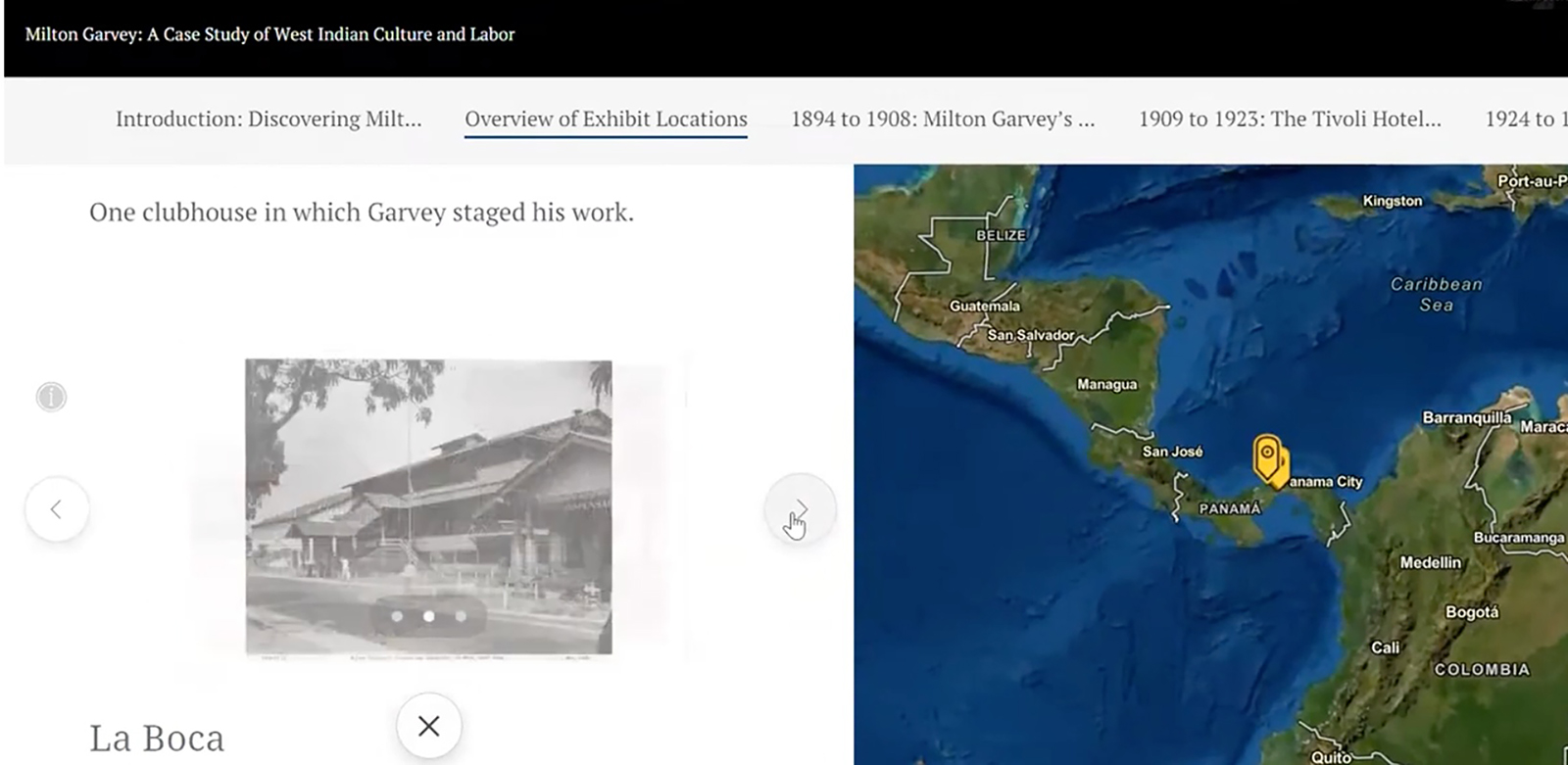
Three classes participated in this work. Seven students in a 2022 graduate seminar in postcolonial digital archiving created "Milton Garvey: A Case Study of West Indian Culture and Labor, " an ArcGIS Story Map documenting Garvey’s life, work, and plays. Undergraduates in a course on collaborative research taught in 2024 and 2026 created eleven additional digital stories in the form of posts for the PCMC Blog. Five of the projects are accessible as the “Raising History From the Grave” collection on the PCMC blog. Six blog posts are currently being edited for upload to the PCMC Blog, and the story map is currently being updated and will be available again soon. My goal is to build the corpus of digital stories in a manner illuminates the connections between the individual stories and can be included in dLOC to ensure its durability.
This collaboration has afforded students the opportunity to increase materials documenting the history of West Indian immigrants to Panama and their descendants available to the public and to increase their presence in the PCMC, thus helping to transform a leading collection on the canal where the story of the United States in Panama has dominated.[11] This research demonstrates the ability of students to “intervene in the gaps and silences that persist in the digital cultural record.”[12] Additionally, they are helping to build the PCS Oral History project which functions as a community archive dedicated to documenting a community shaped by marginalization.[13] As a result, their work constitutes a form of liberatory memory work that Caswell advocates by providing community members with a sense of self-recognition in an archive where they had been invisible or misrepresented. Their projects seek to further the efforts of PCS, and its mother organization, the Corozal - Gatun - Mount Hope (CGM) Cemetery Preservation Foundation of obtaining government support for locating and preserving the now overgrown graves of West Indians. In this respect, they aspire to employ archival research to promote justice and reparations beyond the archive.[14]
PCS co-directors Frances Yearwood-Williams, Casma Henlon, and Carmen Eccles, PCMC curators John Nemmers and Betsy Bemis, and I started our collaboration by imagining a digital map of the three cemeteries where West Indian canal workers were interred. Viewers could click on the image of a grave and learn about the life of the person buried there. However, maps for cemeteries — housing tens of thousands — were unavailable. We settled on a more feasible project: creating digital stories about community leaders. Documenting the lives of West Indians workers, we thought, would build respect for their contributions to the canal — and, by extension, the preservation of their graves — while telling the stories of Pan Caribbean community leaders would deepen community awareness of their history and support the efforts of PCS. The PCS co-directors identified community leaders that the students could research, provided feedback on proposals and final projects, and responded to the students’ questions. They also crafted the course title “Raising History from the Grave” which we borrowed for this article. PCMC curators trained students in research skills and digital tools. I designed a course in collaborative undergraduate research to support this project.
In the 2022 graduate seminar, students worked with PCS member Nydia Thomas to create ArcGIS StoryMap about her grandfather, Milton Garvey a nationally acclaimed playwright whose scripts have not survived. Students built on Thomas’s genealogical research and presented their project as a tribute to Garvey and to Thomas and other family members who worked to document his story. They chronicled Garvey’s migration from Barbados, his work as a butler, and his record in cricket, but their central contribution was to demonstrate that Garvey should be recognized as an important Panamanian and Caribbean writer, despite the absence of surviving scripts. Employing reviews, interviews, and photographs in the West Indian weekly, The Workman, they demonstrated that Garvey both elevated West Indian culture on Panama’s national stage and contributed to a transnational African diasporic cultural renaissance often associated with Harlem.
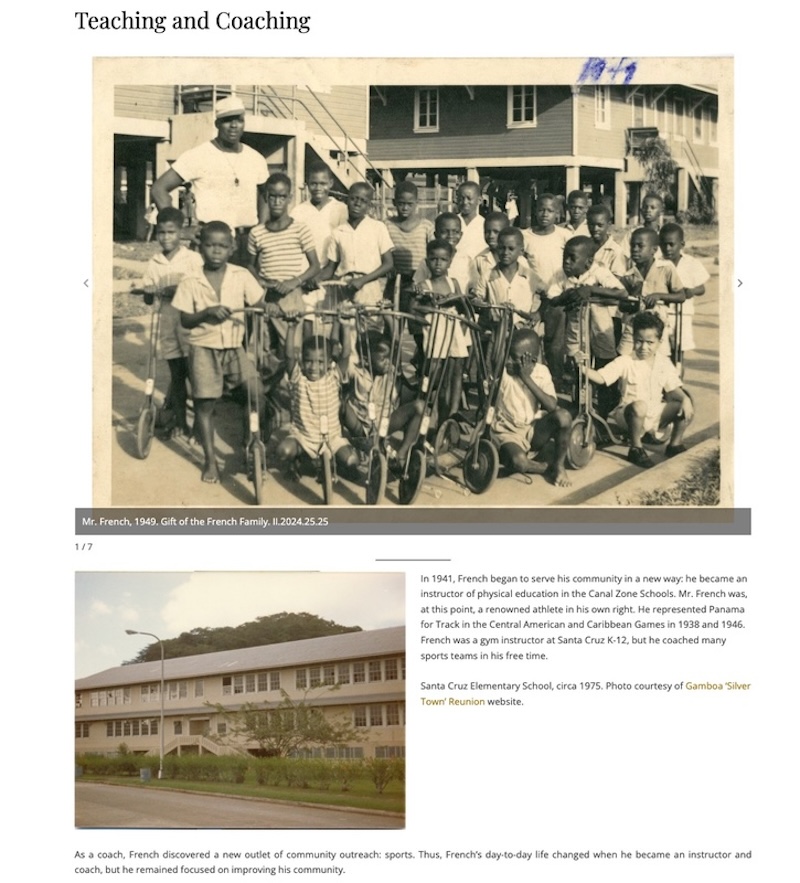
PCS co-directors chose five community leaders for the undergraduates’ research in 2024. Searching through government and church records, scholarship, newspapers, government reports, historical photographs, and newsreel footage, students created posts for the PCMC blog documenting the lives of Rose Grimes, a young midwife who arrived from Grenada in 1905 and whose healing skills and spirituality made her a leader in her community; Luther Hartley a railroad worker who lost his leg in an accident and whose grandson became a Panama canal pilot; George Cockburn a clerk who migrated from Jamaica and whose sons became union leaders; Sidney Young, a journalist who founded the West Indian paper, Panama Tribune; and Joseph French, physical education teacher in Gamboa beloved for coaching men and women athletes, including MLB MVP Rod Carew.
Family and community members expressed self-recognition and joy when they saw the digital stories. When students in the 2022 seminar presented at a symposium held by the PCMC to showcase their work with the PCS, Sheila Clarke-Wilkinson, who traveled from Panama to attend, congratulated the students because “Milton Garvey was invisible but you guys have brought him to life.” Carl Cockburn expanded on Wilkerson’s comment, stating “he was not only invisible to the white Zonians, but he was also invisible to me. I had never heard of that part of my culture.” Garvey’s daughter, Diana Garvey Macias, gave students “a big thank you for letting me know a lot more of my father … It is really something great to know that in my lifetime my father was very known and was very good.”[15] Nydia Thomas, Garvey’s granddaughter asserted that “the students succeeded in capturing not only the factual narrative of his life but also the spirit of a generation of Caribbean men and women.”[16] In 2024, family members who attended the students presentations thanked the students for providing information about their family members they had not known and expressed profound gratitude for making their stories part of the public record.[17]
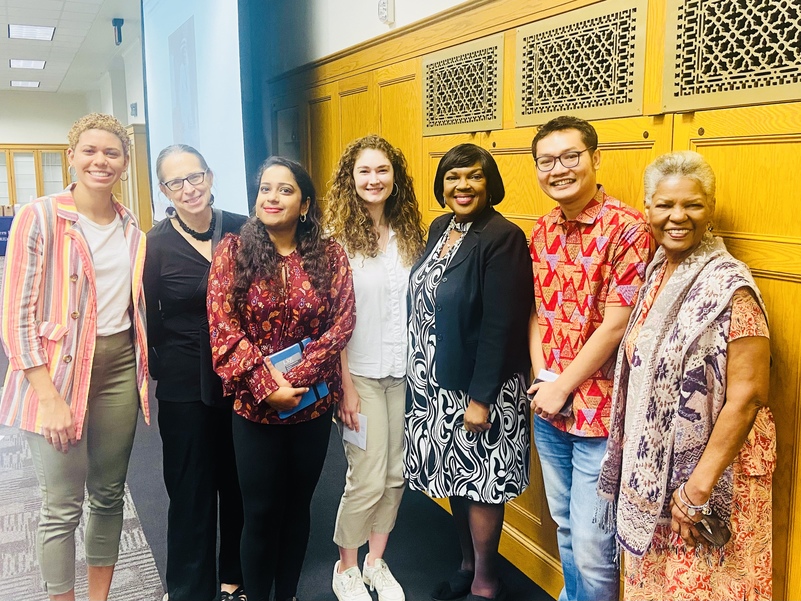
When students in the 2022 and 2024 classes presented at the Latin American and Caribbean DH symposium in 2025, they asserted that their collaboration with PCS/PCMC had given them a strong sense that digital archives are an important means of empowering communities and repairing harm done by the combined material exploitation and archival marginalization. Alejandra Gama asserted that “everyone deserves to see themselves in history …This project made that evident to me and other students. Everyone should know how important digital archives are and how it is critical that they should be accessible and used by academics and non-academics alike.”[18]
The DH projects also had a lasting impact on students’ future studies and work. One student applied skills she learned in oral history and community partnerships to her dissertation in digital rhetoric and healing justice. Another undertook an honors thesis using oral history to illuminate the experiences of her working-class family in New England. Another was inspired to write a master’s thesis about a leader in his own community, the Chakma people in Bangladesh and to work towards creating a digital archive of preserving their history.[19] These examples indicate a further synergy: their experience with archival research and digital humanities inspired students to extend liberatory memory work into other archival spaces.
In addition to creating the digital stories, students helped to build the PCS and PCMC collection, they inspired family members to contribute to the PCS and PCMC collection further and thus helped to increase Pan Caribbean archival presence. Garvey Macias swas interviewed as a special guest at the symposium for the PCS Oral History Project. Joseph French’s family donated photographs and other documents to the PCMC to support the student projects. This collaboration suggests a sustainable model because it furthered the organizational goals of the participants. The collaboration with students accomplished PCS organization goals of “provid[ing] a wider view of the West Indian communities.”[20] PCMC curators increased their collection while supporting the university’s instructional activities, a core mission of their department. I supported UF’s efforts to increase experiential learning opportunities.
The collaboration contributed to all stakeholders’ objectives by helping to transform the PCMC from a collection where Pan Caribbeans felt alienated and invisible into a collection where they can see their community and take pride in its accomplishments.
CASE STUDY 2: COIL as Archival Repair
“Repair is, in part, about imagining and glimpsing more just futures, working towards them without certainty in their shape…”[21]
In Spring 2024, we implemented a six-week interdisciplinary virtual exchange grounded in digital humanities methodologies, linking my university in the Eastern Caribbean with UF. My co-instructor who serves on the advisory board of dLOC, invited me to collaborate on the exchange because of my experience in Caribbean studies. We share a commitment to expanding student access to international learning and to Caribbean digital library resources. Our COIL project explored cultural interpretations of mourning and memorialization from multiple perspectives.
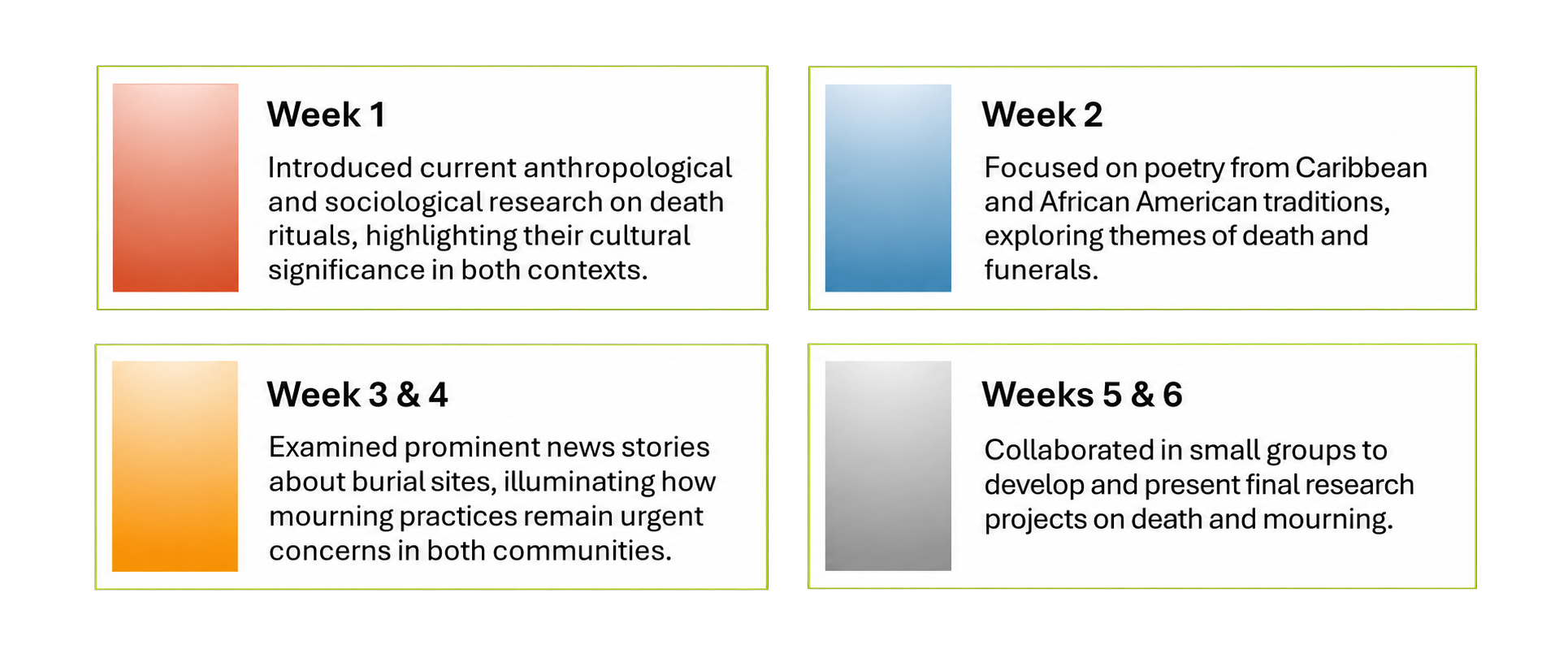
We centered student voices as sources of knowledge by opening the exchange with the question "How do you want to be remembered? " and by linking literary analyses of funerals and mourning to student-led discussions of their own familial practices of remembrance. We then segued to the analysis of two high-profile news stories about the violent disregard for African Diaspora graves and mourning practices. One was a CBS 60 Minutes report on black cemeteries paved over in Florida.[22] The other was The Empty Grave of Comrade Bishop, a Washington Post podcast series[23] investigating the loss and desecration of the bodies of Prime Minister Maurice Bishop, three cabinet members, and four prominent public figures executed in a coup on 19 October 1983.[24] The United States invaded Grenada days later on 25 October and has never provided a full accounting of the bodies’ fate while under the custody of the United States.[25]
The Empty Grave of Comrade Bishop, in its clear, compelling storytelling and its seamless integration of rigorous archival research made a deep impression on all the students participating in the COIL. However, for my students the response was also personal. Powers, in her reporting, foregrounded Grenadian voices that are often erased or marginalized in official records, while also exposing the political consequences of restricted access to information. For many of my Grenadian students, it was the first instance in the COIL project where the teaching material related directly to their own national context — to public figures and public institutions that they were familiar with.[26] Their reaction to Powers’ podcast exemplifies the powerful sense of self-recognition that emerges when individuals encounter representations of their own communities in archival or narrative forms — reactions that underscores the affective and political significance of such moments as part of broader liberatory memory work aimed at fostering recognition and joy. Attentive to open educational practices of “active, constructive engagement with content,” we encouraged our students to make ongoing recommendations to improve the exchange.[27] In response to my students’ impassioned feedback that The Empty Grave of Comrade Bishop warranted extended critical attention, I prolonged my class’s engagement with Powers’ podcast beyond the initial six weeks of the virtual exchange, further deepening their critical and personal investment in the material.
Boum Make’s concept of “building imaginaries of caregiving” was also reflected in my students’ desire to extend their scholarly engagement with Powers’ podcast.[28] In its compelling presentation of circumstances surrounding the missing bodies of the Grenada Eight, the podcast introduced new perspectives on the Grenada Revolution that deepened and reframed my students’ understanding of its historical and political significance.[29] Although they had largely encountered the Grenada revolution through anecdotal oral accounts, the breadth of Powers’ inquiry — grounded in the experiences of people they knew — prompted students to recognize that even partial, intimate stories are forms of oral history worthy of documentation. Given the significant gaps in Grenada’s archival record of the revolution, such accounts constitute a vernacular archive that could meaningfully enrich dLOC’s repository. According to Boum Make, care can be shaped by violence.[30] While the violence to which Boum Make refers is colonial violence, in our case it was the neocolonial violence that the United States perpetrated in the 1983 intervasion, when it commandeered the bodies of the Grenada Eight and to date has not revealed where these bodies are. The failure of the United States to return the bodies to the families and documentation concerning their fate is an act of uncaring that violates all the funeral traditions of the Caribbean. By extension, it dehumanizes the dead and the living alike — a harm that echoes what Joseph-Gabriel, in “The Unnamed Fugitive and the Unknown Maroon,” calls on scholars to confront by filling archival lacunae through stories that deliberately run counter to the official record, moving from restitution to restoration and toward repair.[31]
Positioning themselves as future archivists and scholars, students worked with community intellectuals to create reparative research proposals that expanded knowledge of the Grenada Revolution and, when shared in an open departmental seminar, brought new understanding of the Grenada revolution to their peers.[32]
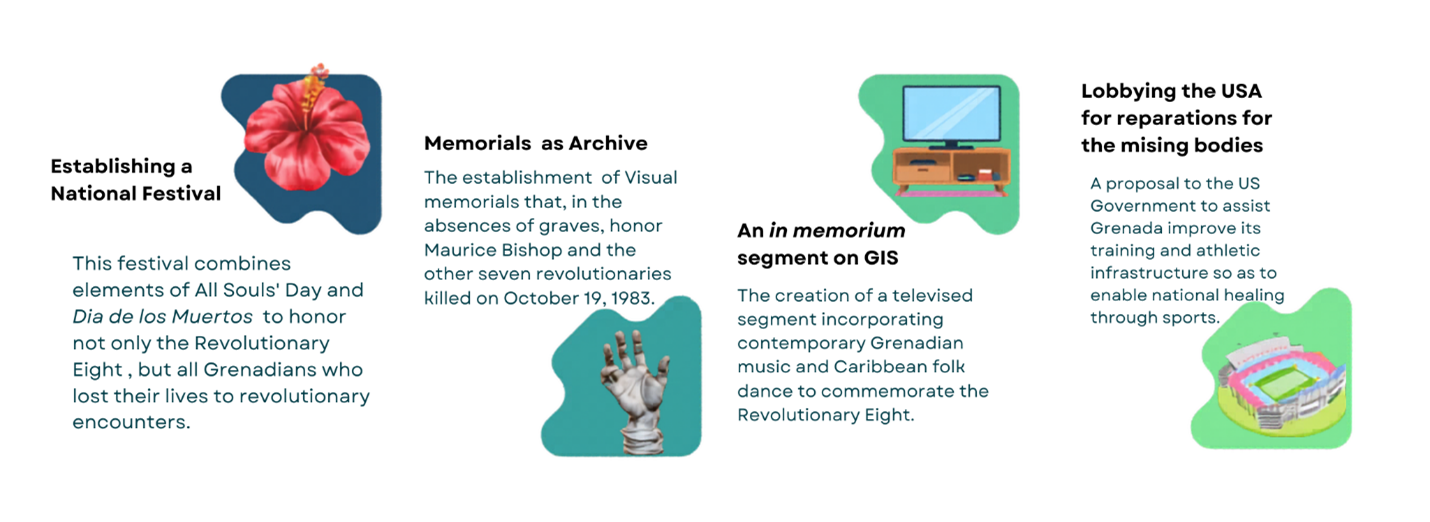
These research project proposals, in their incorporation of Grenada’s funeral traditions — Third Night prayers, Happy Hour, Tombstone feasts, and gravesite celebrations — with national festivals, arts, music and memorabilia from Grenada’s revolutionary period, collectively served as a model for future archival initiatives aimed at honoring the Grenada Eight. Rejecting the notion of the archive as a static repository, my students approached it as a dynamic, interpretive site — one that honors the dead while inviting the living to enact creative, spatial, and material interventions.
One illustrative example emerged from the group presentation on memorials. Students mapped existing memorial sites across Grenada, documenting their locations, their designs and their omissions. This process revealed both the concentration of commemorative artifacts in the capital, St. George’s, and the persistent silences in public memory surrounding figures prominent in the Revolution other than Bishop, such as Jacqueline Creft, who was also executed during the 1983 crisis.[33] Building on this research, students proposed a series of new memorial interventions designed to supplement, rather than replace, existing memorials and murals. Central to this proposal was the inclusion of printed materials — pamphlets, plaques and small archival booklets — integrated into memorial sites and accessible to the public. These materials would provide historical context on the revolution, brief biographies of the Grenada Eight, and excerpts from Maurice Bishop’s speeches, thereby creating a portable and educational archive embedded within the Grenadian landscape itself. In this way, the memorials would serve not only as places of remembrance but also as spaces for learning about and reflection on the Grenada Revolution.
In presenting their creative enterprises to their peers, students experienced a genuine sense of accomplishment. Though the projects existed as speculative interventions within an imagined archival framework, the pleasure they took in researching them with community intellectuals, and talking to their peers about their projects closely reflected what Caswell describes as archival pleasure — the affective reward of making one’s community visible — while the audience response reflects the joy of encountering that community robustly represented in the archive. Liberatory memory work “demands joy, not just of our users, but of archivists as well.”[34] My students’ independent efforts to address this political harm and recover archival histories from enforced silence illustrate the convergence of reparative pedagogy and critical archival studies. Their engagement with The Empty Grave of Comrade Bishop also underscored the value of explicitly integrating reparative pedagogy into future COIL exchanges. While I did not secure student consent or formal ethics approval to share artefacts from this inaugural exchange, I anticipate doing so in future iterations. I recognize that including assignment excerpts would both strengthen the evidentiary foundation of this case study and contribute meaningfully to Grenada’s archival record. While rooted in archival research, such initiatives unfold as living, collective expressions — cultural gatherings and practices that breathe life into remembrance, transforming it into a shared, sustaining act of community engagement.
Conclusion: Reparative Archival Work in Grenada through Civic Engagement
When we taught the virtual exchange on mourning practices and saw the impact of the students’ research projects for PCS and PCMC, it occurred to us that much would be gained by combining the two — by engaging both classrooms through international virtual exchange in a reparative archival research project. In cross-campus groups, students could undertake archival research and oral histories to assist a community underrepresented in the archives in recovering their history and building DH projects to make that history accessible to the public. The community organization would gain by having a larger number of students working to further their organization’s goals. Students would gain skills in archival research, DH, civic engagement and intercultural collaboration. Because the students would be engaged in recovering histories of communities exploited by imperialism and marginalized in the archives, the experience provides students as well the opportunity to participate in postcolonial reparative justice and an ethics of decolonial care.
Our experience also made clear that Grenada was a particularly urgent location for such student-centered recovery and reparative archival projects. Grenadians’ experiences of the Gairy Years, the Grenada Revolution — its successes and its demise — and the subsequent intervasion by the United States have been marginalized in official archival sources. Moreover, the need for archival recovery and public humanities projects amplifying that history is also urgent because few public institutions currently support public history in Grenada; the public library which also housed the national archives, has been closed since 2011. To date, there is no information on when these two public institutions will reopen. The national museum is currently closed for renovation and is also earmarked for extension. The national museum’s planned expansion will include a dedicated space that memorializes the Grenada Revolution. We have engaged the museum in preliminary discussions on student contributions to this initiative, such as the creation of an interactive map highlighting various communities that played a key role in the revolution.[35]
We also envision international virtual exchange (IVE) projects in which students collaborate in creating a collection and exhibit of ephemera and popular culture circulated during the Grenada Revolution (posters, billboards, slogans, songs, etc.) or conduct oral histories and produce an audio collage about the experiences of the revolution. Such projects would assist Grenadians in taking control of an imperial script that has long needed dismantling and reframe the story of the Grenada revolution in ways that honor the dignity and pride of its people. Our proposed initiative in Grenada finds consonance with Schuyler Esprit’s work with Create Caribbean, not only in her development of the creative capacity of youth but more specifically in the fostering of a culture “of intellectual inquiry that promotes the use of digital technologies in research and encourages greater community participation in the preservation of Caribbean history and culture.”[36]
Grenada provides one example of where students’ archival research could assist local archives, museums, and civic organizations. We advocate that instructors in Caribbean studies collaborate to design and teach courses that bring together the skills and labor of multiple classes through IVE to undertake reparative archival projects for local archives and related institutions across the region. It is important that instructors integrate reparative strategies to provide all students with the skills to productively engage in the region’s experience of imperialism, colonialism, and slavery, especially when one of the universities participating is located in the United States, the dominant imperial power in the region throughout the twentieth century and into the twenty-first. We recommend as well that these exchanges incorporate in-depth exploration of the historical context and socio-cultural and political significance of their research topic. In our COIL, studying the social and cultural significance of Afro-Caribbean mourning practices and the influence of slavery and colonialism on Afro-Caribbean communities’ experience of death and mourning proved invaluable because it gave students a deeper understanding of specific contexts they studied and enabled them to conceptualize healing means of memorializing the Grenada Eight appropriate within Grenadians’ cultural practices.
Finally, we recommend that instructors collaborate with dLOC and its partners in developing their COIL and archival projects. Comprising a wide network of libraries, archives, universities, and civic organizations, dLOC partners serve as valuable resources for international virtual exchange. While many dLOC partners lack the time or capacity to mentor students; others — such as PCMC and PCS — have both the time and the desire to do so. dLOC provides excellent training sessions for instructors and students in using dLOC. To further strengthen participation, dLOC is willing to develop a dedicated collection or other venue for showcasing student work developed under the supervision of their instructor.[37] This will highlight the quality and creativity of student projects and increase the visibility of dLOC collaborative partnerships.
Through international and civic collaboration, we envision contributing to the existing robust, sustainable, and interactive scholarly, digital Caribbean studies network. We use scholarly here in its broadest, most inclusive sense — encompassing not only academic researchers but also indigenous, local, and community-based knowledge producers. Our goal is to help build a network that is mutually beneficial and responsive to all participants. In this way, our efforts align with and support the Caribbean Digital Scholarship Collective’s mission to cultivate a sustainable ecosystem of scholars and students engaged in Caribbean digital humanities — one that actively works to address longstanding asymmetries between the Global North and South.
In this article, we use “we” to refer to MacDonald and Rosenberg. In case study 1, the first-person pronoun refers to Rosenberg and in case study 2, it refers to MacDonald. ↩︎
Leah Rosenberg is the instructor in this collaboration. ↩︎
Risam, Roopika. New Digital Worlds: Postcolonial Digital Humanities in Theory, Praxis, and Pedagogy. (Northwestern University Press, 2018), 20, 89-90. ↩︎
“Featured Student Projects,” Early Caribbean Digital Archive, accessed 22 May 2026, https://ecda.northeastern.edu/home/ecda-in-the-classroom/featured-student-projects/; Annette Joseph-Gabriel, “Mapping Marronage,” Archipelagos, no.5 (2020), https://archipelagosjournal.org/issue05/ajg-marronage.html; Laura Wagner and Nathan H. Dize et al., “Intervening in French: A Colony in Crisis, the Digital Humanities, and the French Classroom,” Archipelagos, no. 2 (September 2017), https://doi.org/10.7916/D88K7NG5 ↩︎
In local Grenadian parlance, the words “invasion” and “intervention” are often merged, capturing in the process the different interpretations of this event. ↩︎
Michelle Caswell, Urgent Archives (New York: Routledge, 2021), 83, 101. ↩︎
Boum Make, Jennifer. Decolonial Care: Reimagining Caregiving in the French Caribbean (Rutgers University Press, 2025), 25-27, https://doi.org/10.36019/9781978840478 ↩︎
Martine Powers, The Empty Grave of Maurice Bishop, produced by the Washington Post, seven-part podcast series with update, 11 October-6 December 2023 & 18 October 2024. MP3 Audio. https://www.washingtonpost.com/podcasts/the-empty-grave-of-comrade-bishop/. ↩︎
Julia Paulson, “Reparative Pedagogies,” Decolonizing Education for Sustainable Futures, eds. Hutchinson et al. (Bristol: Bristol UP, 2023), 229, https://doi.org/10.46692/9781529226119.014. ↩︎
Mariana Almanza, “Pedagogy, Memory, and Higher Education: Contributions to Restorative Justice in Colombia,” Globalisation, Societies & Education (2025): 1–12, https://doi.org/10.1080/14767724.2025.2568471. ↩︎
Margarita Vargas-Betancourt, “Finding the Silver Voice: Afro-Antilleans in the Panama Canal Museum Collection at the University of Florida,” paper presented at the 13th International Conference on Caribbean Literature (ICCL)— Panama City, Panama, October 13, 2013. https://www.dloc.com/IR00003593/00001/pdf. ↩︎
Risam, 89-90. ↩︎
Caswell, 83. The collaboration between the PCS and PCMC, the Pan Caribbean Sankofa Oral History Project, functions like the community archives housed within university libraries that Caswell sees as capable of liberatory memory work because the community builds the archive “on its own terms” (Caswell, 2021, p. 16-17). Nevertheless, it is important to acknowledge that some community members abandoned the project because they disagreed with the decision to work with the University of Florida. See Julie Greene, Box 25 Archival Secrets, Caribbean Workers, and the Panama Canal (The University of North Carolina Press, 2025), p.122*.* ↩︎
Caswell, 13. ↩︎
Opening Session, "Memory Lane: Exploring the Lives of Caribbean People at the Panama Canal in the 20th Century, September 13, 2022. Video, 1:58. https://www.youtube.com/live/2AJbrP25Nec?si=nYSwUWunibtLa5pQ ↩︎
Nydia Thomas, email message to Rosenberg, 25 September 2025. ↩︎
Jhmara French, Missy Hartley, Vilma Godbolt, and Carmen Eccles, Zoom transcript of class presentations, 18 April 2024. ↩︎
Alejandra Gama, "Bridging the Classroom, Community, and Collections, "Latin American & Caribbean Digital Humanities Symposium, 12-14 November 2025. ↩︎
Bella Fiorucci, Nina Prouty, and Chandler Mordecai, “Bridging the Classroom, Community, and Collections”; Dinalo Chakma, “Dr. Manik Lal Dewan: A Case Study of Decolonial Indigenous Chakma Educational Approaches in the Chittagong Hill Tracts (CHT), Bangladesh.” Master’s thesis, University of Florida, 2023, https://ufdc.ufl.edu/UFE0060763/00001. ↩︎
Carmen Eccles and Casma Henlon, email message to Rosenberg, 9 September 2025. ↩︎
Paulson, 223. ↩︎
CBS News. “Uncovering Black Cemeteries Paved over in Florida | 60 Minutes.” www.youtube.com, November 28,2022. https://www.youtube.com/watch?v=sT9TaQcWcFs. ↩︎
Martine Powers, The Empty Grave of Maurice Bishop, produced by the Washington Post, seven-part podcast series with update, 11 October-6 December 2023 & 18 October 2024. MP3 Audio. https://www.washingtonpost.com/podcasts/the-empty-grave-of-comrade-bishop/ ↩︎
Amy Li Baksh, “Forward Ever: 40 Years on from the End of the Revolution and U.S. Invasion of Grenada,” The New Today 16, no. 4 (November 24, 2023), https://ufdc.ufl.edu/aa00069343/00355. ↩︎
Germaine McCalpin, “Written Into Amnesia? The Truth and Reconciliation Commission of Grenada,” in Grenada: Revolution and Invasion, ed. Lewis P. Lewis, Glenford D. Williams, and Patrick Sutton (Kingston, Jamaica: University of the West Indies Press, 2015), 199–227. ↩︎
85% of my class were Grenadians. ↩︎
Maha Bali, Catherine Cronin, & Rajiv Jhangiani. (2020). Framing Open Educational Practices from a social justice perspective. Journal of Interactive Media in Education. 2020(1):10, pp. 1–12. https://doi.org/10.5334/jime.565. ↩︎
Boum Make, p. 25 ↩︎
Only recently has the Grenada Revolution been included on the Caribbean Secondary Education Certificate (CSEC) History syllabus, an examination administered by the Caribbean Examinations Council (CXC). ↩︎
Boum Make, p. 19 ↩︎
Annette Joseph-Gabriel. The Unnamed Fugitive and the Unknown Maroon: Anonymity and the Limits of Repair in Black Atlantic Historical Recovery, (2025), p. 4 ↩︎
We are unable to include written or visual evidence of student assignments here, primarily for ethical and legal reasons. Under the Family Educational Rights and Privacy Act (FERPHA), student coursework constitutes personal data and intellectual property, and its inclusion — particularly in the small class that participated in the COIL — raises the risks of deductive disclosure even when anonymization measures are applied. Moreover, in line with institutional ethics guidance and data protection regulations governing educational research, and in the absence of us receiving IRB clearance for this course, I therefore avoid the risks associated with the publication of identifiable or attributable student arti facts. ↩︎
Jacqueline Creft served as Minister of Education during the Grenada Revolution and also held responsibility for the Ministry of Women’s Affairs. She is remembered for her commitment to expanding education as a tool for social empowerment and national development. ↩︎
Caswell, 101. ↩︎
Oliver Benoit, Chairman of the National Museum Board, in-person conversation with MacDonald, September 11, 2025. This interactive map would complement Stephanie Curci and Chris Jones’s “Mapping the Haitian Revolution” (https://www.mappinghaitianrevolution.com/) because the Grenada revolution remains the only successful revolution in the English-speaking Caribbean, will therefore be an important resource for courses on Caribbean Revolution. ↩︎
"The Create Mission, " Create Caribbean, accessed 26 May 2026, https://createcaribbean.org/create/the-create-mission/ ↩︎
Stephanie Chancy, email message to authors, 18 May 2026. ↩︎
Biografías de los autores
Antonia MacDonald
Dr. Antonia MacDonald is Professor Emerita at St. George’s University in Grenada where for the past twenty-five years she served in senior leadership roles overseeing multidisciplinary academic areas and building institutional capacity. Currently, she is a Research Fellow of the Windward islands Research and Education Foundation (WINDREF). She has published on contemporary Caribbean women writers, including Michelle Cliff, Merle Collins, Maryse Condé, and Jamaica Kincaid, and more recently on Derek Walcott, Garth St. Omer, and St. Lucian cultural studies. She is a Senior Editor of the Journal of West Indian Literature (JWIL), the editor of A Casebook on Garth St. Omer, and the author of Making Homes in the West/Indies.
Leah Rosenberg
Leah Rosenberg is associate professor of English at the University of Florida where she teaches Caribbean studies and Digital Humanities. She is the author of Nationalism and the Formation of Caribbean Literature (Palgrave October 2007) and co-editor with J. Dillon Brown of Beyond Windrush: Rethinking Postwar West Indian Literature (University of Mississippi Press, 2105). She is a co-chair of the scholarly advisory board of the Digital Library of the Caribbean and member of the Journal of West Indian Literature editorial board.