
Tracing Caribbean Narratives at the Intersection of Language, Identity, and Social Media
Resumen (en traducción)
Este artículo profundiza en cómo el idioma criollo del Papiamentu navega por las complejidades de la identidad cultural y la praxis decolonial dentro del panorama de las redes sociales. A partir de las reseñas literarias, etnografía digital, análisis digital y una entrevista con el influencer Gerald Lijde, el artículo explora la ambivalencia colonial profundamente arraigada del Papiamentu – un legado que da forma a su uso en línea contemporáneo. Si bien las plataformas digitales ofrecen nuevas vías para celebrar y formalizar el Papiamentu, también arriesgan la comercialización de sus raíces anticoloniales y radicales en narrativas turísticas. Al conectar la producción de contenido en línea a las teorías de agencia y cultura digital, el artículo ilumina el papel perdurable como vasija de resistencia y afirmación comunitaria, reinventada continuamente por sus hablantes para desafiar las jerarquías enraizadas y forjar nuevos caminos de pertenencia a través de las fronteras.
Introduction
Papiamentu, the creole language of the Dutch Caribbean, serves as a vital tool for its speakers to negotiate their cultural identity on social media. This article explores Papiamentu's historical entanglement with colonial narratives and how present-day Papiamentu speakers continue to reinvent the language through digital platforms, where traditional language use and expression intersect with new forms of identity construction. This article asks: How does Papiamentu's colonial legacy shape its contemporary online use? How do Caribbean artists leverage Papiamentu for decolonial and identity work on social media platforms? And how do linguistic dynamics in digital spaces reflect broader sociopolitical tensions?
This article represents a deepening analysis of the presence of creole languages online. It grows out of my ongoing work as a scholar and activist dedicated to defending and innovating Papiamentu and other creole languages via the initiative I founded, the Future Language Innovation (FLI) platform.[1] By linking sociolinguistics to theories of agency and digital culture, I aim to understand how online content production reflects incremental empowerment within a broader history of creole-language advocacy. I conducted literature reviews, digital ethnography, and content analysis of social media posts, interactions, and linguistic trends to understand Papiamentu usage and online cultural representation. I also conducted an in-depth semi-structured interview with former Papiamentu rapper and Curaçaoan-based social media influencer, Gerald Lijde, who reflects critically on the role of Papiamentu in online discourse while remaining playful and accessible to broad audiences. By linking sociolinguistics to theories of agency and digital culture, I aim to understand how online content production reflects incremental empowerment within the wider history of creole-language advocacy.
The first section examines the sociolinguistic foundations of the Papiamentu-speaking community, including its connection to deep-rooted colonial ambivalence. The second section analyzes Papiamentu's complex role in contemporary social media. The third section focuses on Lijde's personal narrative, illustrating the construction of identity within the digital Papiamentu community. By linking broader linguistic and social media dynamics with individual experiences, the analysis illuminates the challenges of self-representation and informs the ongoing growth of the FLI-platform.
Papiamentu's deep-rooted colonial ambivalence
For me, a Curaçao-born, Papiamentu-speaking poet, playwright, and language rights activist who seamlessly code-switches between Papiamentu and other languages, the language feels like an embodied form of defiance.[2] Papiamentu speakers often foreground the language as lingua franca. Speakers of African languages,[3] Upper Guinea Creole, Ibero-Romance languages, and Dutch[4] took part in the language's development. In other words, while all languages are created by fusion and contact, Papiamentu speakers valorize the very creoleness of our language. By creolizing digital culture—infusing it with the 'and-and' model of contact and exchange[5]—the FLI platform challenges the monolingual hegemony of big tech,[6] aligning with Ponzanesi's vision that transnational communities use digital tools like social media and messaging apps[7] to connect emotionally and culturally with others from their home countries or similar backgrounds. These digital connections are not only about sharing information but also about creating feelings of belonging, solidarity, and support across distance and diaspora. It is this ambivalence between so-called "pure cultures" and creolized cultures that FLI is in conversation with.
Every time I speak my native language, Papiamentu, it hits me with this double-edged vibe, like a warm hug from home that also stings with the weight of its history. However, it emerged in the 18th century as the lingua franca of Curaçao's bustling ports; its development dates back to the 17th century. Like creoles across the Caribbean, it emerged from complex social arrangements: in this case, between an undocumented diversity of indigenous Arawak clans, enslaved or free West Africans, Sephardic Jewish merchants, Dutch European imperialists, and every form of in-between identity construction. Early evidence links its formation to the editability and adaptability of Curaçao at that historical moment, a place where people found freedom and also partook in contraband at the edge of judicial clarity.[8]
Traces of Papiamentu in the archives not only reveal dynamics of class, race, and communication, but also richly narrate intimate lived experiences full of social and familiar affection, of love, caregiving roles, and moral instruction.[9] The language’s colonial ambivalence pulses through its history, a defiant thread stitching the Caribbean, Americas, and Europe—where enslaved yayas (enslaved nursemaids) whispered cosmological secrets to the children of the shons (enslavers), turning the tongue of survival into the master's unwitting inheritance through e.g., the folklore of trickster god Compa Nanzi (Anansi).[10] The oldest known written record in Papiamentu is a secret love letter from 1775, written by Abraham de David de Costa Andrade to his lover Sara de Isaac Pardo Vaz Farro.[11] Sara's lawfully wedded husband would later use this secret love letter to shame them out of the Sephardic Jewish community and in the colonial court as proof of adultery. There is also a letter from 1783, written by Anna Charje on behalf of her infant, Jantje, to her husband, Dirk Schermer, in Rotterdam,[12] These two documents show that, although Dutch authorities dismissed Papiamentu as "negro talk," people of Sephardic Jewish and Dutch descent used the language to express connection and affection.[13]
Colonial authorities marginalized Papiamentu by associating creolization with the subversion of the rule of law and puritanical Christian beliefs.[14] In 1819, the teacher Gerrit van Paddenburgh described it as a noisy babble corrupting Spanish and Dutch, dismissing its emerging structure and richness.[15] Yet, by 1833, Roman Catholic missionaries, led by Bishop M.J. Niewindt, embraced Papiamentu in Catacismo Catolico, scripting Christian faith into the vernacular of the marginalized, countering Protestantism's exclusivity for white Dutch elites.[16] Papiamentu became a medium of domestic and communal exchange, both oral and written, sustaining Indigenous names for flora and fauna, resisting erasure.[17] By 1871, Curaçao's urban population read the weekly periodical Civilisadó in Papiamentu.[18] In 1905, the publication of the Papiamentu-language poem “Atardi” by Joseph Sickman Corsen in the daily periodical La Cruz, illustrated for many the language's poetic complexity and enduring significance.[19] The historical evolution of Papiamentu from a vernacular of resistance to a marker of cultural identity laid the groundwork for its contemporary political recognition while upholding aspects of its narrative flexibility.
Over time, Papiamentu gained formal recognition, becoming an official language of the Netherlands Antilles in 2007.[20] However, the double bind of coloniality lingered. To this day, Dutch language policies often prioritize Dutch over Papiamentu in education, reinforcing socioeconomic hierarchies and complicating local identities, as Wiel's studies on multilingual students in Aruba and Curaçao have noted.[21] Debates over Papiamentu in education date back to the abolition of slavery in 1863, when the lawyer and educator Abraham M. Chumacaceiro explained the limits of the Dutch colonial language in educating the formerly enslaved, and proposed Spanish as a language of instruction more closely related to the Curaçaoan experience.[22] The influence of colonial language politics in the Dutch Antilles continues to this day, manifesting in orthographic debates about Aruban "Papiamento," which favors Portuguese/Spanish roots, versus the "Papiamentu" of Curaçao and Bonaire, which prioritizes current pronunciation. In short, long-standing contentions between former colonizers and between colonizer and colonized have shaped the politics of Papiamentu and the Curaçaoans' use of and relationship to their native tongue.
The language also serves as a vehicle of cultural agency, allowing speakers to assert Curaçaoan identity transnationally and transform inherited colonial boundaries into sites of belonging. Rose Mary Allen and Francio Guadeloupe explain this phenomenon in their discussion of the term "Yu di Kòrsou" (child of Curaçao), distinguishing between those from the island and those not.[23]
In recent years, Dutch language authorities have begun to recognize Papiamentu's cultural and linguistic significance. Despite their European roots, creole languages were not initially included in the 1992 European Charter for Regional or Minority Languages. However, on November 23, 2023, the Dutch Minister of Foreign Affairs proposed Papiamentu's inclusion for Bonaire, and on May 24, 2024, officially recognized it as a protected language.[24] While debates persist over standardizing Papiamentu, these developments signal a new era of formal recognition for creole languages by Europeans. The Future Language Innovation (FLI) platform plays a critical role in advocating for Papiamentu, grounded in the belief that formalization is not an end in itself but should serve to re-center Afro-Caribbean subjectivities. Language is not a finished system, but a practice that teaches the world to think relationally.
Papiamentu, creolized from the forced intimacies of Dutch official orders, Spanish inflections, and African survivals amid the horror of plantation slavery, carves identity as a vessel in motion, bearing colonial imprints while at the same time charting paths of reclamation. Papiamentu's power lies in its use as a tool for empowerment, connection, and resistance to marginalization. Beyond its roots in historical trauma, it symbolizes cultural resilience and affirmation within its diaspora. As a living, transnational language, Papiamentu unites its speakers through its multilingual and multicultural entanglements. The language carries ancestral knowledge, serving as both a reminder of past struggles and a defiant act of cultural survival against forces of erasure. It is a dynamic map of belonging and resisting at multiple places at once, shaping identity across borders.
Papiamentu in the social media landscape
For this research, I primarily analyzed data from YouTube, Facebook, and Instagram, three of the most widely used social media platforms in Curaçao. On these platforms, community groups mix grammar lessons with memes and proverbs. On the surface, the internet is giving Papiamentu a new elan with a growing number of pages celebrating its existence. On Instagram, accounts like @quotespapiamento and @papiamentututor share motivational quotes and quick lessons with many thousands of followers. These Papiamentu accounts have evolved into hubs for the approximately 300,000 Papiamentu speakers worldwide to celebrate their language, helping them reconnect while teaching visitors to Aruba, Bonaire, and Curaçao the basics of Papiamentu.
Two Facebook pages about Papiamentu, Literatura na Papiamentu and Dicho i Palabranan di antes i nan nifikashon, showcase the language's soul beyond bite-sized lessons. One curates literary heritage; the other crowdsources traditional sayings. The former celebrates the literary heritage of Papiamentu from diverse geographical locations, thereby connecting and interacting in their native and traditional forms.[25] The latter allows individuals to share sayings in Papiamentu, enhancing knowledge of the language and increasing its visibility.
The banner art of 'Dicho i Palabranan di Antes' tells a deeper, more critical story. Figure 1 and 2 capture the Facebook banners of the pages. In Figure 1, a man steps out of a kunuku home to feed his chickens. Kunuku—from the Arawak word for "farm" or "countryside"—evokes the land once worked by enslaved people, their humble homes outposts of survival. In figure 2, two chapi (hoes) rest in the dirt. Once wielded by the enslaved, agricultural tools now echo through Tambú music as percussive instruments of resistance. The caption reads: "Where the hoe falls from your hand, pick it up and continue to work the thick soil, plant, care, harvest the joyful and wild tongue of my mother."
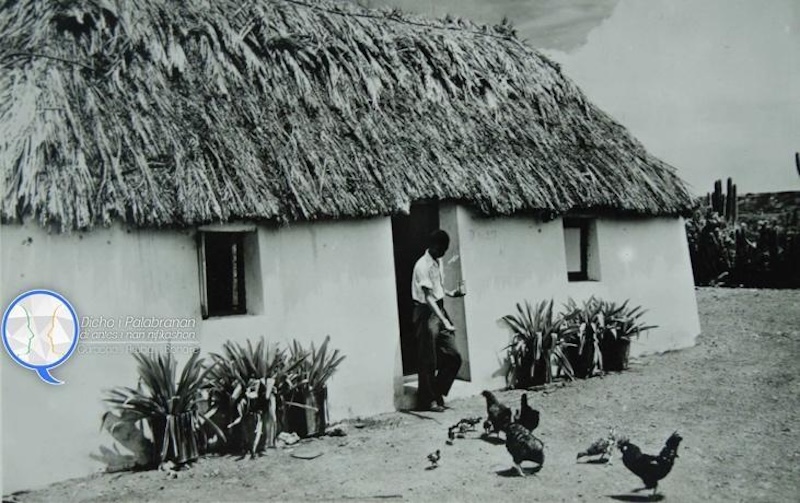
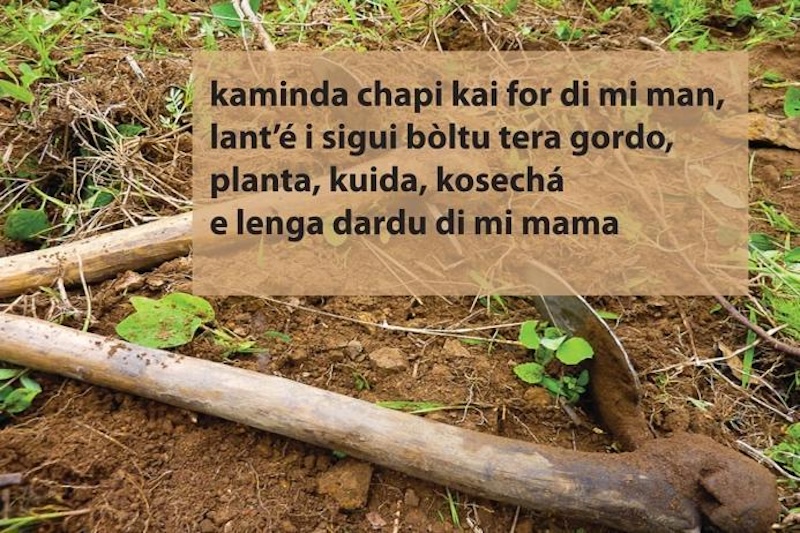
This quote doesn't just recall the past—it reclaims it. The kunuku and chapi aren't mere artifacts, but rather emblems of endurance, creativity, and the will to speak in one's own tongue. To "pick up the chapi" is to continue the unfinished labor of cultural survival—tending to a language that has always been both soil and song. In a digital landscape where Papiamentu is often polished into a tourist-friendly brand, these banners aim to do the opposite. They remind viewers that the language wasn't gently blended from colonial tongues, but birthed in struggle and resistance. Where some pages risk reducing Papiamentu to a tourist gaze, these communities attempt to dig deeper. In this sense, social media platforms can both empower cultural memory and justice and limit perspectives to see the gaze imposed by the tourist economy.
Beneath this celebration and exposure, however, lies a more troubling reality. These digital spaces often repackage the language's radical, anti-colonial roots into tools that monetize instant gratification and Ads.[26] This "platformization" of Papiamentu amplifies Curaçao's cultural complexity while simultaneously flattening it into commodified narratives, highlighting the tension between local identity and global digital frameworks.[27] Instead of Caribbean narratives from within, some social media posts reproduce the image of Curaçao as having palm trees and turquoise beaches and gain far more reach and popularity than the aforementioned Facebook pages. The constant use of bilingual captions (Papiamentu with Dutch or English translations) subtly reinforces the old hierarchy, validating the language only when it's legible to colonial tongues. This mirrors the island's education systems, which reward fluency in Dutch and institutional formats while marginalizing Papiamentu.
Take, for example, the word dushi. It is one of the first words that generally comes to mind when people think of Papiamentu. Derived from the Spanish word 'dulce,' meaning 'sweet,' the word carries many other connotations, including 'tasty,' 'darling,' and 'lovely.' Its meaning, how it rolls off your tongue, and how it excites the tourist and their exoticized gaze of locals reinforce its use and popularity. Many such explanations are available on YouTube. The following explanation was developed by one of the Curaçaoan literary artists active on the FLI-platform, Sheedia Jansen. Her short video, one of the oldest I could find on YouTube explaining the word, walks the fine line between visibility and erasure, where belonging is both affirmed and contested, where the exoticization is exploited but also flipped into a sense of pride and love for Papiamentu.[28]
The same goes for channels like Papiamentu-o.tv, which broadcast sports chatter and short cultural bits for native speakers and celebrate Papiamentu/o, with 14.3k followers on Facebook, 3.8k on YouTube, and almost 18k on Instagram. Infotainment from 5W Press, with casual brunches in Creole, expands domains, but light fare sidesteps to island politics and other news related to the island's sovereignty. Yet, the brand also sits at a crossroads. The transformation of Papiamentu phrases and identity markers into consumable fashion risks commodification, glossing over the deeper structural histories of language marginalization, colonial legacies, and social inequality in Curaçao. If Papiamentu, as a national identity marker, is to fulfill a truly decolonial role, it would need to deepen its engagement with the literary richness and intricacies of the language. However, as the following section shows, the interview with Lijde indicates that the language's complexity is at odds with its status as a popular and accessible language for both locals and tourists.
The personal narrative of Gerald Lijde, former rapper 'Nok Blok'
It is Tuesday, the kids just arrived at school, and the morning rush hour is disappearing. The sun is low, and the air is still cool, when I close my car door. A notification pops up on my phone: "Meet up with Gerald Lijde, April 2nd 2023, 8:30 AM, at Pakaya Society." Pakaya Society is a coffee shop owned by a mutual friend that serves as Lijde and my unofficial morning sanctuary, near the primary school of my two older sons. The open-air terrace was its usual vibrant self, a symphony of parents grabbing a precious moment after school drop-off, their conversations — a mix of Papiamentu, Dutch, and English — ranging from local gossip and the absurdities of small-island life to global politics. I felt excited, since planning this meeting took a few tries, and I was really looking for a specific social media personality.
To ground my theoretical assumptions of how Papiamentu interacts with social media, I wanted to discuss the production of online content in Papiamentu with someone who does it consciously, who can engage with and deepen my scholarly analysis. I was not necessarily looking for someone who produces content about Papiamentu, but rather someone who possesses a deep sense of pride and love for the language and who uses it playfully and artistically. I called my old friend, Gerald Lijde. We had been part of the same social universe since high school in Curaçao. Our friendship ignited when we were both young Caribbean men living in Amsterdam, chasing academic and professional careers – him as a chemist for Shell and rapper, me as an anthropologist, poet, and theater performer – and frequenting the same clubs as part of the Dutch nightlife.
Some context is necessary to understand Lijde's perspective. Today, he is an influencer, a living archive of the language in motion. From 2004 to 2016, he was also Nok Blok, a member of the iconic rap collective Immorales (also known as IMMO), spitting verses in Rotterdam clubs while, on the other side of the Atlantic, Dutch authorities were tightening borders, paranoid about cocaine routes threading through Curaçao.[29] Immorales embodied this moment. Back then, they were the evolution of bubbling music which exploded in the late '80s when DJ Moortje and MC Pester cranked dancehall reggae into something faster, nastier, and unapologetically Papiamentu.[30] In the early 2000s, Immorales took that foundation and layered in reggaeton, crafting something that traveled between islands and continents. Although he has an online following, much of his popularity now manifests in shouts in the streets and subtle fist-bumps of recognition. In Curaçao, Lijde gradually transformed from Nok Blok into a project manager at the same refinery where his father once worked. We lost touch until years later, when I started revisiting Curaçao—exporting innovation services for the City of Amsterdam, playing public servant. The pull of home intensified when I became a parent. My wife and I moved back during the COVID lockdowns, our umbilical cords calling us back to the island where they'd been buried. Lijde and I immediately started reconnecting again.
Lijde arrives at our meeting in sharp office wear—no gym clothes or street wear today. Those shades he always wears make it impossible to tell what he's actually looking at. His phone never leaves his hand, screen illuminating his face every few seconds. Between his three kids and mine, his high-stakes role as a project manager at the island’s industrial port and my strategic advisory role in the arts and city development, matching our schedules has been like a mathematical formula for controlled chaos. We both order shlongs (long blacks with less hot water). He adds a grilled cheese sandwich. Our mutual friend, who owns the place, lets us slip into the back office, where he also runs a marketing agency. The AC hums away the sweaty morning rush.
Digital selves as a practice of being
"So here's the thing," I start, watching him settle into the chair. "You barely mention the rap stuff nowadays. Your posts are all about transitions, youth to adulthood, this constant evolution. But Nok Blok was huge for you, right? How do I even explain who you are?"
"What Nok Blok did was, he found, discovered an avenue in which I could use all the language skills I have creatively," Gerald Lijde starts.
He. Third person. Gerald Lijde talks about Nok Blok like a former roommate, someone he knows intimately but no longer inhabits. This linguistic distancing fascinates me—online, he constantly code-switches between these selves. Though this article addresses the topic of identity, Lijde seems to unsettle aspects of "home" and "identity" as fixed anchors, reimagining them as fluid and lived becoming, making social media platforms seem like his laboratory. Recently his Instagram feels corporate, all professionally polished project management. Other times, wordplay sneaks through, those old lyricist muscles flexing. He goes silent for weeks, then posts daily. He'll delete everything, vanish, resurface.
Nok Blok built his reputation on verses that shifted perspective mid-bar, that played with bubbling's conventions while dismantling them. In one video (see image below) — Immorales member Pimpi Stinki's "Selfie"— Nok Blok roasted the whole selfie culture in verse while clearly enjoying being filmed himself. He was also the only member wearing street clothes in one scene and a buttoned-up shirt in another scene. The contradiction seems to be the point. He critiques and participates simultaneously, never letting you pin him down.
“So how do I address you?” I pushed. “You are Nok Blok, but you’re so clearly not just that.”
“I have loved reading books since I was little,” he responded. “I read a ton of books as a child, the absolute, typical nerd. Delving into science and equations.”
This was not the answer to my question, but it was the key. He wasn't a man leaving a part of himself behind; he was a collage, layering the bookish nerd, the chemist, the father, the industrial energy project manager, and the razor-tongued rapper into a single, evolving self. Critical introspection meets a public persona, showcasing his humanity through both his strengths and flaws. Maybe it is because he was speaking to a friend who has a PhD in cultural anthropology. Would he have responded differently if I were a journalist or a TV celebrity? Lijde's self-description can be interpreted as a reflection of the symbiotic relationship between human identity and technology, where digital platforms serve as tools for self-representation and self-exploration, resonating a notion of technics as fundamental to shaping individual and collective identities in the digital age.[31]
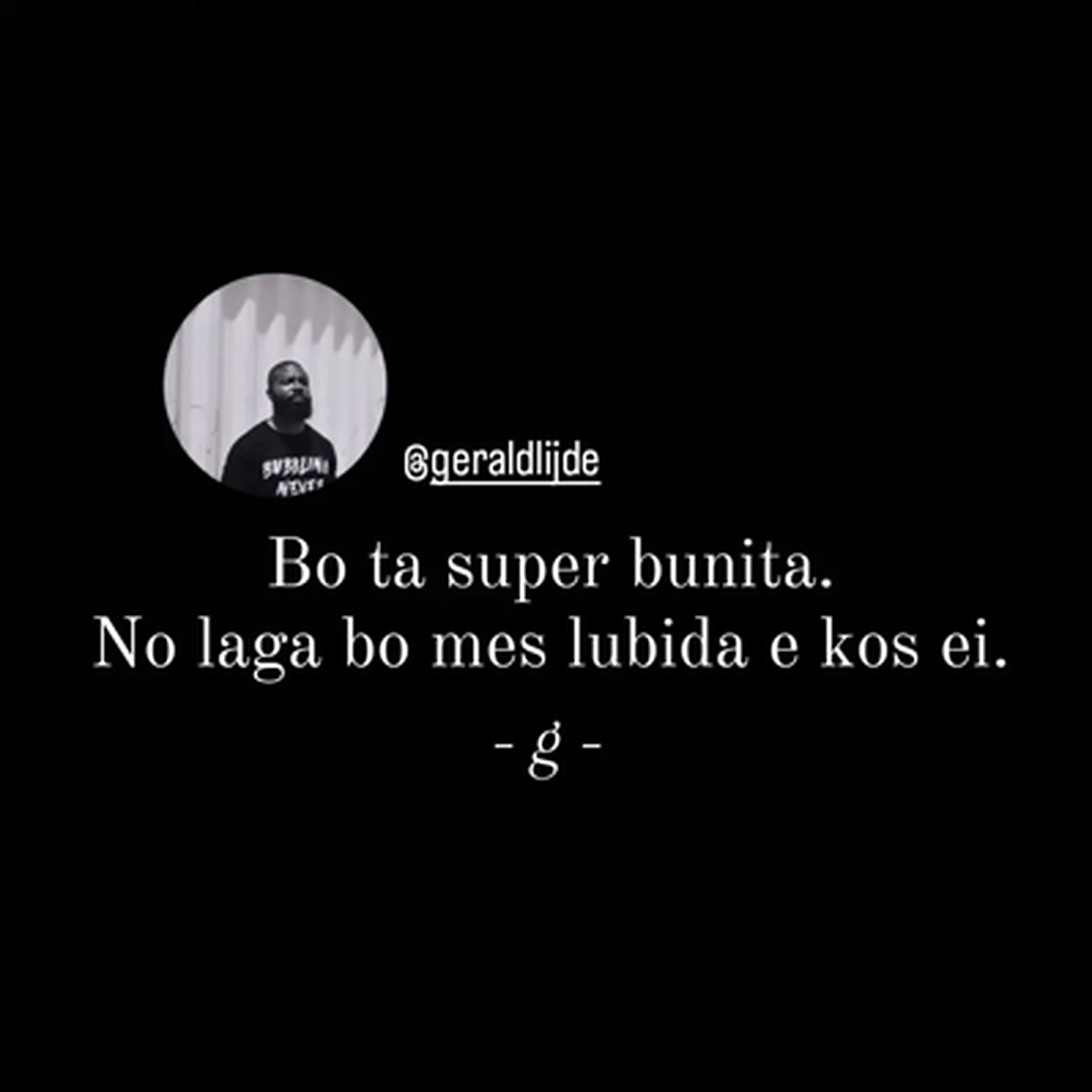
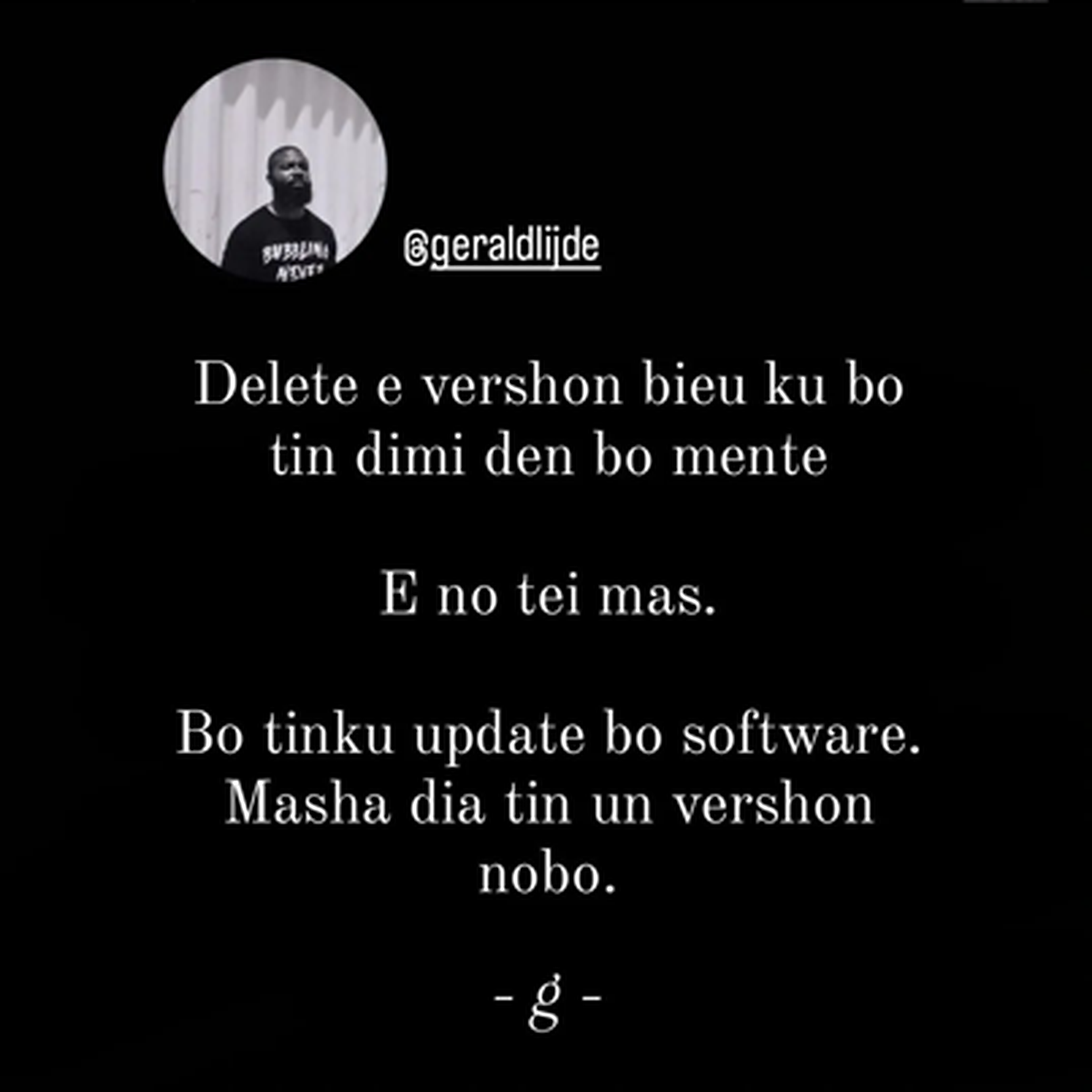
Figure 3, 4 and 5 show three of Lijde's tiles he pinned to his Instagram profile in 2023. They reminded me of quotes he had shared from the Ecuadorian self-help guru Yung Pueblo via Instagram stories a few months earlier. The recurring pattern of these pinned tiles is that Lijde encourages others to rely on their intuition and judgment rather than conforming to external expectations or societal norms. By suggesting that personal authenticity and self-trust are the highest virtues, Lijde promotes a holistic view of personal development. He advocates for self-discovery and self-acceptance, emphasizing that true fulfillment arises from deconstructing and overcoming personal traits that perpetuate a negative self-image.
Papiamentu moves through his posts not as a cultural preservation project but as a daily practice, the day-to-day medium through which transformation happens. When he code-switches between languages, personas, silence and speech, social media presence and absence, he is not contradicting himself but rather showing how identity actually works in the transnational Caribbean—fluid, strategic, multiple, alive.

Language as home
"Is Papiamentu important for your social media posts?" I continued.
"I think it is a big part of our cultural identity because when I'm elsewhere, the primary thing that I feel is that it's not necessarily where Curaçao is located in the Caribbean. It is our language," Lijde said.
Our language. Not the language. The possessive does work here—it claims something, provides a network for belonging that geography apparently can't quite capture. I think about his Instagram tiles —the one about past mistakes being like a first paintbrush—imperfect but necessary (see Figure 5). He writes these in Papiamentu, in colloquial, everyday language, as if there is a method to being in the everyday.

Figure 5: A tile from Lijde's Instagram page, last accessed on June 26, 2023. Translation: Do not feel ashamed of your past mistakes. They were all necessary to grow into who you are today. Remember that the first paintbrush is never perfect, but is the foundation for the next brush to remain in its beauty.
He suddenly admits something unexpected: social media addiction. I remember how he often stares down at his phone in Pakaya Society. Although he admits to also struggling with the need to scroll, seeking likes and connections, he seems driven by something else. He explains how he weaponizes his addiction, transforming it into something else entirely. Those reflective posts that populated his feed in 2023 weren't just thoughts. They're treatment, personal editing, an adaptation, a self-upgrade. Instead of losing himself in just the act of scrolling, he decided to fuel his actions with inspiration, insight, and affirmations.
"It is self-therapeutic in more ways than one. I am a very effective person in everything I do. Instead of mindlessly scrolling, let's give this habit purpose. Let's talk with other people's minds by talking to myself. That's it." The logic is almost too clean, too self-aware. He's turned the scroll into a philosophy of empowerment to others and healing to himself. His feed transformed into a personal journal that others can read. Personal growth as performance, ontologizing functionality. Whether it was pre- or post-emptive remained unclear in the conversation.
The resonance of impact
"How do you know that you have an impact on social media?" I followed.
"When you post an argument, a like indicates they agree with your argument or have engaged with it," said Lijde. For him, likes and follows on Facebook represent not just superficial approval but rather engagement with the content. "Likes show how your post resonated," he continued. "It's a real thing [.…] When you convey a message that gives the reader and myself an added value, it's proof that it has added value beyond superficial images. I've often received messages from people thanking me for providing them with an empowering perspective." A few days after our meeting, my phone lights up. Lijde forwards screenshots and one audio file; WhatsApp messages from followers, anonymous and grateful. "Thank you for this. This helped me today. I needed to hear this." The messages are in Papiamentu: intimate, vulnerable in ways that social media content rarely is. Reading Lijde's posts, I don't always find them radical. The messages about self-trust and authenticity feel like common knowledge, at times even cliché. But that is likely my outsider lens to the online bubble he inhabits, failing. What I seem to be missing is the how, the way Papiamentu itself becomes the medium of empowerment, the way its colloquial everyday practice creates permission for other informal selves to exist, or at least momentarily escape the deep-rooted colonial ambivalence.
The art of influencer critique
Lijde sees himself as part of a broader social media ecosystem. "You know how Oompie Stroopie expresses critique with humor, and Yves Cooper critiques only," he says, citing a series of Papiamentu-speaking influencers, "Roderick Vader Volk critiques with humor… Cossy Curaçao uses critique and humor…"
I know some of these names from scrolling. Oompie Stroopie—real name Quenton Stroop—built his following through a weekly Facebook column called 'resumen di siman' (Week's Summary), razor-sharp social commentary delivered in Papiamentu that grew so popular it spawned its own website. Yves Cooper is an independent journalist with 60,000 Facebook followers whose style is pure critique, no sugar coating. Roderick "Vader" Volk, followed by over 6,000 people, is a musician and actor who writes Papiamentu comedy sketches about Curaçaoan life and gossip. Cossy Curaçao is an island-based memes and satire page with over 43,000 followers that mixes video content with social commentary. Though Lijde's followers are fewer (nearing 4,000), he identifies with these other influencers and their reach.
"Some implicitly say, take what you want from what I think; do not take it personally, neither should you. This is humor. Others sarcastically ask to be taken seriously and use critique to demonstrate the seriousness of their post. Then someone thinks, I identify myself with this critique or humor. So, people engage with the content."
He wanted to include humor and critique, too, he tells me, but he leans toward reflection. Different lane, same highway. These fellow influencers use memes, satire, and local idioms to create a specific kind of digital activism, one in which selves are valid on their own terms. The archetype of humor and critique is intricately embedded in local trickster storytelling cosmologies, particularly those of Anansi tales.[32] Humor allows commentators to challenge cultural norms and express subversive critiques that might otherwise be contentious. This "double-bottomed" language employs metaphor and humor to conceal critical messages from outsiders while conveying deep meaning to an informed audience. Self-documentation through these means is a decolonial act that does not require an external framework to validate a discourse; influencers each have their own complex, internally legible systems of knowledge production and social commentary. Notably, all the influencers he mentioned were male, in some way commenting on society, and, in that sense, performing a specific Caribbean-style masculinity. This short-list curated by Lijde expresses how vulnerability is shadowed by humor and critique.[33]
After a moment of silence, Lijde continues, "I am achieving for myself the art of being able to express myself. At the same time, expressing without content is not effective for me." He's working through the logic aloud, as if he were testing his nerdy bookworm part of himself against my reactions. “Expression needs content. Content needs purpose.” Purpose means making himself and his readers think differently about their realities. "So that's what I do. And I do it with extra effectiveness, which is expressed on Facebook."
Then he breaks down the local social media landscape like he's teaching a masterclass. "Look at Facebook in Curaçao. In Curaçao, there is a culture of 'we post to critique or to joke.' Effectiveness in this context is if I critique or joke, and you have nothing left to joke about or critique, but reflect!" He slaps the table for emphasis. "Because you cannot tell me anything, because I did not accuse you of anything, I did not label you. I told you that I am doing the thing that I critique. But I told you in a way that undoubtedly you yourself are questioning yourself, like, 'Do I also do this? And why?' That is the critique part."
Ongoing tensions with formality in Papiamentu
When people in the streets read something, they stop at the first line if it's boring, he said. In Papiamentu: “Ora e hende den kaya lesa algu, nan ta stop di lesa na e promé alinea si e ta laf.” Formal writing loses them immediately. He gives another example, performing it: "'Si, ayera nos tabata presente.' Present? Nò, kla! Kla!" ('Yes, yesterday we were present' Present? No, done! Done!) The repetition of kla underlines that people are finished; they've tuned out. It hammers the point. Political language, formal Papiamentu, disconnects instantly.
"Yesterday we were present at the opening that was held at' done! That's formal political talk. It doesn't connect with anyone in the streets." His hands move expressively now. "I take the same phrase and change it to say, 'I was in the streets.' The reader thinks, 'Let me see what comes next, because yesterday this man was in the streets. Papiamentu has to be lived'"
He's describing code as strategy, informality as an access point. "To be honest, most people have more moments in their lives where they are informal than formal."
This anti-formal stance isn't just a stylistic preference—it is rooted in Papiamentu's entire history with legitimacy. The language only became official in 2007, following centuries of fighting for recognition, for the right to exist in classrooms, government offices, and churches.[34] Even now, with official status, Papiamentu carries a colonial aftertaste. Dutch institutional presence still shapes many things—economic mobility, political power, and whose voice counts.
Simultaneously, this history also fuels resilient linguistic pride and creative strategies of resistance and affirmation. Speakers actively deploy Papiamentu in vernacular cultures and everyday interactions, transforming it into a potent symbol of community solidarity. Through code-switching, stylistic variation, and innovative language practices, Papiamentu users negotiate power and assert agency, reshaping institutional norms and expanding the spaces for the language's legitimacy under the guise of entrenched colonial values. The increasing visibility of Papiamentu in media, education, and public life heralds a dynamic shift—one where the language's colonial shadows give way to recognition of its intrinsic value and enriching contribution to local and global linguistic diversity.
Concluding reflections
While transcribing and analyzing our conversation, listening to and re-reading Lijde's toggling between languages and personas, I start to see the parallel he's drawing. Social media has the potential to work through narratives like a creole language, as Papiamentu itself does: a mixed narrative space where African, European, and Indigenous cosmologies become something new. Users construct online selves the way Papiamentu emerged historically: through communication, adaptation, and survival. But when is this remix for better or worse? As the FLI-platform gains more users, how can it transcend its role as a mere digital archive or social media space for creole languages? If the platform is deepening our understanding of small and dying creole languages, e.g., creating content and visibility about Forro from São Tomé e Príncipe, can it simultaneously disrupt colonial hierarchies embedded in language and identity? Is the formalization the end or the means? And if formalization is the means, is there an end? These questions still follow me in the development of the FLI-platform.
Amid dual forces of visibility and erasure, it negotiates on social media, Papiamentu emerges not merely as a language caught in colonial crosscurrents but as a medium for decolonial praxis. In the age of the platformization of the internet, creole languages are already troubling large language models attempting to stabilize all online content into their neural net syntax.[35] The absence of fully standardized orthographies for creole languages results in AI-agent biases and the naive handling of regional, social, and stylistic variability, as well as of spelling and convention diversity. Ultimately, FLI's future lies in these radical imaginaries that transcend borders, transforming online spaces into SycoraX sorceries where identity is not contested but collectively liberated from the empire's grasp. Future research might benefit from incorporating quantitative content analysis alongside in-depth digital ethnography across multiple platforms, or from user surveys, to strengthen claims about audience reception and collective empowerment.
The WhatsApp messages Lijde shared return to my mind, those anonymous thank-yous. They represent isolated selves, maybe even marginalized voices, finding themselves through Lijde's posts. The obvious assumption would be that social media is building communities in digital spaces when physical spaces remain shaped by colonial hierarchies. But the platforms themselves? Owned by Meta, driven by algorithms designed in California, monetizing engagement patterns that exploit the very addictions Lijde talks about. Who gets to theorize this connection? Lijde does it from inside, living the contradiction. I do it from another angle, academic and adjacent, mixing it with artistic literary practices. Neither perspective completely resolves the tension. Maybe that's the point—perhaps the multiplicity of his inner narratives is the story. Caribbean identity as fluid practice, digital selves as ongoing experiments, language as the water we swim through rather than the shore we reach.
The platform defending Papiamentu and other creole languages I have founded, through EU (Creative Europe) funding is called Future Language Innovation: www.futurelanguageinnovation.com. ↩︎
More information about the theater piece this article refers to see: https://www.youtube.com/watch?v=GthYrsFbZXQ. ↩︎
Nicolas Quint and Karina Moreira Tavares, “The Common African LexicalCore of the Upper Guinea Creoles and Its Historical Significance,” Journal of Ibero-Romance Creoles 9 (2019): 115–61. ↩︎
E.F.M Arion, The Kiss of a Slave: Papiamentu’s West-African Connections (De Curaçaosche Courant, 1996), 29. N. I. de Moraes, “La Traite des Esclaves Effectuée Par Les Hollandais à Gorée (1637-1677),” Gorée et l’escthat lavage, 1998, 41–52; B. Jacobs, “The Upper Guinea Origins of Papiamentu: Linguistic and Historical Evidence,” Diachronica 26, no. 3 (2009): 319–79; L. M. Rupert, Creolization and Contraband: Curaçao in the Early Modern Atlantic World (The University of Georgia Press, 2012). ↩︎
C. Mair, The Digital Diffusion of Pidgin/Creoles: Langwij, Kolcha, Media and Large Language Models, John Benjamins, 2025, https://doi.org/10.1075/jpcl.24025.mai ↩︎
H. Kelly-Holmes, “Multilingualism and Technology: A Review of Developments in Digital Communication from Monolingualism to Idiolingualism,” Annual Review of Applied Linguistics 39 (2019): 24–39; I. Beekmans, “Micro-Hegemonic Path Dependence: How Big Tech Power Operates through Ideological Fragmentation and Self-Reinforcing Technologies,” Convergence: The International Journal of Research into New Media Technologies 31, no. 6 (2025): 2086–100, https://doi.org/10.1177/13548565251336462. ↩︎
S. Ponzanesi, “Digital Diasporas: Postcoloniality, Media and Affect,” Interventions 22, no. 8 (2020): 977–93, https://doi.org/10.1080/1369801X.2020.1718537; L. Candidatu and S. Ponzanesi, “Digital Diasporas: Staying with the Trouble,” Communication, Culture and Critique 15, no. 2 (2022): 261–68. ↩︎
Rupert, L. M. Creolization and Contraband: Curaçao in the Early Modern Atlantic World. The University of Georgia Press, 2012. ↩︎
R.M. Allen, Di Ki Manera? A Social History of Afro-Curaçaoans, 1863-1917 (Amsterdam: SWP, 2007). Women, in particular, actively passed down to their children (or those of the enslavers) the importance of family and knowledge about ancestors (avochi), demonstrating that love and respect for family lineage were central to daily life. The narrative about a father teaching his children about unity through the metaphor of breaking twigs also shows the teaching of solidarity and care as a form of love within the family. ↩︎
Nanzi (Anansasem or Anansi) is a mythical spider from folktales from West Africa and the Caribbean. A. Claassen, ed., De Navelstreng van Mijn Taal. Poesía Bibo Di Aruba / Levende Poëzie van Aruba: Tweetalige Bloemlezing Uit Het Werk van Dertien Dichters, n.d., 14; Henriquez, Ta Asina? O Ta Asana? Abla Uzu i Kustumber Sefardí. J. Murray-Román, “Twitter’s and @douenislands’ Ambiguous Paths,” Archipelagos, no. 1 (2016), https://doi.org/10.7916/D8S46S1S. ↩︎
J. Roitman, “'There are no secrets here: Sex and Scandal in the Streets of Curaçao.” Studia Judaica 26 (2023), nr 2 (52), s. 375–400 https://doi.org/10.4467/24500100STJ.23.016.18942. There are actually bits and pieces of older documentation that give proof to the existence of Papiamentu. However, the love letter between Sara and Abraham contains full sentences and a consistent grammar use. ↩︎
M. Groenewoud, “Digital Humanities, Social Justice and the Pluricultural Realities of Dutch Caribbean Heritage Archives,” 2023, 235–50. ↩︎
I.S. Emmanuel and S.A. Emmanuel, A History of the Jews of the Netherlands Antilles (Cincinnati: American Jewish Archives, 1970), 271–72; M. Henriquez, Ta Asina? O Ta Asana? Abla Uzu i Kustumber Sefardí, Second edition (Port’i Heru Publications, 1988). ↩︎
J. Knörr, “Contemporary Creoleness; or, The World in Pidginization,” Current Anthropology 51, no. 6 (2010): 731–59. ↩︎
R. Severing and C. Weijer, “Gaining Perspective on Papiamentu: Milestones and Achievements,” in Crossing Shifting Boundaries: Language and Changing Political Status in Aruba, Bonaire and Curaçao (Curaçao: Fundashon pa Planifikashon di Idioma, FPI, Universiteit van de Nederlandse Antillen, Universidad de Puerto Rico, Recinto de Río Piedras, UPR, University of the West In-dies at Cave Hill UWI, n.d.), 13–28. The title of the book points to "Curaçao and Dependencies, " which was the colonial name used until 1936 for what are now Aruba, Bonaire, Curaçao, Sint Eustatius, Sint Maarten and Saba. From 1634 to 1828, Curaçao and Dependencies referred to the Dutch part of the Leeward Islands, the ABC islands. ↩︎
Niewindt was born on 1796 in Amsterdam. In 1824 he left to Curaçao to give spiritual assistance to the people, first as a priest and later on he became Apostolic Prefect of the Netherlands Antilles. In 1843 he was ordained as bishop in Warmond, Holland. As an advocate of Roman Catholicism to the enslaved community he pleaded for abolition of slavery in the Netherlands Antilles. He served in the Netherlands Antilles for 36 years and passed away on January 12th 1860, just three years before slavery was abolished. ↩︎
G. Buurt and S. M. Joubert, Stemmen uit het verleden: Indiaanse woorden in het Papiamentu (Van Buurt, 1997). ↩︎
Curaçao developed multiple newspapers by the end of the 19th century. The first newspaper was Civilisadó and was published between 1871 and 1875. Amigoe, still one of the most known newspapers, was initiated in 1884. It was initially in Dutch and Papiamentu. There was also the Papiamentu newspaper La Union (1889-1897 and again in 1922) and last but not least La Cruz (1900 – 1970). ↩︎
W.S. Muller, “Leven En Werken van de Dichter-Musicus JS Corsen” (JSTOR, 1985). ↩︎
Severing and Weijer, “Gaining Perspective on Papiamentu: Milestones and Achievements.” ↩︎
K. Wiel, “Perceptions On The Social Status Of Papiamentu In Contrast To Its Official Significance In Aruba And Curacao,” 2010, https://stars.library.ucf.edu/etd/4410/. ↩︎
A. Broek, Pa Saka Kara, Part 1: Historia Di Literatura Papiamentu, trans. L. Berry-Haseth et al., n.d., 21. ↩︎
R.M. Allen and F. Guadeloupe, “Yu Di Kòrsou, A Matter of Negotiation: An Anthropological Exploration of the Identity Work of Afro-Curaçaons,” in The Culturalization of Citizenship, ed. J.W. Duyvendak, P. Geschiere, and E. Tonkens (London: Palgrave Macmillan UK, 2016). ↩︎
Link: https://english.rijksdienstcn.com/latest/news/2024/july/4/papiamentu-in-the-netherlands-recognised-under-charter, last visited September 10th 2024 ↩︎
Nicté Fuller Medina, “Data Is Patrimony: On Developing a Decolonial Model for Access and Repatriation of Sociolinguistic Data,” Archipelagos, no. 6 (2022), https://doi.org/10.7916/archipelagos-n3pb-rx95 ↩︎
T. Poell, D. Nieborg, and J. Van Dijck, “Platformisation,” Journal of Internet Regulation, Internet Policy Review, 8, no. 4 (2019): 1–19. ↩︎
B. Bratton, The Stack (MIT Press, 2016); T. Poell, D. Nieborg, and J. Van Dijck, “Platformisation,” Journal of Internet Regulation, Internet Policy Review, 8, no. 4 (2019): 1–19. Poell et al also speak of the concept of platformization. Platformization refers to the process by which digital platforms penetrate various infrastructures, economic processes, and governmental frameworks, leading to significant reorganization of cultural practices and activities around these platforms. It involves the transformation of interactions and economic relations in diverse sectors through centralized, proprietary systems that shape user engagement and content production. ↩︎
É. Ortega, “From Street Protest to Twitter Protest: A Review of Leonardo Flores’s Twitter Bots,” 2020, https://doi.org/10.7916/archipelagos-fvgc-xs31 ↩︎
B. Bowling, Policing the Caribbean: Transnational Security Cooperation in Practice (Oxford University Press, 2010), 69–102, 213–45. Drug-trafficking via Curaçao was a major concern during the turn of the millennium, which led to the stigmatization of Dutch Caribbean youth in the Netherlands. The Dutch State Council, Judgment of 3 September 2008 (Verwijsindex Antillianen), upheld the legality of the VIA, a database targeting Antillean and Aruban youth in the Netherlands who met specific "risk criteria." The Council ruled that the measure, while involving ethnic differentiation, was necessary and proportionate to address significant public concerns, such as crime and social disadvantage, and did not violate anti-discrimination laws. The foundation representing Dutch Caribbean Migrants Overlegorgaan Caribische Nederlanders (OCaN) opposed the decision, citing risks to privacy and equality, and considered enables him to navigate and negotiate various aspects of his identity both escalating the case to the European Court of Human Rights. More information on the verdict can be found here: https://njcm.nl/actueel/raad-van-state-3-september-2008-verwijsindex-antillianen/ , last visited on the 26th of January 2025 ↩︎
The documentary directed by Wensly Francisco "Bandje 64" delves into the cultural, social, and historical significance of the “cassette 64” that captured Papiamentu music and oral storytelling in the 1990’s, serving as an artifact of the bubbling culture. The music genre laid the foundation for globally known electronic dance music originating from Dutch soil, such as Tiesto, Hardwell, Armin van Buuren and Afrojack. More information on the documentary can be found here: https://npo.nl/npo3/bubbling-bandje-64; https://www.youtube.com/watch?v=N4Q-bLo3QHE&t=4s, last visited on the 26th of January 2025 ↩︎
B. Stiegler, Automatic Society, Volume 1: The Future of Work, 1st edition (Cambridge, UK ; Malden, MA: Polity, 2016). ↩︎
Römer, L. Rituals of Mourning and the Poetics of Papiamentu Talk Radio, 2024, In The Oxford Handbook of Ritual Language, edited by D. Tavárez. https://doi.org/10.1093/oxfordhb/9780192868091.013.27. ↩︎
A.A. Jones, Identity via Papiamentu: From Marginalization to Language of Instruction. 2016, https://doi.org/10.13140/RG.2.1.3774.7441. ↩︎
Severing and Weijer, “Gaining Perspective on Papiamentu: Milestones and Achievements.” ↩︎
C. Mair, The Digital Diffusion of Pidgin/Creoles: Langwij, Kolcha, Media and Large Language Models, John Benjamins, 2025, https://doi.org/10.1075/jpcl.24025.mai ↩︎
Biografías de los autores
Juan-Carlos M.E. Goilo
Juan-Carlos Goilo is an independent artistic and design researcher and practitioner working on systemic transitions, with a particular focus on the Caribbean. He is the founder of Mente Kaweta and the Curaçao Doughnut Economy Foundation, organizations that explore regenerative urban development, circularity, and new approaches to social and ecological prosperity. His work examines how knowledge, data, collaboration, and collective action can support transitions towards more inclusive, distributive, regenerative, and ecologically sustainable societies. He combines an interdisciplinary background in anthropology, information, arts, and technology with a strong emphasis on place-based and participatory approaches to systemic change.